Atomic Number and Mass Number (original) (raw)
Last Updated : 23 Apr, 2026
The mass number of an atom is the total number of protons and neutrons present in it. Electrons, protons, and neutrons make up an atom, but only protons and neutrons contribute to its mass since electrons' mass is negligible.
- The atomic number of an element is the total number of protons that are present in the atom.
- The atomic number of an atom explains the properties of an element; it is represented using the letter "Z."
- All the elements are arranged in the periodic table on the basis of their atomic number.
**Example:
- Atomic number of oxygen is 8
- Atomic number of carbon is 6
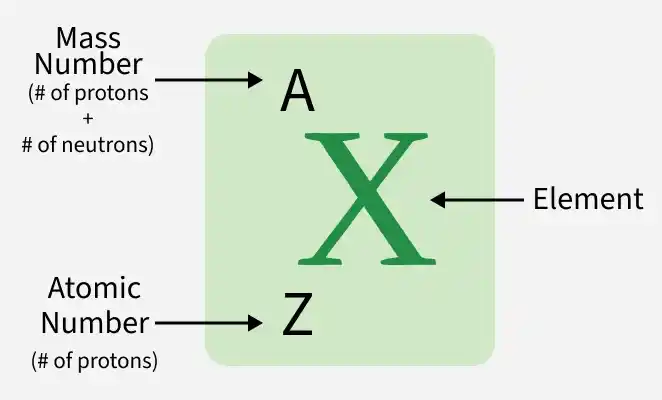
We represent the atomic number as,
- Z = 7 (Atomic Number of Nitrogen)
Mass Number
- The mass number of an atom, also called the atomic mass number, is the total number of protons and neutrons present in an atom.
- Rutherford, in his gold foil experiment, concluded that the mass of the atom is concentrated in a small region called the nucleus, which is positively charged.
- Neutrons and protons are together called nucleons.
- A proton is a positively charged subatomic particle, while a neutron is a neutral particle.
- The mass of a proton and neutron is the same and is equal to 1.67 ⨯ 10⁻²⁷ kg.
- Compared to a proton and neutron, an electron is 1000 times lighter, as the mass of an electron is 9.1 ⨯ 10⁻³¹ kg.
- A mass number is defined as the sum of the total number of protons and neutrons present in the nucleus of an atom. It gives an idea of how much heavier an element's atom is.
**Example:
- Hydrogen Atom has 1 proton, and no neutron hence the mass number of hydrogen is 1.
- Helium has 2 Protons and 2 Neutrons, hence, the mass number of Helium is 4.
- Sodium has 11 Protons and 12 Neutrons, hence the mass number of sodium is 23.
Formula
Mass number (A) is the total number of protons and neutrons present in the nucleus of an atom.
Mass Number (A) = Number of Protons + Number of Neutrons
Properties
- The mass number is the sum total of the number of protons and neutrons present in an atom.
- The symbol for the mass number is A.
- The mass number for an element can be different for different atoms of the same element. These are called isotopes.
**Example: C-12, C-13 and C-14
- Mass numbers for two elements can be the same for atoms of two different elements. Such a pair of atoms are called isobars.
**Example: Ar-40 and Ca-40 both have the same mass number but different atomic numbers as they are different elements.
Steps to Find Mass Number
**Step 1: First look for the atomic number of the element.
**Step 2: Now look for the number of neutrons in the atom.
**Step 3: Add the number of protons, i.e., the atomic number, and the number of neutrons to get the mass number of the element.
Calculation of Number of Neutrons
Number of Neutrons = Mass Number - Number of Protons
OR
Number of Neutrons = Mass Number - Atomic Number
List of Mass Numbers of First 20 Elements
| **Element | **Symbol | **Atomic Number (Z) | **Mass Number (A) | **Number of Protons | **Number of Electrons | **Number of Neutrons (A-Z) |
|---|---|---|---|---|---|---|
| **Hydrogen | H | 1 | 1 | 1 | 1 | 0 |
| **Helium | He | 2 | 4 | 2 | 2 | 2 |
| **Lithium | Li | 3 | 7 | 3 | 3 | 4 |
| **Beryllium | Be | 4 | 9 | 4 | 4 | 5 |
| **Boron | B | 5 | 11 | 5 | 5 | 6 |
| **Carbon | C | 6 | 12 | 6 | 6 | 6 |
| **Nitrogen | N | 7 | 14 | 7 | 7 | 7 |
| **Oxygen | O | 8 | 16 | 8 | 8 | 8 |
| **Fluorine | F | 9 | 19 | 9 | 9 | 10 |
| **Neon | Ne | 10 | 20 | 10 | 10 | 10 |
| **Sodium | Na | 11 | 23 | 11 | 11 | 12 |
| **Magnesium | Mg | 12 | 24 | 12 | 12 | 12 |
| **Aluminum | Al | 13 | 27 | 13 | 13 | 14 |
| **Silicon | Si | 14 | 28 | 14 | 14 | 14 |
| **Phosphorus | P | 15 | 31 | 15 | 15 | 16 |
| **Sulfur | S | 16 | 32 | 16 | 16 | 16 |
| **Chlorine | Cl | 17 | 35 | 17 | 17 | 18 |
| **Argon | Ar | 18 | 40 | 18 | 18 | 22 |
| **Potassium | K | 19 | 39 | 19 | 19 | 20 |
| **Calcium | Ca | 20 | 40 | 20 | 20 | 20 |
| Atomic Number | Mass Number |
|---|---|
| It is the weighted average of the mass of an atom in the natural stage, which also includes its isotopes | It is the total number of protons and neutron present in an atom |
| Atomic Mass takes into account all the isotopes that exist | Mass number is calculated differently for different isotopes |
| Atomic Mass can be fractional or in decimal | Mass Number is always a whole number |
| Unit of Atomic Mass is atomic mass unit. | Mass Number has no units |
| Atomic Mass is the same for all the atoms of an element regardless | Mass Number is different for different isotopes |
**Related Articles:
Solved Examples
**Example 1: Find the number of electrons, protons, and neutrons of an atom with Atomic Number (Z) 13 and Mass Number (A) 26.
**Solution: Given,
Z = 13 and A = 26
- Atomic Number = Number of Protons = Z =13
- Number of Electrons = Number of Protons = 13
- Mass Number = Number of Neutrons = A - Z = 26 - 13 = 13
**Example 2: Find the number of electrons, protons, and neutrons in an atom with the atomic number (Z) 19 and the mass number (A) 39.
**Solution: For the atom given above,
Number of Protons = Z
= 19Number of Electrons = Number of Protons
= Z
= 19Number of Neutrons = A - Z
= 39 - 19
= 20