Aufbau Principle (original) (raw)
Last Updated : 6 May, 2026
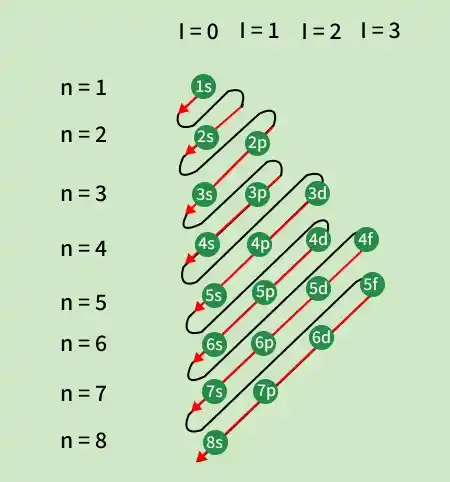
The Aufbau Principle explains how electrons are arranged in the atomic orbitals of an atom. According to this principle, electrons are added step by step to the orbitals of an atom, starting from the lowest energy orbital and then moving to orbitals with higher energy. The 1s orbital has the lowest energy and is more stable, so it is filled first. After the 1s orbital is filled, electrons move to the 2s orbital, then 2p, 3s, 3p, and so on.
**Example:
For Sodium (Na) which has 11 electrons, the electrons are filled according to the Aufbau principle as:1s2 2s2 2p6 3s1
Here, electrons first fill the 1s orbital, then 2s, then 2p, and finally the 3s orbital, following the order of increasing energy.
**Rules for filling of Orbitals (n + l rule)
To determine the order in which electrons fill different atomic orbitals, a rule called the n+l is used. This rule helps us understand which orbital has lower energy and will be filled first.
- According to the n+l rule, the energy of an orbital depends on the sum of the principal quantum number (n) and the azimuthal quantum number (l).
Energy ∝ ( n + l )
- The orbital with the smaller value of n+l is filled first.
- If two orbitals have the same value of n+l, the orbital with the smaller value of n will be filled first.
Example:
**For 3p orbital
n = 3, l = 1
n+l = 3 + 1 = 4
**For 4s orbital
n = 4, l = 0
n + l = 4 + 0 = 4
Both have the same n+l value (4), so the orbital with the smaller n fills first. Therefore, 4s is filled before 3d
**Order of Filling of Orbitals
Using the Aufbau principle and the n+l rule, the order of filling orbitals is:
1s < 2s < 2p < 3s < 3p < 4s < 3d < 4p < 5s < 4d < 5p < 6s < 4f < 5d < 6p < 7s
**Salient Features of Aufbau Principle
The Aufbau principle describes how electrons are arranged in the orbitals of an atom. The following are the main features of this principle:
**1. Electrons fill orbitals in order of increasing energy
- According to the Aufbau principle, electrons always occupy the lowest energy orbital first.
- After the lower-energy orbital is completely filled, electrons move to the next higher-energy orbital.
**2. Each orbital can hold a maximum of two electrons
- An orbital can contain only two electrons, and these electrons must have opposite spins.
- This is in accordance with the Pauli Exclusion Principle.
**3. Order of filling of orbitals follows the (n+l) rule
- The order in which orbitals are filled depends on the sum of the principal quantum number (n) and the azimuthal quantum number (l).
- The orbital with the lower value of n+l is filled first.
- If two orbitals have the same n+l value, the orbital with the lower n value is filled first.
**4. Orbitals are filled in a specific sequence
- Electrons fill orbitals in the following order:
1s < 2s < 2p < 3s < 3p < 4s < 3d < 4p < 5s < 4d <5p < 6s
**5. Helps in determining electronic configuration
- The Aufbau principle is used to determine how electrons are arranged in an atom.
- This arrangement is called the electronic configuration, which helps in understanding the chemical properties and position of elements in the periodic table.
**6. Works mainly for atoms in ground state
- The Aufbau principle mainly explains the ground-state electronic configuration, which is the most stable arrangement of electrons in an atom.
**Electronic Configuration Using Aufbau Principle
- Electronic configuration refers to the arrangement of electrons in the different orbitals of an atom.
- The Aufbau principle helps us determine this arrangement by filling electrons in orbitals starting from the lowest energy level and moving to higher energy levels.
- According to the Aufbau principle, electrons are added to orbitals in a specific order of increasing energy.
- Each orbital can hold a maximum of two electrons, and they must have opposite spins.
- By following this rule, we can write the electronic configuration of any element.
**Examples:
**1. Sodium (Z = 11)
- Sodium has 11 electrons.
- The first 10 electrons fill the 1s, 2s, and 2p orbitals, and the 11th electron enters the 3s orbital.
1s2 2s2 2p6 3s1
**2. Magnesium (Z = 12)
- Magnesium has 12 electrons.
- The 3s orbital is filled after the 2p orbital.
1s2 2s2 2p6 3s2
**3. Aluminium (Z = 13)
- Aluminium has 13 electrons.
- After filling 3s, the next electron enters the 3p orbital.
1s2 2s2 2p6 3s2 3p1
**4. Chlorine (Z = 17)
- Chlorine has 17 electrons.
- Here, five electrons are present in the 3p orbital.
1s2 2s2 2p6 3s2 3p5
Exceptions of Aufbau Principle
- Although the Aufbau principle generally explains the order in which electrons fill atomic orbitals, there are some elements where the actual electronic configuration does not strictly follow this rule.
- These exceptions occur mainly in transition elements, especially in the d-subshell.
- The reason for these exceptions is the extra stability of half-filled and completely filled subshells. Because of this stability, sometimes one electron from the s orbital shifts to the d orbital, giving a more stable configuration.
A half-filled subshell (like d5) and a completely filled subshell (like d10) are more stable due to:
- symmetrical distribution of electrons
- minimum electron–electron repulsion
- extra exchange energy
1) Chromium (Cr)
- Atomic number of Chromium = 24. Here, one electron from the 4s orbital moves to the 3d orbital. This creates a half-filled 3d5 subshell, which is more stable.
**Expected configuration (according to Aufbau principle):
[Ar] 3d 4 4s 2
**Actual configuration:
[Ar] 3d 5 4s 1
**2) Copper (Cu)
- Atomic number of Copper = 29. In this case, one electron from the 4s orbital shifts to the 3d orbital, resulting in a completely filled 3d 10 subshell, which provides extra stability.
**Expected configuration:
[Ar] 3d 9 4s 2
**Actual configuration:
[Ar] 3d 10 4s 1