Quantum Numbers (original) (raw)
Last Updated : 23 Mar, 2026
Quantum numbers are a set of numbers used to describe the position, energy, and orientation of an electron in an atom. They help scientists understand how electrons are arranged around the nucleus in different energy levels and orbitals. Quantum numbers are important in atomic structure and electronic configuration because they give complete information about an electron.
Each electron in an atom is described by four quantum numbers. These numbers were developed from the study of atomic models and quantum mechanics, mainly by scientists such as Erwin Schrödinger and Wolfgang Pauli.
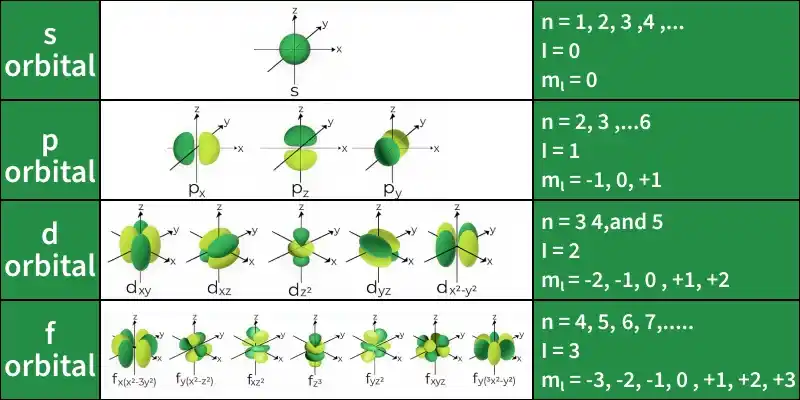
**Example: in a hydrogen atom, the single electron present in the first energy level has the quantum numbers:
- n = 1 (first energy level)
- l = 0 (s orbital)
- ml = 0
- ms = +1/2 or −1/2
Thus, quantum numbers help in identifying the exact location and behavior of electrons in an atom.
Significance
Quantum numbers are very important in understanding the arrangement and behaviour of electrons in an atom. They provide detailed information about the position and energy of electrons in atomic orbital.
- One important significance of quantum numbers is that they describe the energy level of an electron in an atom.
- The principal quantum number shows how far an electron is from the nucleus and its energy level.
- Quantum numbers also help to describe the shape and orientation of atomic orbitals.
- The azimuthal quantum number tells the shape of the orbital (such as s, p, d, and f), while the magnetic quantum number shows the orientation of the orbital in space.
- Another important role of quantum numbers is that they help in writing the electronic configuration of elements.
- By using these numbers, scientists can understand how electrons fill different orbitals according to rules such as the Pauli Exclusion Principle.
- Quantum numbers also explain that no two electrons in an atom can have the same set of four quantum numbers, which helps identify each electron uniquely.
Types of Quantum Numbers
Four quantum numbers are used to fully describe all the characteristics of an electron in an atom. These quantum numbers are:
1) Principal Quantum Number (n)
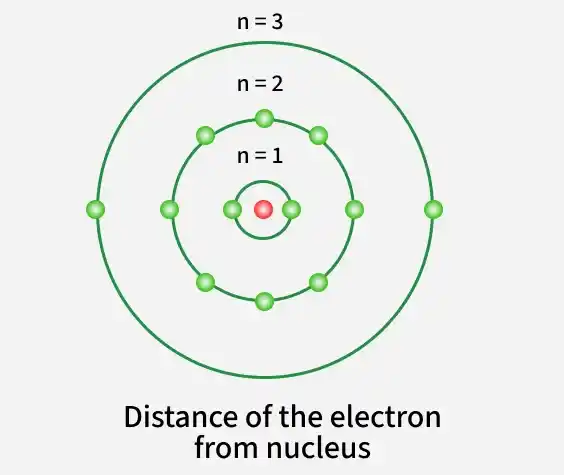
The principal quantum number describes the main energy level or shell in which an electron is present in an atom. It gives information about the size of the orbital and the energy of the electron. The principal quantum number is represented by the symbol n.
- The value of n is always a positive integer, such as 1, 2, 3, 4, ….
- These values represent different energy levels or shells around the nucleus.
- As the value of n increases, the electron is located farther from the nucleus and its energy also increases.
The maximum number of electrons that can be present in a shell is given by the formula: 2n2
Each value of n corresponds to a specific shell:
- n = 1 → First shell (K shell)
- n = 2 → Second shell (L shell)
- n = 3 → Third shell (M shell)
- n = 4 → Fourth shell (N shell)
**Example:
In the sodium atom (Na), the electronic configuration is 2, 8, 1. This means electrons are present in three energy levels (n = 1, 2, 3). The outermost electron is in the third shell (n = 3).
2) Azimuthal Quantum Number (l)
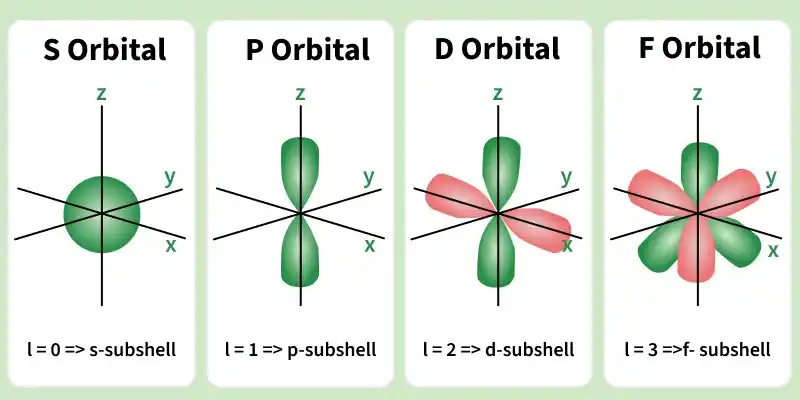
The azimuthal quantum number describes the shape of the atomic orbital in which an electron is present. It is also called the angular momentum quantum number and is represented by the symbol l.
- This quantum number helps in identifying the subshells within a principal energy level.
- The value of the azimuthal quantum number depends on the value of the principal quantum number (n).
- For any given value of n, the value of l can range from 0 to (n − 1).
- These orbitals have different shapes.
- For example, the s orbital is spherical, while p orbitals have a dumbbell shape.
Each value of l represents a different type of orbital or subshell:
- l = 0 → s orbital
- l = 1 → p orbital
- l = 2 → d orbital
- l = 3 → f orbital
**Example:
If the principal quantum number n = 3, the possible values of l are 0, 1, and 2. This means the third energy level contains 3s, 3p, and 3d subshells.
3) Magnetic Quantum Number (ml)
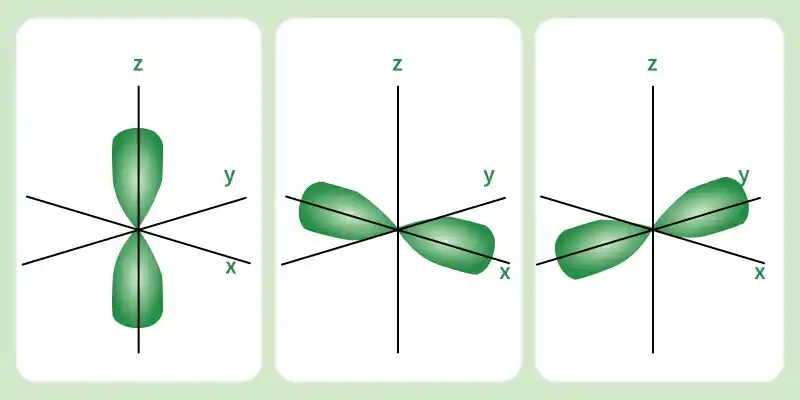
The magnetic quantum number describes the orientation of an orbital in space. It is represented by the symbol ml. This quantum number shows how orbitals are arranged in different directions around the nucleus.
- The value of the magnetic quantum number depends on the azimuthal quantum number (l).
- For a given value of l, the value of mₗ ranges from −l to +l, including zero.
- This means different orbitals within the same subshell have different orientations in space.
Values of ml for different orbitals:
- For s orbital (l = 0) → ml = 0
- For p orbital (l = 1) → ml = −1, 0, +1
- For d orbital (l = 2) → ml = −2, −1, 0, +1, +2
- For f orbital (l = 3) → ml = −3, −2, −1, 0, +1, +2, +3
**Example: If an electron is present in a p orbital, the azimuthal quantum number l = 1. Therefore, ml = −1, 0, and +1. These represent the three p orbitals (px, py, pz) that are oriented in different directions in space.
4) Electron Spin Quantum Number (ms)
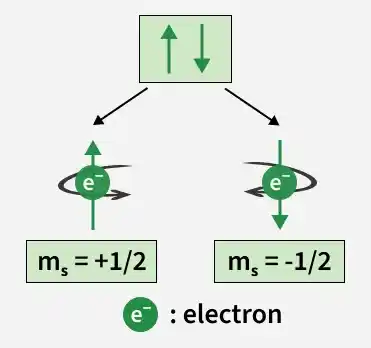
The electron spin quantum number describes the direction of rotation (spin) of an electron in an orbital. It is represented by the symbol ms. Electrons behave like tiny spinning particles, and this spin creates a small magnetic field..
These two values represent the two possible spin directions of an electron:
- +1/2 → clockwise spin (spin up)
- −1/2 → anticlockwise spin (spin down)
- According to the Pauli Exclusion Principle, an orbital can contain a maximum of two electrons, and they must have opposite spins.
**Example:
In the 1s orbital of a helium atom, two electrons are present. Both electrons occupy the same orbital, but one has ms = +1/2 and the other has ms = −1/2. This opposite spin allows both electrons to stay in the same orbital.
Solved Examples
**Questions 1: Find all four quantum numbers of the last electron of the Rubidium.
**Solution:
Rubidium has the atomic number, Z = 37.
Electronic Configuration of Rubidium,
1s2 2s2 2p6 3s2 3p6 3d10 4s2 4p6 5s1
Valence last shell electron is 5s1
Therefore,
Principal Quantum Number, n = 5,
Azimuthal Quantum Number, l = 0,
Magnetic Quantum Number, ml = 0,
Spin Quantum Number, s = +1/2
**Questions 2: State the possible values of the magnetic quantum number for l = 2.
**Solution:
Given that, the Azimuthal Quantum Number, l = 2
We know that,
ml = - l to + l
Therefore,
ml = -2 to +2
i.e.
ml = -2, -1, 0, +1, +2
**Questions 3: Find all four quantum numbers of the last electron of the Sodium.
**Solution:
Sodium has the atomic number, Z = 11.
Electronic Configuration of Sodium,
1s2 2s2 2p6 3s1
Valence shell last electron is 3s1
Therefore,
Principal Quantum Number, n = 3,
Azimuthal Quantum Number, l = 0,
Magnetic Quantum Number, ml = 0,
Spin Quantum Number, s = +1/2
**Questions 4: State the possible values of the magnetic quantum number for l = 3.
**Solution:
Given that, the Azimuthal Quantum Number, l = 3
We know that,
for l = 3,
ml = - 3 to + 3
i.e.
ml = -3, -2, -1, 0, +1, +2 +3