Carbanions (original) (raw)
Last Updated : 18 May, 2026
In organic reactions, certain reactive intermediates are formed during the course of a reaction. One such important intermediate is the carbanion, in which a carbon atom carries a negative charge. Due to the presence of an extra pair of electrons, it is electron-rich and highly reactive. Carbanions play a significant role in many organic reaction mechanisms.
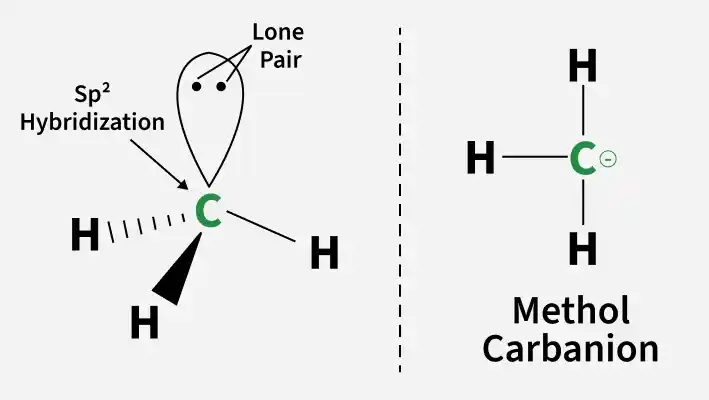
Structure of Carbanions
Carbanion has sp³ hybridisation, a trigonal pyramidal shape, and a lone pair of electrons, making it electron-rich. It forms three sigma (σ) bonds with atoms or groups. The geometry of the carbanion is trigonal pyramidal.
- The bond angle is slightly less than 109.5°.
- The carbon atom has a lone pair of electrons.
- Due to the presence of this lone pair, the carbanion is electron-rich.
Characteristics of Carbanions
Carbanions exhibit certain characteristic properties due to the presence of a negative charge and high electron density.
- **Electron-rich nature: Carbanions have an extra pair of electrons, making them electron-rich.
- **Negative charge: The carbon atom carries a negative charge (C⁻).
- **Trigonal pyramidal structure: Carbanions have a pyramidal geometry with a bond angle slightly less than 109.5°.
- **Presence of lone pair: They contain a lone pair of electrons on carbon.
- **Highly reactive and unstable: Due to high electron density, carbanions are unstable intermediates and react quickly.
- **Nucleophilic nature: Carbanions act as nucleophiles (Lewis bases) as they donate electron pairs.
Formation of Carbanions
Carbanions are formed when a carbon atom retains the shared pair of electrons during heterolytic bond cleavage and becomes negatively charged (C⁻). This mainly occurs by heterolytic bond cleavage.
Formation by Heterolytic Bond Cleavage
- In heterolytic cleavage, a bond breaks unequally.
- Both electrons are taken by the carbon atom.
- Carbon gains electrons and forms a carbanion.
R–M → R⁻ + M⁺ (where M = electropositive metal such as Na, Li)"
**Example: CH3–Na → CH3⁻ + Na+
**Mechanism
- The bond between carbon and sodium breaks.
- Carbon takes both electrons.
- Carbon becomes negatively charged (CH3⁻).
Types of Carbanion
Carbanions are classified on the basis of the number of alkyl groups attached to the negatively charged carbon atom.
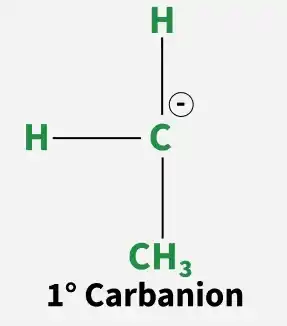
1. Primary (1°) Carbanion
- The negatively charged carbon is attached to one alkyl group
- Structure: R–CH₂⁻
**Example: CH3–CH2⁻
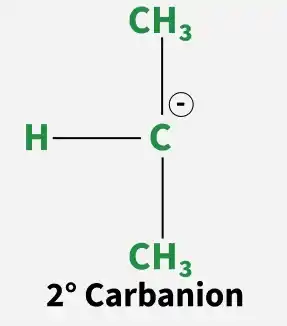
2. Secondary (2°) Carbanion
- The negatively charged carbon is attached to two alkyl groups
- Structure: R₂CH⁻
**Example: (CH3)2CH ⁻
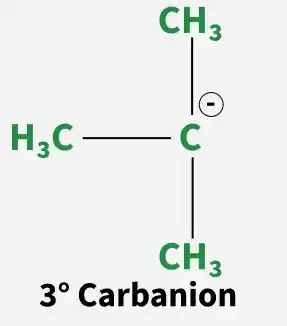
3. Tertiary (3°) Carbanion
- The negatively charged carbon is attached to three alkyl groups
- Structure: R₃C⁻
**Example: (CH3)3C ⁻
Stability of Carbanions
The stability of a carbanion depends on the ability to disperse or reduce the negative charge on the carbon atom.
**Order of Stability:
CH3-> 1° > 2° > 3°
- Methyl carbanion (CH₃⁻) is most stable.
- Tertiary (3°) carbanion is least stable.
Reasons for Stability
**1. Inductive Effect (–I Effect)
- Electron-withdrawing groups (–NO₂, –CN, etc.),stabilise the carbanion by withdrawing electron density away.
- Alkyl groups show +I effect, increase electron density and destabilise carbanion.
**2. Electron Density
- More alkyl groups, more electron donation.
- This increases negative charge and decreases stability.
**3. Resonance Effect
- Carbanions become more stable when the negative charge is delocalised through resonance.
- Example include Allylic carbanion and Benzylic carbanion.
- In these cases, the negative charge spreads over more than one atom, reducing charge concentration and increasing stability.