Electromeric Effect (original) (raw)
Last Updated : 18 May, 2026
The electromeric effect is a temporary effect observed in organic compounds containing multiple bonds (such as C=C or C=O). It involves the complete transfer of shared π-electrons of the multiple bond to one of the bonded atoms in the presence of an attacking reagent. This effect exists only during the course of a chemical reaction and disappears once the reagent is removed. It plays an important role in understanding how electron movement occurs during organic reactions.

**Characteristics of Electromeric Effect
The electromeric effect shows certain characteristic features that help in understanding its nature and role in organic reactions.
- It is a temporary effect and exists only during the attack of a reagent.
- It involves the complete transfer of π-electrons of a multiple bond to one atom.
- It is observed only in unsaturated compounds containing multiple bonds like C=C and C=O.
- The effect occurs only in the presence of an attacking reagent and vanishes when the reagent is removed.
- It leads to the formation of temporary charged species (ions) in the molecule.
Types of Electromeric Effect
The electromeric effect is classified into two types based on the direction in which the π-electrons are transferred:
1. +E Effect (Positive Electromeric Effect)
In the +E effect, the π-electrons of a multiple bond are completely transferred towards one of the bonded atoms in the presence of an electrophile. This shift occurs in such a way that electron density moves towards the carbon atom that will ultimately form a bond with the electrophile.
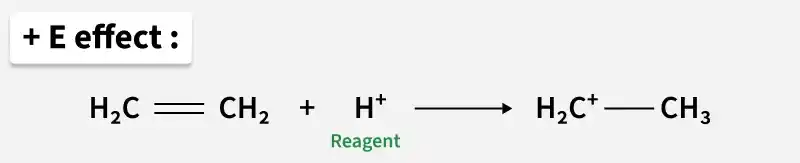
- When an electrophile like H⁺ approaches ethene, the π-electrons of the C=C bond shift towards one carbon atom.
- This results in temporary development of positive and negative charges on atoms, allowing the reagent to attach.
2. –E Effect (Negative Electromeric Effect)
Here, the π-electrons are completely transferred away from the atom to which the attacking reagent attaches. This takes place when the attacking reagent is a nucleophile.
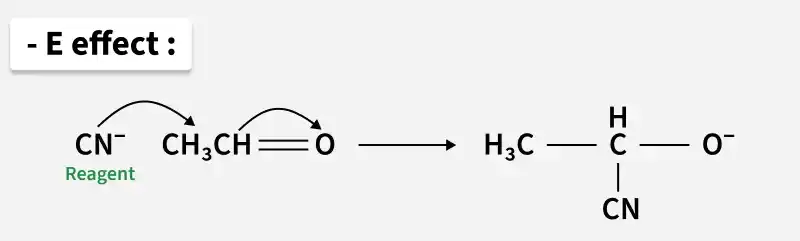
- When a nucleophile like CN⁻ attacks a carbonyl group, the π-electrons of the C=O bond shift towards the oxygen atom.
- This creates a negative charge on oxygen and reduces electron density on carbon, facilitating the attack.
Examples of Electromeric Effect
The electromeric effect can be better understood with the help of some common examples involving addition reactions.
****1. +**E Effect Example: Addition of Br2 to Ethene
When bromine (Br₂) approaches ethene, the π-electron cloud of the C=C bond polarizes the Br₂ molecule, inducing a partial positive charge (Brδ⁺) on one bromine atom and a partial negative charge (Brδ⁻) on the other. The π-electrons of the double bond then shift towards the electrophilic Brδ⁺, leading to the formation of a cyclic bromonium ion intermediate rather than a free carbocation.
2. –E Effect Example: Attack of OH⁻ on Carbonyl Group
In aldehydes or ketones, the carbonyl group (C=O) is polar.
- When a nucleophile like OH⁻ attacks the carbon atom of the carbonyl group, the π-electrons of the C=O bond shift completely towards the oxygen atom.
- This creates a negative charge on oxygen, while the nucleophile attaches to carbon.