Cathode Ray Experiment (original) (raw)
Last Updated : 16 May, 2026
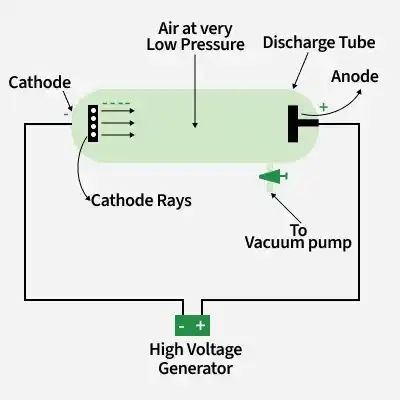
The cathode ray experiment was conducted by J. J. Thomson to study the internal structure of the atom. At that time, atoms were considered indivisible, but this experiment helped to prove that atoms are made up of smaller particles. In this experiment, Thomson used a discharge tube with low-pressure gas and applied high voltage across two electrodes. Under these conditions, certain rays were observed to originate from the cathode and move towards the anode. These rays were called cathode rays.
Properties of Cathode Rays
Cathode rays show several important properties which help in understanding their nature.
- **Travel in Straight Lines: Cathode rays move in straight lines from the cathode to the anode. This can be observed by the formation of sharp shadows when an object is placed in their path.
- **They possess a negative charge: They are deflected towards the positive plate in an electric field, which shows that they carry a negative charge.
- **Consists of Particles (Electrons): These are made up of small particles called electrons, which have mass and charge.
- **Produce Fluorescence: When cathode rays strike certain materials like glass, they produce a glowing effect known as fluorescence.
- **Independent of Gas and Electrodes: The properties do not depend on the type of gas present in the discharge tube or the material of the electrodes. This shows that electrons are present in all atoms.
Cathode Ray Experiment Setup
The Cathode Ray Experiment is a fundamental experiment in physics that led to the discovery of the electron.
- **Cathode Ray Tube (CRT): A sealed glass tube with a cathode and an anode at either end.
- **Cathode: A negatively charged electrode inside the CRT.
- **Anode: A positively charged electrode inside the CRT.
- **High Voltage Generator: A power supply capable of providing a high voltage between the cathode and anode.
- **Vacuum Pump: A pump to evacuate air from the CRT to create a low-pressure environment.
- **Discharge Tube: A sealed glass tube containing electrodes and low-pressure gas.
Procedure of Experiment
The cathode ray experiment was performed by following certain steps to observe the formation and behavior of cathode rays.
- A discharge tube fitted with two metal electrodes (cathode and anode) was taken.
- The air inside the tube was partially removed to create a low-pressure environment.
- The tube was then connected to a high voltage source.
- When a high potential difference was applied, rays were emitted from the cathode and moved towards the anode.
- These rays produced a glow on the glass wall of the tube, indicating their presence.
- The behavior of these rays was further studied by applying electric and magnetic fields to observe their deflection.
Observation of Cathode Ray Experiment
During the cathode ray experiment, certain observations were made which helped in understanding the nature of cathode rays.
- When a high voltage was applied, rays were emitted from the cathode and moved towards the anode.
- These rays produced a glow on the glass wall of the discharge tube.
- The rays travelled in straight lines, as shown by the formation of shadows.
- When an electric or magnetic field was applied, the rays were deflected towards the positive plate.
- The behavior of these rays was found to be independent of the gas present in the tube.
Limitations of Cathode Ray Experiment
Although the cathode ray experiment provided important information about electrons, it had certain limitations.
- The experiment could only prove the existence of electrons, but it did not give information about other particles present in the atom.
- It did not explain the overall structure of the atom or how electrons are arranged within it.
- It could not describe the distribution of positive charge in the atom.
- The experiment did not provide information about the mass or exact position of electrons.