Discovery of Electrons, Neutrons and Protons (original) (raw)
Last Updated : 23 Apr, 2026
Atoms were once considered indivisible particles of matter. However, later experiments showed that atoms are made up of smaller subatomic particles. The discovery of electrons, protons, and neutrons helped scientists understand the internal structure of the atom. These particles have different charges and masses, and together they determine the properties and behaviour of atoms.
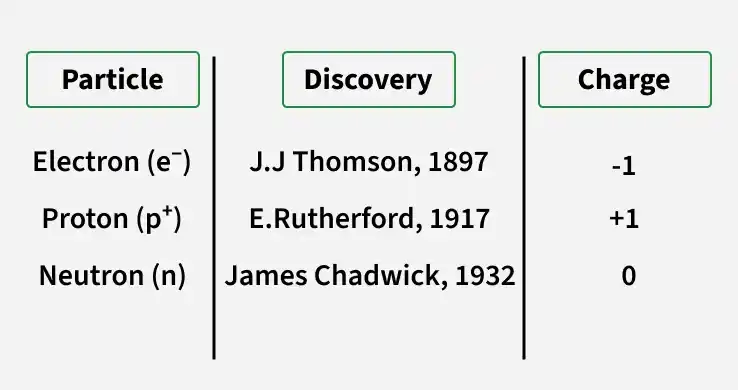
Through various scientific experiments carried out in the late 19th and early 20th centuries, scientists discovered that an atom consists of three main subatomic particles: electrons, protons, and neutrons. The electron is a negatively charged particle found outside the nucleus, while the proton is a positively charged particle present in the nucleus. The neutron is a neutral particle that also exists in the nucleus. This understanding helped explain the structure of atoms, their stability, and their role in chemical bonding.
Electrons
An electron is a negatively charged subatomic particle present in an atom. It was discovered during the cathode ray tube experiment. Electrons are very small and light compared to protons and neutrons.
- They revolve around the nucleus of an atom in different energy levels or shells.
- The charge of an electron is −1.602 × 10⁻19 coulomb, and its mass is approximately 9.11 × 10⁻31 kg, which is extremely small.
- Electrons play an important role in chemical reactions and bonding because they are involved in the formation of chemical bonds between atoms.
Discovery of the Electron
The discovery of the electron was an important step in understanding the internal structure of atoms. Before this discovery, atoms were believed to be indivisible particles. In 1897, the British physicist J. J. Thomson discovered the electron through experiments with cathode rays. This discovery proved that atoms contain smaller charged particles.
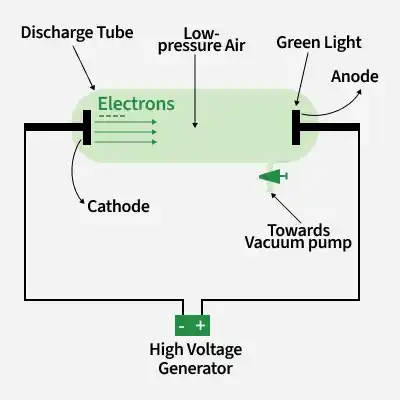
Cathode Ray Experiment
- To discover the electron, Thomson performed an experiment using a cathode ray tube, which is a sealed glass tube containing gas at very low pressure.
- The tube had two metal electrodes called the cathode (negative electrode) and anode (positive electrode).
- When a high voltage was applied across the electrodes, rays were produced from the cathode and moved toward the anode.
- These rays were called cathode rays.
- Thomson observed that the rays travelled in straight lines and produced a glowing spot when they struck the wall of the tube or a fluorescent screen.
- He then applied an electric and magnetic field to the rays.
- The rays were deflected toward the positive plate, which showed that they carried a negative charge.
- From these observations, Thomson concluded that cathode rays consist of very small negatively charged particles present in all atoms.
- These particles were later called electrons, and their discovery helped scientists understand the structure of atoms.
Protons
After the discovery of the electron, scientists continued studying the structure of the atom to understand the presence of positive charge inside it. This led to the discovery of another important subatomic particle called the proton.
- The proton was discovered during his experiments with atomic particles.
- Rutherford conducted experiments by bombarding nitrogen gas with fast moving alpha particles.
- During the experiment, he observed that hydrogen nuclei were produced.
- From this observation, he concluded that the hydrogen nucleus is a fundamental positively charged particle present in atoms.
- This particle was later named the proton.
Discovery of Proton
It was discovered in 1917 by the scientist Ernest Rutherford. The discovery of the proton helped scientists understand that the nucleus of an atom contains positively charged particles, which play an important role in determining the identity of an element.
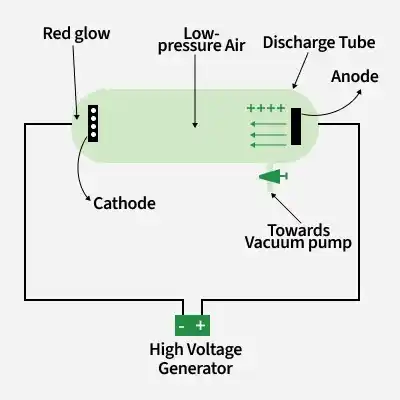
Rutherford Nitrogen bombardment experiment
- The proton was discovered through an experiment involving nitrogen gas and alpha particles.
- Rutherford directed a beam of high-energy alpha particles toward nitrogen gas in an experimental chamber.
- Alpha particles are positively charged particles emitted by radioactive substances.
- When the alpha particles collided with the nitrogen atoms, He observed that some positively charged particles were released from the atoms.
- These particles behaved like the nucleus of hydrogen atoms.
- After careful observation and analysis, Rutherford concluded that these particles were hydrogen nuclei.
- Since the hydrogen nucleus carries a positive charge and is the simplest nucleus, he suggested that it must be a fundamental particle present in the nucleus of atoms.
- This positively charged particle was later named the proton.
- The discovery of the proton helped scientists understand that the nucleus of an atom contains positively charged particles, which balance the negatively charged electrons present around the nucleus.
Neutrons
After the discovery of the electron and proton, scientists noticed that the mass of atoms could not be explained by these two particles alone. This led to the idea that another particle must be present in the nucleus of the atom.
- A neutron is a neutral subatomic particle present in the nucleus of an atom.
- It has no electric charge but has a mass almost equal to that of a proton.
- The discovery of the neutron helped scientists better understand the structure of the nucleus and the total mass of atoms.
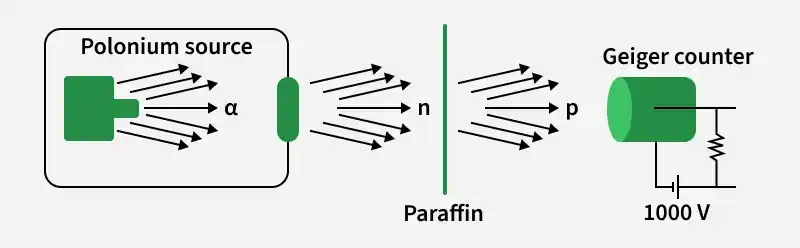
The Discovery of Neutron
The mass of atoms was found to be greater than the combined mass of protons and electrons. This suggested that another particle must be present in the nucleus which led to discovery of neutron.
Beryllium Bombardment Experiment
- The neutron was discovered in 1932 by James Chadwick through the Beryllium Bombardment Experiment.
- In this experiment, Chadwick used alpha particles emitted from a radioactive source and directed them toward a thin sheet of beryllium metal.
- When the alpha particles struck the beryllium atoms, a new type of radiation was produced.
- This radiation had no electric charge, but it had enough energy to knock protons out of paraffin wax placed in front of it.
- The ejected protons were detected and studied carefully.
- From these observations, Chadwick concluded that the radiation consisted of neutral particles with mass.
- Since these particles had no charge, they were different from protons and electrons.
- He named these particles neutrons.
- The discovery of the neutron helped scientists better understand the structure of the atomic nucleus and the mass of atoms.
Electron, Proton and Neutron
| Electron | Proton | Neutron |
|---|---|---|
| It is a negatively charged particle (–1 charge). | It is a positively charged particle (+1 charge). | It is a neutral particle (no charge). |
| Its mass is very small (about 1/1836 of proton). | Its mass is approximately 1 atomic mass unit. | Its mass is approximately equal to proton (about 1 amu). |
| It is present outside the nucleus in shells or orbitals. | It is present inside the nucleus. | It is present inside the nucleus. |
| It is responsible for chemical bonding and reactions. | It determines the atomic number and identity of the element. | It contributes to the stability of the nucleus. |