Chemical Formula (original) (raw)
Last Updated : 23 Apr, 2026
A chemical formula is a symbolic representation of a chemical substance. It shows the types of elements present, the number of atoms of each element in one molecule or formula unit and the ratio in which atoms are combined.
**Chemical formulas use:
- Symbols of elements (H, O, Na, Cl, etc.)
- Subscripts (small numbers written below) show the number of atoms.
- Sometimes brackets ( ), +, − signs for ions or complex compounds.
**Example: Water → H2O, Carbon dioxide → CO2
Features of Chemical Formula
1. It represents the name of the compound in symbolic form.
2. It shows the elements present in the compound.
3. It tells the exact number of atoms of each element.
4. It represents one molecule or one formula unit of a substance.
5. It helps in calculating:
- Molecular mass
- Molar mass
- Chemical reactions
6. It shows the definite mass ratio in which elements combine.
Types of Chemical Formulae
A chemical formula is a symbolic representation of a substance that shows the elements present and the number of atoms of each element in a molecule or compound. Different types of chemical formulas are used to represent substances in various ways, depending on the information required.
The main types of chemical formulas are discussed below:
**1. Molecular Formula
- Shows the actual number of atoms of each element in one molecule.
- Written using element symbols and subscripts.
| Compound | Molecular Formula |
|---|---|
| Urea | CH4N2O |
| Acetic Acid | CH3COOH |
| Glucose | C6H12O6 |
| Methane | CH4 |
**2. Empirical Formula
- Shows the simplest whole number ratio of atoms.
- Does not show actual number, only ratio.
| Compound | Molecular Formula | Empirical Formula |
|---|---|---|
| Urea | CH4N2O | CH4N2O |
| Acetic Acid | C2H4O2 | CH2O |
| Glucose | C6H12O | CH2O |
**3. Structural Formula
- Shows the arrangement of atoms in a molecule.
- Displays how atoms are bonded.
**Example:
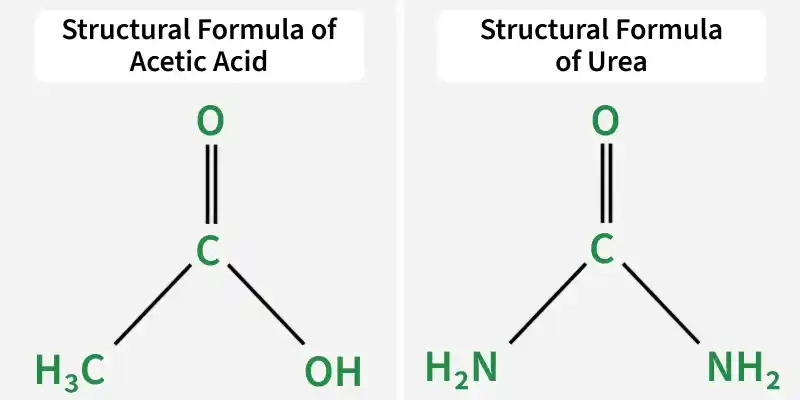
Valency
Valency is the combining capacity of an atom, i.e., the number of electrons an atom can lose, gain, or share to form a stable compound.
- Atoms try to achieve a stable outer shell (like noble gases).
- Metals usually lose electrons, so they have positive valency.
- Non-metals usually gain electrons, so they have negative valency.
**Examples:
- Aluminium (Al) → valency = 3 (loses 3 electrons)
- Oxygen (O) → valency = 2 (gains 2 electrons)
Ions
An ion is an atom or group of atoms that carries a charge due to loss or gain of electrons.
- Cation → positively charged ion (loss of electrons)
**Example: Al 3+
- Anion → negatively charged ion (gain of electrons)
**Example: O 2-
Rules for Writing Chemical Formula
The chemical formula is written by balancing the valencies of the combining elements so that the overall compound becomes electrically neutral.
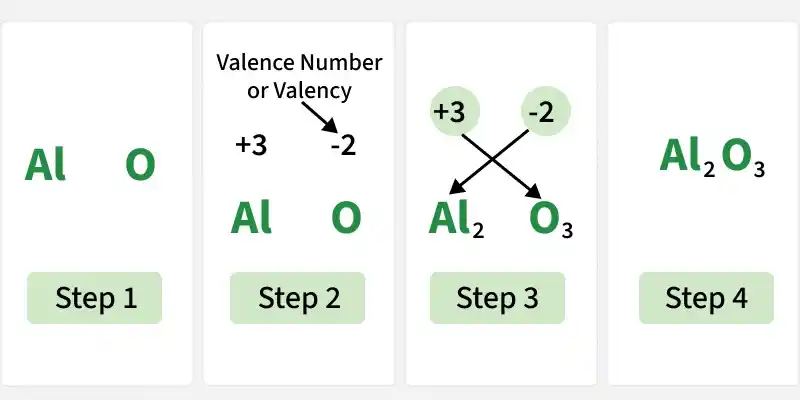
**Step 1: Write the symbols of the elements
- Aluminium → Al
- Oxygen → O
**Step 2: Write their valencies
- Aluminium (Al) → 3
- Oxygen (O) → 2
**Step 3: Find the LCM of valencies
- LCM of 3 and 2 = 6
**Step 4: Cross the valencies
- Al gets 2 (from O)
- O gets 3 (from Al)
- Formula becomes → Al₂O₃
**Step 5: Write metal first, then non-metal
- Aluminium (metal) comes first, then Oxygen → Al₂O₃
**Step 6: Simplify if possible
- 2 and 3 cannot be simplified further → final formula remains Al₂O₃
Examples:
**1. Chemical Formula of Rust:
Elements present in Rust are Iron and Oxygen.
**Symbol Iron, Fe (26) Oxygen, O (8) **Valency 3 2 Lowest common multiple of valency is 6. Therefore,
Fe = 2 × 3 = 6
O = 3 × 2 = 6
This implies that the chemical formula is Fe2O3.
**2. Chemical Formula of Aluminium Oxide:
The elements present in Aluminium Oxide are Aluminium and Oxygen.
**Symbol Aluminium, Al (13) Oxygen, O (8) **Valency 3 2 The lowest common multiple of valency is 6. Therefore,
Al = 2 × 3 = 6
O = 3 × 2 = 6
This implies that the chemical formula is Al2O3.
**3. Chemical Formula of Methane:
Elements present in Methane are Carbon and Hydrogen.
**Symbol Carbon, C (6) Hydrogen, H (1) **Valency 4 1 Lowest common multiple of valency is 4. Therefore,
C = **1 × 4
H = **4 × 1
This implies that the chemical formula is CH4.
**4. Chemical Formula of Sodium Chloride:
Elements present in Sodium Chloride are Sodium and Chloride.
**Symbol Sodium, Na (11) Chlorine, Cl (17) **Valency 1 1 Lowest common multiple of valency is 1. Therefore,
Na = **1
Cl = **1
This implies that the chemical formula is NaCl
**5. Chemical Formula of Calcium Oxide:
Elements present in Calcium Oxide are Calcium and Oxygen.
**Symbol Calcium, Ca (20) Oxygen, O (8) **Valency 2 2 Lowest common multiple of valency is 2. Therefore.
Ca = **1 × 2
O = **1 × 2
This implies that the chemical formula is CaO.
Chemical Formula Table
A chemical formula table shows the symbols, valencies, and formulas of different compounds in a clear and organized way. It helps in understanding how elements combine in fixed ratios to form stable compounds.Compound Name
| Chemical Symbol | Molecular Weight (g/mol) | |
|---|---|---|
| Acetic acid | CH3COOH | 60.052 |
| Hydrochloric acid | HCl | 36.458 |
| Sulfuric acid | H2SO4 | 98.072 |
| Ammonia | NH3 | 17.031 |
| Nitric acid | HNO3 | 63.012 |
| Phosphoric acid | H3PO4 | 97.994 |
| Sodium phosphate | Na3PO4 | 119.976 |
| Calcium carbonate | CaCO3 | 100.086 |
| Ammonium sulfate | (NH4)2SO4 | 132.134 |
| Carbonic acid | H2CO3 | 62.024 |
| Sodium bicarbonate | NaHCO3 | 84.0066 |
| Sodium hydroxide | NaOH | 39.997 |
| Calcium hydroxide | Ca(OH)2 | 74.092 |
| Ethanol | C2H5OH | 46.069 |
| Hydrobromic acid | HBr | 80.912 |
| Nitrous acid | HNO2 | 47.013 |
| Potassium hydroxide | KOH | 56.11 |
| Silver nitrate | AgNO3 | 169.872 |
| Sodium carbonate | Na2CO3 | 105.988 |
| Sodium chloride | NaCl | 58.44 |
| Magnesium hydroxide | Mg(OH)2 | 58.319 |
| Methane | CH4 | 16.043 |
| Nitrogen dioxide | NO2 | 30.006 |
| Sodium nitrate | NaNO3 | 84.994 |
| Aluminium sulfate | Al2(SO4)3 | 342.15 |
| Aluminium oxide | Al2O3 | 101.96 |
| Ammonium nitrate | NH4NO3 | 80.043 |
| Ammonium phosphate | (NH4)3PO4 | 132.056 |
| Barium hydroxide | Ba(OH)2 | 171.341 |
| Carbon tetrachloride | CCl4 | 153.811 |
Polyatomic Ions
Polyatomic ions are ions made up of two or more atoms bonded together that carry an overall charge and act as a single unit in chemical reactions.
- They have a fixed composition and charge
- They behave like a single ion during chemical reactions
- Most polyatomic ions are negatively charged (anions), though some are positive
**Examples:
- Ammonium (NH4+)
- Hydroxide (OH ⁻)
- Nitrate (NO3⁻)
- Sulphate (SO42-)