Types of Chemical Reactions (original) (raw)
Last Updated : 28 Apr, 2026
A chemical reaction is a process in which the bonds break in reactants and new bonds form to produce products. Such changes can be seen in a chemical reaction as the change in state, the change in colour, the evolution of gas, and the change in temperature.
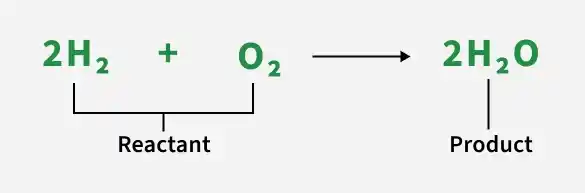
Chemical reactions can occur in different ways depending on how substances react and what products are formed. Based on these changes, Chemical Reaction can be classified into different types.
**1. Combination Reaction
- In the Combination Reaction, two or more reactants combine together to form a single product.
- As in this reaction, new compounds are formed with the help of other compounds, so it is also called a synthesis reaction.
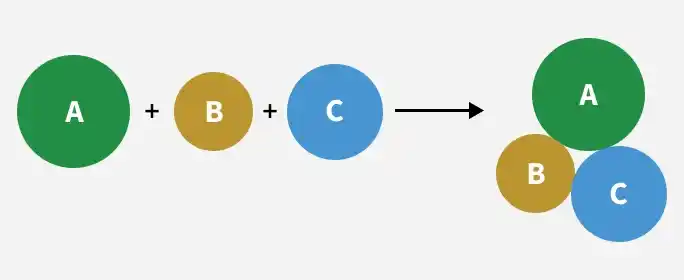
**Example 1: Reaction of quick lime (Calcium Oxide) with water results in calcium hydroxide,
CaO (s) + H2O (l) → Ca(OH)2 (aq)
**Example 2: Reaction of sulfur trioxide gas with water results in sulfuric acid,
SO3(g)+H2O(l)→H2SO4(aq)
**2. Decomposition Reaction
- In the Decomposition reaction, a single component breaks down into two or more products.
- To break the bonds between different components a lot of energy is required, we can provide it in the form of heat, electricity or sunlight, etc.
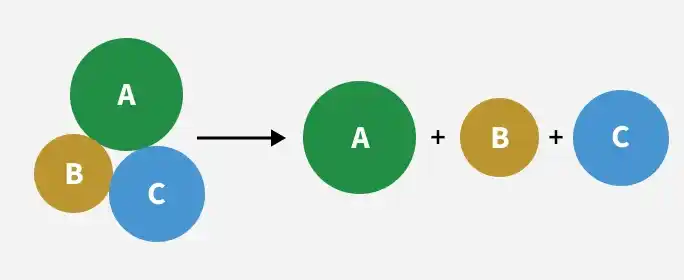
**Example 1: Decomposition of carbonic acid,
H2CO3 (aq) → H2O(l) + CO2(g)
**Example 2: Decomposition of Nickel (III) Oxide,
2Ni2O3 (s) → 4Ni(s) + 3O2(g)
**Example 3: The decomposition of calcium carbonate (CaCO3) gives CaO (Quick Lime) which is a major component of cement.
CaCO3(s) heat > CaO(s) + CO2(g)
**Example 4: Calcium hydroxide (Slaked lime) on decomposition gives Quick lime (CaO).
Ca(OH)2 heat> CaO(s) + H2O (l)
**3. Redox Reaction
- Redox Reaction which is also called Reduction-oxidation reaction involves reduction(gain of the electron) and oxidation (loss of electron) to takes place simultaneously.
- It is the process of transfer of electrons between different elements and compounds to form new compounds.
Example 1: Reaction of Zinc
Zn + 2H+ → Zn2+ + H2
**Example 2: Reaction of Iron with copper sulfate
CuSO4 (aq) + Fe(s) → FeSO4 (aq) + Cu(s)
**4. Single Displacement Reaction
- In a Single Displacement Reaction, more reactive metal displaces less reactive metal from its salt or other compounds.
- In these reactions, through reactivity series, products can be determined.
- Reactivity series is a series of elements in which elements are arranged in decreasing order of their reactivity.
- Thus, the elements present at the top of the series are more reactive than the elements present at the bottom of the series.

**Example 1: Potassium displaces Magnesium
2K + MgCl2 → 2KCl + Mg
In this reaction, potassium displaces magnesium from its salt because of the more reactivity of potassium than magnesium. Potassium is present at the top of the reactivity series and hence, it is the most reactive element.
**Example 2: Zinc reacting with hydrochloric acid to produce zinc chloride and hydrogen gas:
Zn + 2HCl → ZnCl2 + H2
**Example 3: Iron reacting with copper sulfate to produce copper and iron sulfate:
Fe + CuSO4 → Cu + FeSO4
**5. Double Displacement Reaction
- A type of chemical reaction in which two compounds react with each other and exchange their ions.
- The products of the reaction will be silver chloride and sodium nitrate after the double displacement reaction.

**Example 1: Reaction between silver nitrate and sodium chloride, results in silver chloride and sodium nitrate,
AgNO3 (aq)+ NaCl (s) → AgCl (s) + NaNO3 (aq)
**Example 2: Reaction between potassium nitrate and aluminium chloride, results in aluminium nitrate and potassium chloride,
3KNO3 + AlCl3 → Al(NO3)3 + 3KCl
**Example 3: Reaction between sodium sulfate and barium chloride, results in barium sulfate and sodium chloride.
Na2SO4 (aq) + BaCl2 (aq) → BaSO4 (s) + 2NaCl(aq)
**6. Precipitation Reaction
- A precipitation reaction is a type of chemical reaction that occurs when two solutions are mixed and a solid substance (precipitate) is formed as a result of the reaction.
- In this type of reaction, the ions of two different aqueous solutions react with each other to form an insoluble solid.
- This solid substance is called a precipitate and it settles at the bottom of the container.
**Example: Reaction is the reaction between silver nitrate (AgNO3) and sodium chloride (NaCl):
AgNO3 (aq) + NaCl (aq) → AgCl (s) + NaNO3 (aq)
- In this reaction, silver nitrate and sodium chloride are mixed together, and the silver ions (Ag+) and chloride ions (Cl-) react with each other to form solid silver chloride (AgCl), which appears as a white precipitate.
- The sodium and nitrate ions remain in the solution as they do not react with each other.
**7. Neutralization Reaction
- A neutralization reaction is a reaction between an acid and a base to give salt and water as the products.
- The formation of the water molecules is by the combination of OH– ions and H+ ions.
- The overall pH of the products when a strong base and a strong acid undergo a neutralization reaction must be 7.
**Example: Neutralization reaction between Hydrochloric acid (HCl) and Sodium Hydroxide (NaOH) giving out sodium chloride (Common Salt) and water.
HCl (aq) + NaOH (aq) → NaCl (aq) + H2O (l)
**8. Combustion Reaction
- A combustion reaction is a type of chemical reaction between a fuel and an oxidant that produces a product called an oxidized product.
- An oxidizer is a chemical fuel required to burn such as oxygen.
**Example 1: Reaction between hydrocarbon and oxygen to yield carbon dioxide, water, and heat.
Hydrocarbon + Oxygen → Carbon dioxide + Water + Heat
**Example 2: Combustion of methane gas
CH4 (g) + 2O2 (g) → CO2 (g) + 2H2O (g) + Heat
**Example 3: Combustion of Magnesium ribbon
2Mg + O2 → 2MgO + Heat