Evaporation (original) (raw)
Last Updated : 23 Apr, 2026
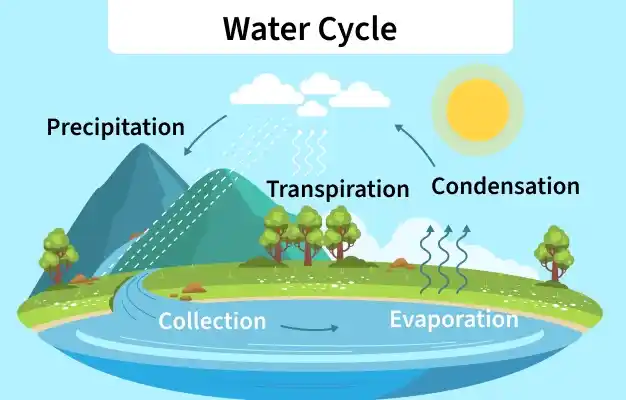
Evaporation is the process by which a liquid changes into a vapor (gas) at temperatures below its boiling point. It occurs when particles at the surface of the liquid absorb heat energy and gain enough kinetic energy to escape into the air. Since only surface particles are involved, evaporation is considered a surface phenomenon. It is the opposite of condensation, where vapor changes back into liquid.
For example, when water is left in an open container, it slowly disappears. That’s because the water molecules gain enough energy (from heat in the surroundings) to escape into the air as water vapor.

**Key Points
- It happens at the surface of a liquid
- It can occur at any temperature (not just boiling)
- Heat speeds it up
- Common example: drying clothes in the sun
**Examples of Evaporation
**Drying of Clothes in Sun: As wet garments are laid out in the sun, the water available in the garments absorbs sunlight and air heat. These water molecules on the surface acquire adequate kinetic energy and get released into the air as water vapor. As a result, the clothes dry up. On hot and windy days, clothes dry up faster due to the increased rate of evaporation.
**Drying of a Mopped Floor: When a floor is mopped, water spreads as a thin film, increasing its surface area. This larger surface area allows faster evaporation. During evaporation, water absorbs heat from the surroundings, which helps it change into vapour and leaves the floor dry. The floor dries faster in summer because higher temperature increases the rate of evaporation compared to winter.
**Chilling of Water in a Clay Pot: A clay pot possesses minute holes on the surface. It is through these pores that a little water trickles out and evaporates. Water is the one that absorbs the heat of the water within the pot during evaporation thus decreasing its temperature. Therefore, water that is held in clay pots is kept cool during summer.
**Reduction of Water Table of Ponds and Lakes: Temperature is high and humidity is low during summer. As a result of this, water evaporates on a continual basis in ponds, lakes and intermittent rivers. The level of the water in the long run reduces and in some instances the little water bodies can even dry up entirely.
**The salt is formed by the seawater: Seawater is gathered in shallow salt pans and is allowed to be exposed to the Sun. Heat causes the water to evaporate gradually leaving the salt behind as solid crystals. Salt is produced in this way of sea water.
Mechanism of Evaporation
**Constant movement of molecules:
- Molecules in a liquid are always moving.
- They have varying quantities of kinetic energy.
**Absorption of heat:
- Liquid molecules absorb heat from the surroundings, such as sunlight or air.
- This increases their kinetic energy and makes them move faster.
- Molecules at the surface gain more energy than those inside the liquid.
- Some of these surface molecules get enough energy to overcome intermolecular forces and escape.
**More energetic surface molecules:
- Molecules at the surface gain more energy than those inside the liquid.
- Some surface molecules become energetic enough to overcome the attractive forces between them.
- Only these high-energy molecules escape from the liquid.
**Escape into the air:
- These energetic molecules leave the surface and enter the air as vapor, causing evaporation.
**Cooling effect:
- Because the higher-energy molecules escape, the remaining molecules have lower average energy, which results in a drop in temperature and produces a cooling effect.
Factor Affecting Evaporation
**1. Temperature
- Rising of temperature enhances the kinetic energy of liquid molecules.
- A sufficient number of molecules acquire enough energy to be able to escape into the gaseous state.
- Thus, the temperature increases the rate of evaporation.
Temperature ∝ Rate of Evaporation
**Example: During the hot summer day, clothes dry quickly compared to a cold day.
**2. Surface Area
- The evaporation takes place at the surface of a liquid.
- Increases in surface area imply increasing the number of molecules exposed to air.
- The evaporation is therefore accelerated.
**Surface Area ∝ Rate of Evaporation
**Example: Water evaporates more quickly when laid in a plate as compared to when it is laid in a glass.
**3. Humidity
- The proportion of water vapor in the air is known as humidity.
- The high humidity implies that the air already has a high amount of water vapour.
- This decreases the capacity of air to accommodate more vapour, and thus, slow down the evaporation.
**Humidity ∝ 1 / Rate of Evaporation
**Example: During the rainy season, clothes take a long period to dry.
**4. Wind Speed
- The water vapour that is found close to the surface of the liquid is removed by wind.
- This reduces the liquid humidity and increases the evaporation.
- Increase in speed of wind heightens the rate of evaporation.
**Wind Speed ∝ Rate of Evaporation
**Example: On windy day clothes dry quicker.
Evaporation vs Boiling
| Evaporation | Boiling |
|---|---|
| Slow change of liquid into vapour | Rapid change of liquid into vapour |
| Occurs at any temperature below boiling point | Occurs at a fixed temperature (boiling point) |
| Surface phenomenon | Bulk phenomenon |
| Slow process | Fast process |
| No bubbles formed | Bubbles formed throughout the liquid |
| Causes cooling | Does not cause cooling |
| Uses energy from surroundings | Requires continuous heat supply |
| Drying of clothes, cooling in earthen pot | Boiling of water at 100°C |