Gibbs Free Energy (original) (raw)
Last Updated : 12 May, 2026
Gibbs free energy is the maximum useful work obtainable at constant temperature and pressure. It is denoted by G and is widely used in chemistry to understand energy changes in reactions and processes. It takes into account two important factors: enthalpy (heat content) and entropy (degree of disorder) of a system.
Equation of Gibbs Free Energy
This equation shows that Gibbs free energy depends on both the enthalpy and the entropy of a system. It helps in understanding how these two factors together determine the energy available in a system.
G = H - TS
where:
- S is the entropy of the system,
- H is Enthalpy, and
- T is the Temperature.
Change in Gibbs Free Energy
The change in Gibbs free energy, denoted by ΔG, represents the difference in free energy between the final and initial states of a system during a process. It helps in understanding the direction and feasibility of a reaction at constant temperature and pressure.
It depends on both enthalpy (ΔH) and entropy (ΔS) of the system, which together determine how the energy of the system changes.
ΔG = ΔH - T ΔS
Where:
- ΔG = Change in Gibbs free energy
- ΔH = Change in enthalpy
- T = Temperature (in Kelvin)
- ΔS = Change in entropy
**Gibbs Energy and Spontaneity
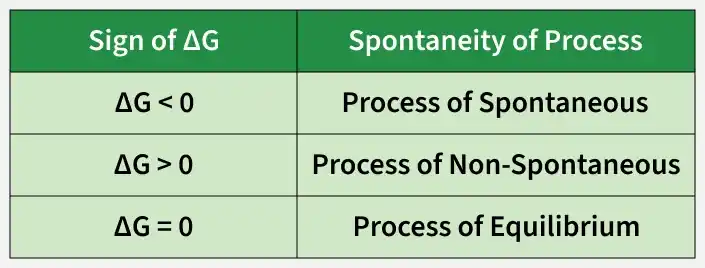
The concept connects enthalpy (ΔH) and entropy (ΔS) to predict the direction of a process. Spontaneity means a process can occur on its own without external energy. Gibbs free energy gives a clear criterion for this.
- If ΔG is negative, the system has enough energy to proceed on its own, so the process occurs naturally.
- If ΔG is positive, energy is required to make the process occur, so it is not spontaneous.
- If ΔG is zero, there is no net change, and the system is in balance (equilibrium).
ΔG = ΔH − TΔS
Where:
- ΔG = Change in Gibbs free energy
- ΔH = Change in enthalpy
- T = Absolute temperature (in Kelvin)
- ΔS = Change in entropy
**Factors affecting Gibbs Free Energy
Gibbs free energy depends on both enthalpy (ΔH) and entropy (ΔS). Thus, the factors that affect Gibbs free energy are:
**1. Enthalpy Change (ΔH)
- If ΔH is negative (exothermic) , ΔG becomes more negative, process becomes more spontaneous.
- If ΔH is positive (endothermic), ΔG increases, process becomes less spontaneous.
**Example: Burning of fuel releases heat , ΔH is negative , favors spontaneity.
**2. Entropy Change (ΔS)
- If ΔS is positive (increase in disorder) , ΔG decreases , favors spontaneity.
- If ΔS is negative (decrease in disorder), ΔG increases, opposes spontaneity.
**Example: Solid → Liquid → Gas, entropy increases , ΔG becomes more negative.
**3. Temperature (T)
- Temperature plays a key role in the term TΔS.
- If ΔS is positive: Increasing temperature makes ΔG more negative, increases spontaneity.
- If ΔS is negative: Increasing temperature makes ΔG more positive, decreases spontaneity.
| ΔH | ΔS | Effect on ΔG | Spontaneity |
|---|---|---|---|
| –ve | +ve | Always negative | Always spontaneous |
| +ve | –ve | Always positive | Never spontaneous |
| –ve | –ve | Depends on T | Spontaneous at low T |
| +ve | +ve | Depends on T | Spontaneous at high T |
**Standard Gibbs Free Energy (ΔG°)
Standard Gibbs free energy, denoted as ΔG°, is the change in Gibbs free energy when all reactants and products are in their standard states at a specified temperature (usually 298 K) and pressure (1 bar).
ΔG° = ΔH° − TΔS**°
Where:
- ΔG° = Standard Gibbs free energy change
- ΔH° = Standard enthalpy change
- ΔS° = Standard entropy change
- T = Temperature in Kelvin
**ΔG and Equilibrium constant
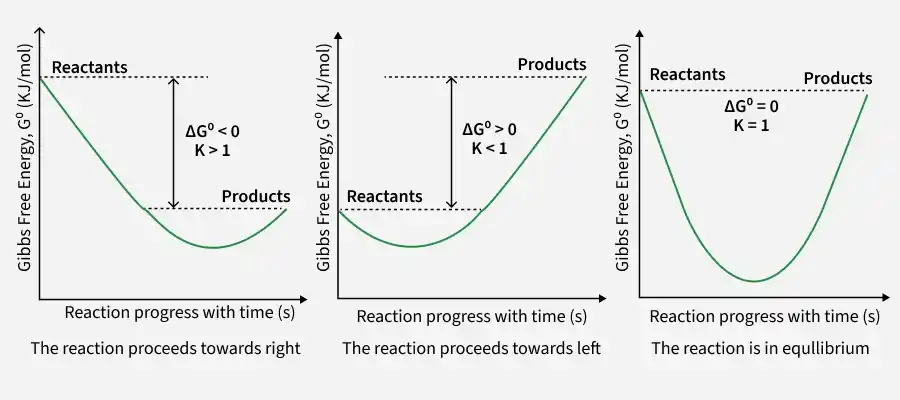
This equation shows the link between standard Gibbs free energy (ΔG°) and the equilibrium constant (K). It tells us how thermodynamics (ΔG°) is related to equilibrium (K).
- If K > 1, ΔG° is negative
- If K < 1, ΔG° is positive
- If K = 1, ΔG° = 0, system is at equilibrium
ΔG° = −RT ln K
Where:
- ΔG° = Standard Gibbs free energy change
- R = Gas constant
- T = Temperature in Kelvin
- K = Equilibrium constant
**Solved Examples
**Problem 1: Determine whether the reaction is spontaneous or non-spontaneous for the given value of ΔH and ΔS. Also, state whether they are exothermic or endothermic.
- **ΔH = - 40 kJ and ΔS = +135 JK -1 at 300K
- **ΔH = - 60 kJ and ΔS = -160 JK -1 at 400K
**Solution:
ΔG = ΔH - T ΔS
ΔH = - 40 kJ, ΔS = +135 J K-1 = 0.135 kJ K-1 and T = 300K
ΔG = -40 (kJ) - 0.135(kJ K-1) × 300(K)
ΔG = –80.5 kJ
Because ΔG is negative, the reaction is spontaneous. The negative ΔH value indicates that the reaction is exothermic.
- ΔG = ΔH - T ΔS
ΔH = - 60 kJ, ΔS = - 160 J K-1 = - 0.160 kJ K-1 and T = 400K
ΔG = −60 −[ 400 ( − 0.160 ) ]
= -60 kJ + 64 kJ = 4kJ
The reaction is non-spontaneous because ΔG is positive and exothermic as ΔH is negative.
**Problem 2: For a certain reaction ΔH = -25kJ and ΔS = -40J K -1 . At what temperature will it change from spontaneous to non-spontaneous.
**Solution:
T = ΔH / ΔS
ΔH = - 25 kJ, ΔS = -40 J K-1 = -0.04 kJ K-1
Hence, T = -25(kJ) / -0.04 kJ K-1 = 625K
Because both ΔH and ΔS are negative, the reaction will occur spontaneously at lower temperatures. As a result, the reaction will be spontaneous below 625K and non-spontaneous beyond 625K.
At 625K, the transition from spontaneous to non-spontaneous occurs.
**Problem 3: Determine ΔS total and decide whether the following reaction is spontaneous at 298K.

**ΔH° = -24.8 kJ, ΔS° = 15 J K -1
**Solution:
The heat evolved in the reaction is 24.8 kJ. The same quantity of heat is absorbed by the surroundings.
Hence, Entropy change of the surrounding will be,
ΔS = −ΔH / T
= - [(24800 (J)) / 298 (K)]
= + 83.2 J K-1
ΔStotal = ΔSSystem + ΔSSurr
ΔSSys = ΔS° = 15 J K-1
= 15(J K-1) + 83.2 (J K-1)
= 98.2 J K-1
As ΔStotal is positive, the reaction is spontaneous at 298 K.
**Problem 4: Determine whether the reaction,
**N 2 O 4 **(g)⟶2NO 2 (g)
**is spontaneous at 298 K from the following data.
**Δ f H° (N 2 O 4 ) = 9.16 kJ mol -1 , Δ f H° (NO 2 ) = 33.2 kJ mol -1
**ΔS° = 175.8 × 10 ⁻³
**Solution:
ΔH∘ = ∑ ΔfH∘ (products) − ∑ΔfH∘ (reactants)
= 2 × ΔfH° (NO2) - ΔfH° (N2O4)
= 2(mol) × 33.2(kJ mol-1) -1(mol) × 9.16(kJ mol-1)
= +57.24 kJ
ΔG° = ΔH° - TΔS°
57.24(kJ) - 298(K) × 175.8 × 10⁻³ (kJ K-1)
= +4.85 kJ.
Because ΔG° is positive, the reaction is non-spontaneous at 298 K.
The temperature at which the reaction changes from spontaneous to non-spontaneous is given by,
T = ΔH° / ΔS°
= 57.24(kJ) / 0.1758(kJ K-1)
= 325.6 K
Because ΔH° and ΔS° are both positive, the reaction will be spontaneous at high temperature.
The reaction will be spontaneous above 325.6 K.
**Problem 5: Determine K p for the reaction,
**2SO 2 (g) + O 2 (g) ⟶ 2SO 3 (g)
**is 7.1 × 10 24 at 298 K. Calculate ΔG° for the reaction (R = 8.314 JK -1 mol -1 ).
**Solution:
ΔG° = -2.303RT log10 Kp
Kp = 7.1 × 1024
R = 8.314 JK-1 mol-1
T = 298K
Hence,
ΔG° = -2.303 × 8.314 × 10-3 (kJ K-1 mol-1) × log10 (7.1 × 1024)
= -141.8 kJ mol-1
**Problem 6: Calculate K p for the reaction at 513 K,
**2NOCl (g) ⟶ 2NO(g) + Cl 2 (g)
**with ΔG° = 17.38 kJ mol -1 .
**Solution:
ΔG° = -2.303 RT log10 Kp
ΔG° = 17.38 kJ mol-1
R = 8.314 J K-1 mol-1
T = 513K
Hence,
log10 kp = - ΔG° / 2.303 RT
= - (17380(J mol-1) / 2.303 × 8.314 ( J K-1 mol-1) × 513(K))
= -1.769
Hence, Kp = antilog(-1.769)
= 0.017