What is Equilibrium? Definition, Types (original) (raw)
Last Updated : 16 May, 2026
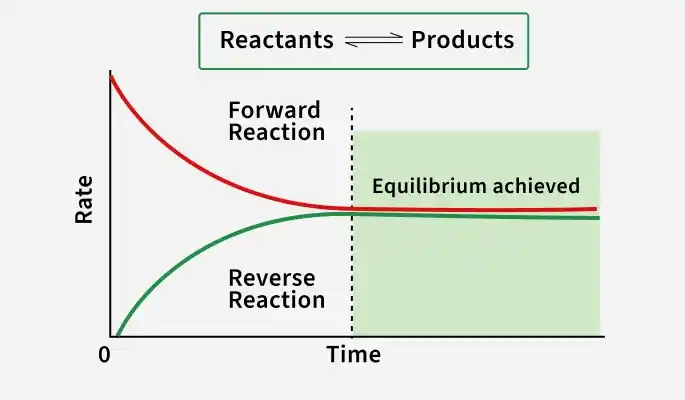
When a reversible reaction takes place in a closed system, a stage is reached where the rate of the forward reaction becomes equal to the rate of the backward reaction. At this stage, no further change in the concentration of reactants and products is observed, even though the reactions are still continuing. This state is known as equilibrium.
Equilibrium Constant
When a chemical reaction reaches dynamic equilibrium, the rate of the forward reaction equals the rate of the backward reaction, and the concentrations of reactants and products remain constant.
The equilibrium constant is a numerical value that expresses the ratio of product concentrations to reactant concentrations at equilibrium, each raised to the power of their respective stoichiometric coefficient.
General Reaction
aA + bB ⇌ cC + dD
The equilibrium constant expression is:
K_c = \frac{[C]^c [D]^d}{[A]^a [B]^b}
Where,
- [A],[B],[C],[D] is molar concentrations at equilibrium.
- a,b,c, and d are stoichiometric coefficients from the balanced equation.
If the reaction involves gases, the equilibrium constant can also be expressed in terms of partial pressures (Kp) instead of concentrations:
K_p = \frac{(P_C)^c (P_D)^d}{(P_A)^a (P_B)^b}
Where,
P represents the partial pressure of the gases.
Types of Equilibrium
Equilibrium is classified into different types based on the nature of the system:
**1. Homogeneous Equilibrium
An equilibrium in which all reactants and products are in the same phase (all gases, all liquids, or all aqueous solutions). The phase is uniform throughout the system.
**Example:
N2 (g) + 3H2 (g) ⇌ 2NH3 (g)
All species are gases.
2. Heterogeneous Equilibrium
An equilibrium in which reactants and products exist in more than one phase (solid, liquid, gas, or solution). Different phases are involved, e.g., solid with gas or liquid with gas.
**Example :
CaCO3 (s) ⇌ CaO (s) + CO2 (g)
Solid and gas are present.
Factors affecting Equilibrium
These factors influence how the system responds, but only temperature can change the equilibrium constant.
- **Concentration of Reactants or Products: Changing the concentration of reactants or products disturbs the balance between the forward and backward reactions. The system responds to minimize this disturbance.
- **Pressure: Changing the pressure by changing the volume affects equilibrium only if gases are involved. The system favors the side with fewer or more moles of gas depending on the change.
- **Temperature: Temperature changes the rate of reactions and the equilibrium constant. Whether the equilibrium shifts depends on whether the reaction is exothermic or endothermic.
- **Catalyst: A catalyst increases the rate of both forward and backward reactions equally.
Equilibrium in Physical Change
Physical equilibrium occurs when a reversible physical process reaches a state where the rate of the forward process equals the rate of the backward process, and macroscopic properties remain constant. In physical equilibrium, no new substance is formed; only state or form changes.
1. Solid–Liquid Equilibrium
Equilibrium between a solid and its liquid occurs in a reversible melting/freezing process. Rate of melting equals to Rate of freezing.
**Example:
Ice (s) ⇌H2O (l)
- When ice is melting, some water may freeze simultaneously, so the amount of ice and water remains constant at equilibrium.
- This happens only at the melting point under constant pressure.
2. Liquid–Vapor Equilibrium
Equilibrium between a liquid and its vapor occurs in a reversible evaporation/condensation process. Rate of evaporation equals to Rate of condensation.
**Example:
H2O (l) ⇌ H2O (g)
- The vapor pressure of the liquid becomes constant at equilibrium.
- Molecules continuously evaporate and condense.
- Occurs in a closed container where vapor cannot escape.
3. Solid–Vapor Equilibrium
Equilibrium between a solid and its vapor occurs in a reversible sublimation/deposition process. Rate of sublimation equals to Rate of deposition.
**Example:
I2 (s) ⇌ I2 (g)
- Solid iodine sublimes into iodine vapor, and some vapor deposits back into solid, reaching equilibrium.
Equilibrium in Chemical Change
In a reversible chemical reaction, chemical equilibrium is said to be established when the rate of the forward reaction equals the rate of the backward reaction, and the concentrations of reactants and products remain constant with time.
- Even though the reaction continues at the molecular level, macroscopic properties like concentration, pressure, or color do not change.
- This is a dynamic equilibrium, because molecules are constantly reacting, but the system appears stable.
**Examples:
Ammonia Formation (Haber Process):
N2 (g) + 3H2 (g) ⇌ 2NH3 (g)
- Forward reaction: N2 + H2 → NH3
- Backward reaction: NH3 → N2 + H2
- At equilibrium: rate of formation of NH3 = rate of decomposition of NH3
**Solved Examples
**Question 1: Find the equilibrium constant for the given reaction N 2 (gas)+ 3H 2 (gas) ⇌ 2NH 3 (gas) at 500 K temperature, when concentrations are N 2 **=2×10 -2 **M, H 2 **= 4×10 -2 M and NH 3 = 1×10 -2 M.
**Answer:
Use Equilibrium constant reaction which is,
Kc = ([P1] c[P2] d) / ([R1] a[R2] b)
Therefore,
Kc = ([NH3] 2) / ([N2][H2] 3)
= (1×10⁻²) 2 / (2×10⁻²)(4×10⁻²) 3
= 78.1
**Question 2: Find the equilibrium constant for the given reaction PCl 5 ⇌ PCl 3 **+ Cl 2 at 500 K temperature, when concentrations are PCl 5 = 1.5 M, PCl 3 **= 2 M and Cl 2 = 2 M.
**Answer:
Kc = [PCl3][Cl2] / [PCl5]
= [2][2] / [1.5]
= 2.67
**Question 3: Find the equilibrium constant for the given reaction:
**N 2 + O 2 ⇌ 2NO at 800 K temperature,
**when concentrations are NO = 1×10 -2 M, O 2 = 2×10 -2 M and N 2 = 2×10 -2 M.
**Answer:
Kc can be calculated by using formula:
Kc = [NO] 2 / [N2][O2]
= [1×10⁻²] 2 / [2×10⁻²][2×10⁻²]
= 0.25