Law of Constant Proportions (original) (raw)
Last Updated : 23 Apr, 2026
The Law of Constant Proportion, also known as the Law of Definite Proportions, states that a chemical compound always contains the same elements combined in a fixed proportion of mass, regardless of its source or the method by which it is prepared. This means that the ratio of the masses of the constituent elements in a compound is always constant.
**Example:
In water(H2O)
- water always contains hydrogen and oxygen in the mass ratio of 1:8.
- whether it is obtained from a river, rainwater, or prepared in a laboratory.
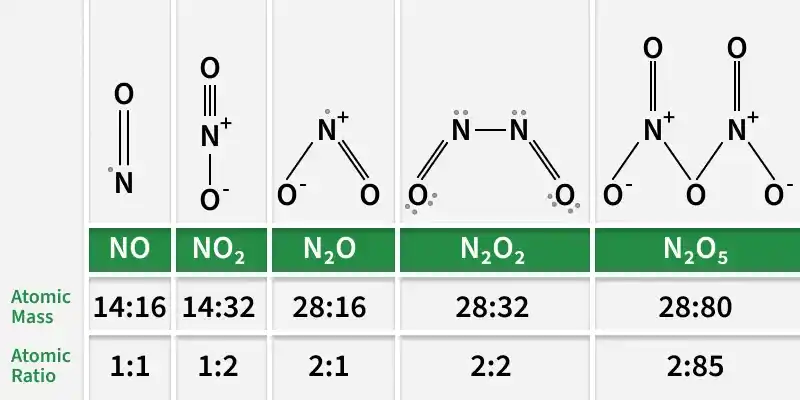
- According to the law of constant composition, chemical compounds are made up of elements combined in a fixed ratio by mass.
- The elements may differ in physical state or appearance before combining, but once the compound is formed, its composition is uniform and fixed.
- This law applies only to pure substances (compounds) and not mixtures, because in mixtures, the components can be present in any proportion.
**Examples:
**1. Water (H₂O)
Atomic mass:
- Hydrogen = 1
- Oxygen = 16
Mass of hydrogen in water = 2 × 1 = 2
Mass of oxygen in water = 16Mass Ratio = 2 : 16
Simplified ratio = 1 : 8
**2. Carbon Dioxide (CO₂)
Atomic mass:
- Carbon = 12
- Oxygen = 16
Mass of carbon = 12
Mass of oxygen = 2 × 16 = 32Mass Ratio = 12 : 32
Simplified ratio = 3 : 8
Limitations of the Law
The Law of Constant Proportions states that a chemical compound always contains the same elements in a fixed ratio based on mass. However, there are some exceptions where this ratio may vary slightly. These exceptions occur mainly due to the presence of isotopes and non-stoichiometric compounds, which can cause small changes in the mass ratio of elements in a compound.
**1. Presence of Isotopes:
- Isotopes are atoms of the same element with the same atomic number but different mass numbers.
- This is due to a difference in number of neutrons
**Example: Hydrogen has three isotopes
- Protium (¹H) – mass= 1
- Deuterium (²H) – mass = 2
- Tritium (³H) – mass =3
**2. Non-Stoichiometric Compounds:
- In these compounds, elements do not combine in exact whole-number ratios.
- Their composition may vary slightly, especially in solid compounds like metal oxides.
**Example: Iron Oxide (FexO)
- The ratio of elements is not perfectly fixed under all condition.
**3. Impure Samples:
- The Law of Constant Proportion applies only to pure compounds.
- If a substance contains impurities or is mixed, the observed mass ratio may change