Pure Substance (original) (raw)
Last Updated : 23 Apr, 2026
A pure substance is a material made up of only one kind of particle. It has a fixed composition and definite properties throughout. All parts of a pure substance are the same. It cannot be separated into other substances by physical methods.
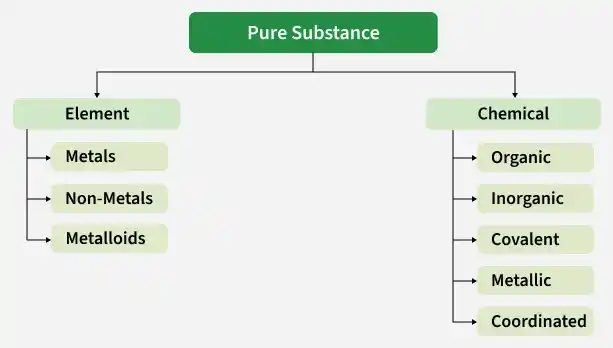
Pure substances are classified into two main types:
Characteristics of Pure Substance
Pure substances have certain characteristic features that distinguish them from mixtures. These properties help in identifying and understanding their nature.
**1. Definite composition: Pure substances have a fixed and constant chemical composition. The elements present in them are always combined in the same proportion, regardless of their source.
**2. Single type of particle: A pure substance consists of only one type of particle, such as atoms or molecules. Because of this, all parts of the substance show similar properties.
**3. Uniform properties: Pure substances show uniform physical and chemical properties throughout the sample. Properties like colour, density, and solubility remain the same in every part.
**4. Fixed melting and boiling points: Pure substances melt and boil at definite temperatures. These fixed temperatures help in identifying a substance and checking its purity.
**5. Cannot be separated by physical methods: Pure substances cannot be separated into simpler substances by physical methods such as filtration or evaporation. Compounds can only be broken down by chemical reactions.
**6. Definite chemical behaviour: Pure substances show specific and predictable chemical behaviour. They react in a particular way with other substances, which helps in studying chemical reactions.
Phases of Pure Substance
The word "phase" refers simply to the state of matter of any pure substance: solid, liquid, or gaseous. Phases depend on temperature and pressure, in most cases. There are primarily three phases of pure substance
- **Solid: The molecules of a solid are closely packed in a rigid structure. It has a definite form and volume.
- **Liquid: Once the solid hits its melting point, it starts to turn into a liquid. At this stage, the solid does already have a certain volume but takes the form of the container; this level of freedom of molecules is much more than what is found in a solid.
- **Gas: If the temperature gets higher than usual, then boiling sets in, and gas is formed. This occurs because gases have no definite shapes and volumes, so they tend to expand, filling up the volume of their container.
Types of Pure Substance
**1. Elements
An element is a pure substance made up of only one type of atom. It cannot be broken down into simpler substances by chemical methods. Elements consist of only one kind of atom. They cannot be decomposed into simpler substances by chemical reactions. Each element has a fixed atomic number and symbol. They may exist as atoms or molecules.
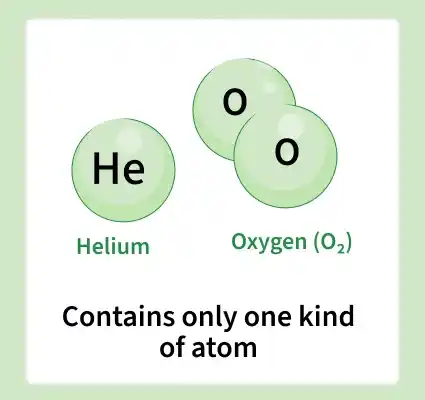
- An element is a pure substance that is composed of a single form of atom.
- Physical or chemical processes do not simplify elements, and these substances cannot be reduced to simpler ones.
- An element is the most basic matter and it possesses distinctive physical and chemical characteristics. In the current periodic table, there exist 118 known elements.
- The elements may be broadly grouped as metals, non-metals and metalloid.
**Examples: gold, oxygen, carbon, iron, and helium.
**Based on their composition, elements can be further classified into different types:
**a) Metals
- Those elements which are likely to lose their outermost electrons to produce positive ions (cations).
- They normally exhibit lustre, (they are shiny on the surface).
- Metals conduct heat and electricity well therefore they are useful in electrical wires and utensils.
- They are soft (beaten into thin sheets) and plastic (stretched into wires).
- Metals tend to be melting and boiling at very high temperature and are predominantly in the solid state at room temperature.
- The majority of metals are dense.
**Examples: Aluminium, gold, copper, and iron.
**b) Non-Metals
- Elements that do not release electrons are called non-metals and naturally, they like to acquire electrons to form negative ions.
- They tend to be unlustrous and are forgettable.
- Non-metals are ineffective conductor of heat and electricity and they are insulators.
- They tend to be easily broken when in solid states.
- Non-metals typically melt and boil at low temperatures and many of them are gases at room temperature.
**Examples: Oxygen, nitrogen, sulphur, and carbon.
**c) Metalloids
- Metalloids are those elements which exhibit the characteristics of both metals and non-metals.
- They are also referred to as semi-metals.
- Metalloids are semiconductors, which implies that they are able to conduct electricity when in specific conditions.
- When energy is provided their conductivity increases.
- Their applications are common in the electronics business.
**Examples: silicon, germanium and boron.
2) Compounds
A compound is a pure substance formed when two or more elements combine chemically in a fixed ratio by mass. Compounds contain two or more different elements chemically combined. They have a fixed composition. The properties of a compound are different from the properties of its elements. They can be broken down into simpler substances by chemical methods.
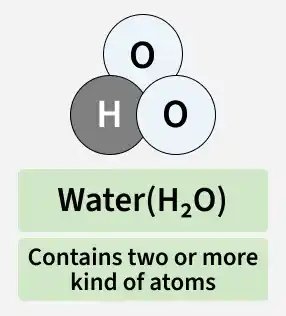
- Compounds are pure materials that consist of two or more elements other than hydrocarbons which are chemically bonded in a constant proportion.
- This is because the properties of a compound are quite distinct as compared to the properties of the element constituents.
- Chemical methods can be used to break compounds into a simple substance.
**Example: Water (H2O) is a compound which is composed of hydrogen and oxygen in the ratio of 2:1.
**Compounds can be further classified as:
**a) Organic Compounds
- Carbon and hydrogen are the major compounds found in organic compounds.
- They more commonly possess either a carbon-carbon or carbon-hydrogen backbone.
- Living organisms are known to have organic compounds.
- Urea (NH2CONH2 ) was the first organic substance to be synthesized in the laboratory.
**Examples: glucose (C6H 12O6 ) and methane (CH4 ).
**b) Inorganic Compounds
- The inorganic compounds lack carbon-carbon bonding.
- They usually do not contain hydrocarbon chains.
- These substances are largely present in inanimate material.
**Examples: carbon dioxide (CO2 ), calcium carbonate (CaCO3 ) and ammonia (NH3 ).
**c) Ionic Compounds
- The Ionic compounds occur through a transfer of electrons between atoms.
- They are made of both negative and positive ions that are bound together by strong electric attraction.
- Compounds containing ions tend to be high melting and boiling points. They mostly exist in form of solid at room temperature.
**Examples: sodium chloride (NaCl) and calcium carbonate (CaCO3).
**d) Covalent Compounds
- Covalent compounds are formed when atoms share pairs of electrons with each other to achieve a stable electronic configuration.
- They too are referred to as molecular compounds.
- These are normally low melting and boiling compounds as opposed to ionic compounds.
- These may be in form of solids, liquids or gases at room temperature.
**Examples: water (H2O ), carbon dioxide (CO2 ), and methane (CH4 ).
**e) Metallic Compounds
- The metallic compounds are made of metal atoms in a metallic pattern.
- The electrons in these compounds are free to move and this makes the metals highly electrically and thermally conductive.
- Metallic compounds are represented by alloys.
**Examples: steel (iron and carbon), and bronze (copper and tin).
**f) Coordinated Compounds
- Ligands envelop a central metal ion resulting in a coordination complex.
- The metal ion receives the electron pairs of ligands.
- These compounds are normally coloured.
- They have significant functions in the biological system and catalysis.
**Examples: haemoglobin (iron complex) and chlorophyll (magnesium complex).
Applications of Pure Substance
Pure substances are widely used in different fields because of their fixed composition and reliable properties. Some important applications are given below:
**1. Scientific Research: In laboratories, pure substances are used to study physical and chemical properties such as melting point, boiling point, density, and reactivity. Their fixed composition ensures accurate and reliable results.
**2. Chemical Reactions: Pure substances act as reactants in chemical reactions. Their predictable behaviour helps in obtaining correct and consistent outcomes.
**3. Medicines and Pharmaceuticals: They are essential in preparing medicines and drugs to ensure accurate dosage, safety, and effectiveness.
**4. Industrial Processes: Industries use pure substances to manufacture chemicals, fertilizers, plastics, dyes, and other materials with consistent quality.
**5. Testing and Quality Control: Pure substances serve as reference standards to check the purity of other materials by comparing properties like melting and boiling points.
**6. Food and Beverages: Pure substances such as sugar and salt are used in food preparation to maintain uniform taste and quality.
**7. Electronics and Technology: Pure elements like silicon are used in semiconductors and electronic devices because of their specific and controlled properties.
Elements vs Compounds
| Elements | Compounds |
|---|---|
| An element is a pure substance made of only one type of atom. | A compound is a pure substance made of two or more different elements chemically combined in a fixed ratio. |
| Contains only one kind of atom. | Contains different kinds of atoms. |
| Elements are the simplest form of matter. | Compounds are not the simplest form, as they are made from elements. |
| Cannot be broken down into simpler substances by chemical methods. | Can be broken down into simpler substances by chemical methods. |
| Show properties of the element itself. | Have properties different from their constituent elements. |
| Represented by symbols (e.g., H, O, Fe). | Represented by chemical formulae (e.g., H₂O, NaCl). |
| Classified into metals, non-metals, and metalloids. | Classified into ionic, covalent, organic, inorganic, etc. |
| May vary widely from element to element. | Have definite melting and boiling points. |
| **Example: Gold, oxygen, iron, carbon. | **Example: Water, common salt, carbon dioxide. |