Laws of Chemical Combination (original) (raw)
Last Updated : 23 Apr, 2026
The laws of chemical combination are basic principles in chemistry that explain how substances react to form new substances. Around us, different materials combine with one another, and these changes follow certain rules. During a chemical reaction, the form and properties of matter may change, but the process happens in a fixed and orderly way. These laws help us understand how substances join together to make new compounds.
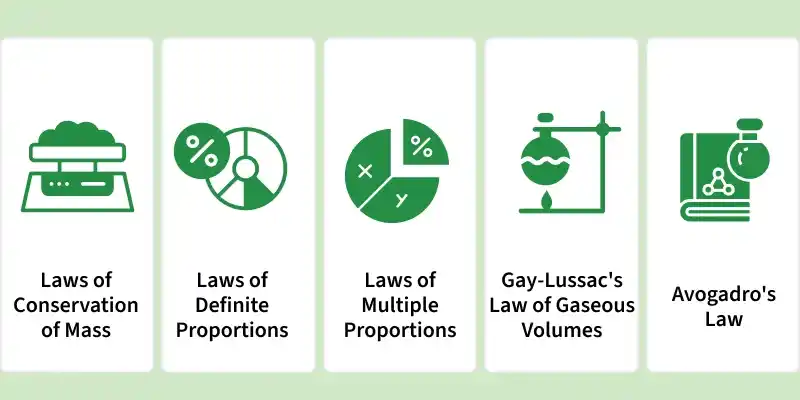
The types of laws of chemical combination include the Law of Conservation of Mass, Law of Definite Proportions, Law of Multiple Proportions, and Gay-Lussac’s Law of Gaseous Volumes.
**1. Law of Conservation of Mass
- Law of Conservation of Mass states that "Mass can neither be created nor can be destroyed in a chemical reaction" but it can be transformed from one form to another.
- In other words, in an enclosed system whenever matter undergoes a chemical or physical change, the total mass of reacting matter (reactants or matter before the change) is exactly equal to the total mass of reaction products.
- As no products or reactants are allowed to exit the system in a closed system, there is no loss of the substance, and hence the mass is conserved.
- For example, in automobiles, fuel is burned to create energy for vehicles to move forward and the fuel is converted into fumes such as carbon dioxide, carbon monoxide, or sulfur dioxide, etc.
**Example: The formation of a water molecule from oxygen and hydrogen molecules.
**2H 2 + O 2 **→ 2H 2 O

In the above example, 2 molecules of Hydrogen combine with 1 molecule of Oxygen to form 2 molecules of water.
- Mass of H is 1 unit and O is 16 units.
- Mass of 2 molecules of Hydrogen (2H2) is 4 units.
- Mass of 1 molecule of Oxygen (O2) is 32 units.
- Mass of 2 molecules of water (2H2O) is 36 units.
**2H 2 + O 2 **→ 2H 2 O
**4 unit 32 unit 36 unit
The total mass of the reactants equals the total mass of the products in this case. Furthermore, the number of hydrogen and oxygen atoms in the reactant and product sides are also equal.
**2. Law of Definite Proportions
Law of Definite Proportions which is also known as the Law of Constant Composition, states that in any given chemical compound the composition of the element by mass is always remains the same.
In other words, this means that the ratio of the mass of the elements in the chemical compounds always remains the same i.e., in a water molecule there will always be two hydrogens and one oxygen molecule.
**Example:
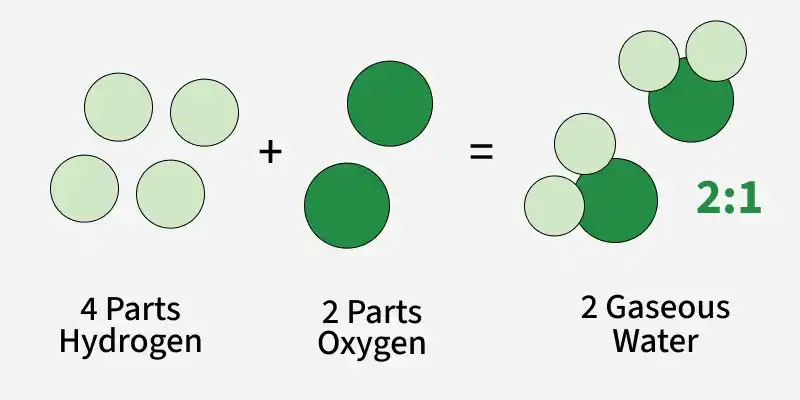
- In the diagram, Hydrogen and Oxygen combine to form Water (H₂O).
- 4 parts of Hydrogen react with 2 parts of Oxygen.
- This reaction produces 2 molecules of water (H₂O).
- Each water molecule contains: (a) 2 Hydrogen atoms (b) 1 Oxygen atom
- Therefore, the ratio of Hydrogen : Oxygen = 2 : 1.
**3. Law of Multiple Proportions
- According to the Law of Multiple Proportions, If two elements combined to form more than one compound under different circumstances, then the ratio of the masses for one element when second mass is fixed for all different compounds is always a small whole number.
- This law doesn't hold for non-stoichiometric compounds as well as heavy molecules such as polymers and oligomers.
**Example: Carbon and oxygen combine to form two distinct compounds (under different circumstances). The first is the most common gas, CO2 (Carbon dioxide), and the second is CO (Carbon monoxide).

4. **Gay Lussac’s Law of Gaseous Volumes
- This law states that "when gases are produced or combined in a chemical reaction, they do so in a simple volume ratio provided that all the gases are at the same temperature and pressure."
- This law is regarded as an of definite proportions for gases and the difference between these two chemical combination laws is that Gay Lussac's Law is stated the ratio of volume, whereas the law of definite proportions is stated in terms of mass.
**Example:

In the above example 2 volumes of H2 combines 1 volume of O2 to form 2 volumes of H2O.
**2H 2 ****(g) + O** 2 ****(g)→ 2H** 2 O (g)
**5. Avogadro’s Law
- According to Avogadro’s Law, an ‘equal volume of all gases contains the equal number of molecules under the same conditions of temperature and pressure.'
- In other words, this law states that the volume and number of moles of any gas are always directly proportional to each other.
- This means that two liters of hydrogen have the same number of molecules as two liters of oxygen at the same temperature and pressure.
**Example:

Equivalent volumes of different gases contain the same number of molecules at the same temperature and pressure. In the above example CL2 and H₂ has 1 volume each combines to form 2 volume of HCL.
Here,
Mole is a unit of measurement for substance. 1 mole substance contains 6.02214076×10²³ particles.