Oxidation Number | Definition, How To Find, Examples (original) (raw)
Last Updated : 16 May, 2026
Oxidation number is an important concept in chemistry that helps us understand how electrons are transferred during chemical reactions. It is defined as the apparent charge assigned to an atom in a molecule or ion, assuming that all bonds are completely ionic. The concept of oxidation number is very useful in identifying oxidation and reduction (redox) reactions, where oxidation involves the loss of electrons and reduction involves the gain of electrons.
Oxidation is a chemical process in which a substance loses electrons during a reaction. As a result, the oxidation number of that substance increases. It can also be defined as,
- Addition of oxygen, or
- Removal of hydrogen
**Example:
Fe 2+ → Fe 3+ + e -
- Iron loses one electron
- Oxidation number increases from +2 to +3
- So, it is oxidation
Rules to determine oxidation number
To find the oxidation number of elements in compounds or ions, we follow some standard rules:
**1. Free (Uncombine) Elements
- Any element in its natural or free state has oxidation number zero.
- Because there is no transfer of electrons.
**Examples:
- H2 , O2 , N2
- Na, Fe, Cu
2. Monatomic Ions
- For ions made of a single atom, oxidation number equals its charge.
- This is because the atom has either lost or gained electrons.
**Examples:
- Na +→ +1 (lost 1 electron)
- Mg 2+ → +2 (lost 2 electrons)
- Cl -→ –1 (gained 1 electron)
3. Alkali and Alkaline Earth Metals
- Group 1 elements (Na, K, Li), always have oxidation number +1.
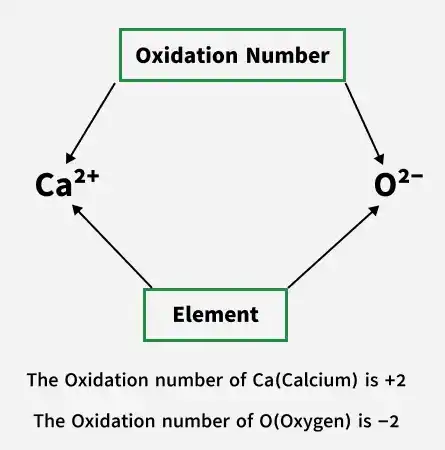
- Group 2 elements (Mg, Ca), always have oxidation number +2.
- They easily lose electrons to form stable ions.
**Examples:
- NaCl → Na = +1
- CaO → Ca = +2
4. Oxidation Number of Hydrogen
- Hydrogen usually has +1 because it loses one electron.
- But with metals, it gains electron and becomes –1.
**Examples:
- H2O → H = +1
- NH3 → H = +1
- NaH → H = –1
5. Oxidation Number of Oxygen
- Oxygen usually has –2 oxidation number.
- Because it tends to gain two electrons.
**Exceptions:
- Peroxides (like H₂O₂) → O = –1
- In OF₂, oxygen shows +2 oxidation number because fluorine is more electronegative.
6. Oxidation Number of Halogens (F, Cl, Br, I)
- Usually –1 because they gain one electron.
- **Exception: when bonded with oxygen or more electronegative atoms.
**Examples:
- NaCl → Cl = –1
- In Cl2O, the oxidation number of chlorine is +1
7. Sum of Oxidation Numbers Rule
- In a neutral compound, total oxidation number = 0
- In a charged ion, total oxidation number = charge on ion.
**Examples:
- H2O
- H = +1, O = –2
- Total = 0
- NH4+
- H = +1 each
- Total charge = +1
- SO42-
- O = –2
- Total charge = –2
Steps to find Oxidation Number
The oxidation number of an element is calculated by following a step-by-step method:
Step 1: Write the chemical formula clearly
- First, write the formula of the compound or ion.
- Identify all the elements present.
**Example: H2SO4 , KMnO4 , NH4+
Step 2: Write known oxidation numbers
The next step is to write the oxidation number.
- Hydrogen (H) = +1
- Oxygen (O) = –2
- Group 1 metals (Na, K) = +1
- Group 2 metals (Ca, Mg) = +2
Step 3: Assume unknown oxidation number
- Let the oxidation number of the element you need to find be x.
**Example:
In H2SO4 , let S = x
Step 4: Multiply by number of atoms
- Multiply oxidation number with number of atoms present.
**Example:
H2 → 2 × (+1)
O4 → 4 × (–2)
Step 5: Apply sum rule
- For neutral compound , total oxidation number = 0
- For ion , total oxidation number = charge
Step 6: Form equation
- Add all values and make an equation.
Step 7: Solve the equation
- Solve for x to get oxidation number.
Solved Examples
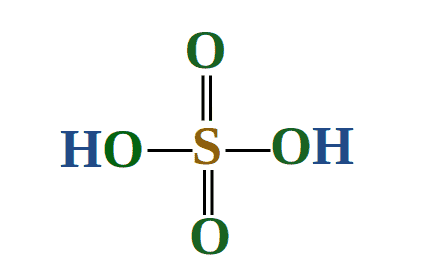
**Example 1: Oxidation Number of Sulphur (H 2 SO 4 )
**Solution:
Step 1: Assume the oxidation number of sulphur to be x
Step 2: The oxidation number for Hydrogen is +1 and O is -2.
Step 3: Since the overall charge on the molecule is 0, therefore 2(+1) + x + 4(-2) = 0
Step 4: 2 + x- 8 = 0 ⇒ x - 6 = 0 ⇒ x= +6
Hence, the oxidation number of Sulphur in H2SO4 is +6
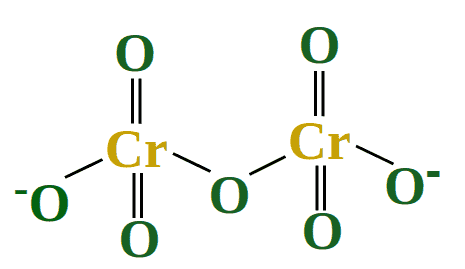
**Example 2: Oxidation Number of Chromium in Cr 2 O 7 2-
**Solution:
Step 1: Assume the oxidation number for Chromium be X
Step 2: The oxidation number for oxygen is -2
Step 3: Since the ion has an overall charge of -2 the equation can be written as 2X + 7(-2)=-2
Step 4: 2X - 14 = -2 ⇒ 2X = +12 ⇒ X = +6
Hence the oxidation number of chromium in Cr2O72- is +6.