Purification of Organic Compounds (original) (raw)
Last Updated : 11 May, 2026
Organic compounds obtained from natural or laboratory sources are usually impure and contain unwanted substances such as other compounds or dust. Purification is the process of removing these impurities to obtain a pure substance. Pure compounds have definite physical properties like sharp melting and constant boiling points. Therefore, purification is important for the correct identification, study, and practical use of organic compounds.
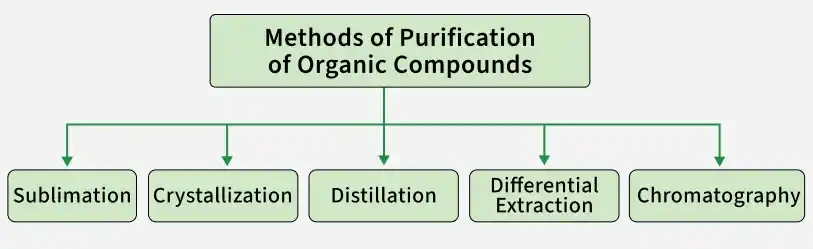
**Methods of Purification of Organic Compounds
Various methods used for the purification of complex organic compounds are:
**1. Sublimation
Sublimation is the process in which a solid substance changes directly into a vapour (gas) without passing through the liquid state when heated. This process usually occurs in substances that have weak intermolecular forces, allowing their particles to escape directly from the solid state into the gaseous state.

- The impure solid is taken in a china dish and covered with an inverted funnel whose stem is plugged with cotton.
- The substance is then heated gently so that it sublimes.
- The vapours formed rise upward and get cooled on the inner walls of the funnel.
- The pure substance deposits there as solid, while the non-volatile impurities remain in the dish.
**2. Crystallization
Crystallization is a method used to purify solid organic compounds. It is based on the principle that different substances have different solubilities in a solvent at different temperatures.

- The impure solid is dissolved in a suitable hot solvent to form a saturated solution.
- The hot solution is filtered to remove insoluble impurities.
- The filtrate is then allowed to cool slowly so that pure crystals separate out.
- The crystals are collected by filtration and dried, while impurities remain dissolved in the solution.
**3. Distillation
Distillation is the process of selectively boiling a component in a liquid mixture and then condensing it. It is a method of separation that can be applied to either get more of one particular component out of a mixture or to separate it out almost completely. It is further classified into three types:
**a) Fractional Distillation
Fractional distillation is a type of distillation that involves the separation of miscible liquids. The process involves repeated distillations and condensations and the mixture is usually separated into component parts.

- The liquid mixture is taken in a flask fitted with a fractionating column and condenser, and then heated slowly.
- As vapours rise through the column, repeated condensation and vaporisation occur.
- The component with higher boiling point condenses and returns to the flask, while the lower boiling component reaches the condenser.
- It is then cooled, condensed, and collected as pure liquid.
**b) Vacuum Distillation
Vacuum distillation is a method used to purify liquids that have very high boiling points or decompose at high temperatures. In this process, the pressure above the liquid is reduced using a vacuum pump, which lowers the boiling point of the liquid.

- The liquid is taken in a distillation flask connected to a vacuum pump to reduce the pressure inside the apparatus.
- The substance is heated gently so that it boils at a temperature lower than its normal boiling point.
- The vapours formed pass into the condenser, where they are cooled and converted into liquid.
- The purified liquid is then collected.
**c) Steam Distillation
Steam Distillation is a separation process for temperature-sensitive substances. It is an exclusive kind of distillation. It is used to separate immiscible liquid bases based on how volatile they are.

- Steam is passed through the mixture containing the organic compound so that the compound vaporises along with steam.
- The vapours formed are carried into a condenser where they are cooled and condensed.
- A mixture of water and the organic compound is obtained, which is then separated to collect the pure compound.
Differential extraction is the method of extracting an organic component from its aqueous solution by shaking it with an organic solvent in which it is soluble.
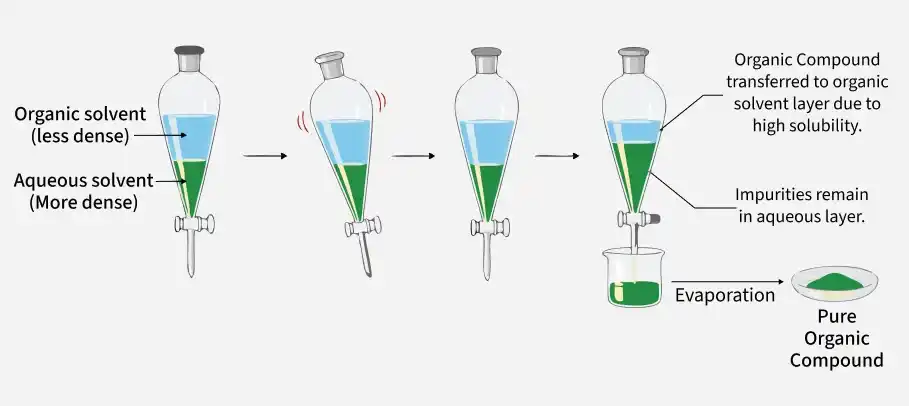
- The mixture containing the desired organic compound is taken in a separating funnel along with a suitable solvent in which the compound is more soluble.
- The funnel is shaken well and then allowed to stand so that two separate layers are formed.
- The organic compound gets transferred into the solvent layer due to higher solubility.
- The two layers are then separated using the stopcock, and the solvent is evaporated to obtain the pure compound.
**5. Chromatography
Chromatography is a technique in which components of a mixture are separated based on their different distribution between a stationary phase and a mobile phase. The different colour ink particles travel at different speeds through the filter paper allowing us to see the constituent colours of the pen ink. Chromatography is of two types:
**a) Adsorption Chromatography
Adsorption chromatography is a type of chromatography in which the components of a mixture are separated through adsorption. It is one of the oldest chromatography techniques still in use. It employs a mobile phase, which can be either liquid or gaseous, during the process. It is the components of the mixtur**e that get adsorbed differently on the stationary phase, not the mobile phase.
**Adsorption Chromatography is further classified into:
**Thin Layer Chromatography
Thin-layer chromatography (TLC) separates a mixture of chemicals into their constituents using a glass plate coated with a very thin layer of adsorbent, such as silica gel and alumina.

- In this technique, the glass plate is used.
- The solution of the to-be-separated mixture is applied as a small spot 2 cm above one end of the plate and the plate is placed in a closed jar containing an eluant, which rises up the plate carrying various components of the mixture to various heights.
**Column Chromatography
Column chromatography is a technique for separating the components of a mixture using a column of appropriate adsorbent packed in a glass tube. The combination is placed on top of the column, and an adequate eluant is allowed to slowly trickle down the column.

- A glass column is packed with a suitable adsorbent like silica gel or alumina, which acts as the stationary phase, and the mixture to be separated is placed on top of this column.
- A solvent (mobile phase) is then allowed to flow through the column.
- As the solvent moves down, different components of the mixture travel at different speeds depending on their adsorption affinity to the stationary phase.
- Substances that are more strongly adsorbed move slowly, while those less adsorbed move faster and come out first.
- The separated components are collected in different fractions as they elute from the column.
**b) Partition Chromatography
Partition chromatography refers to the chromatography technique that is based on the partitioning of components of a mixture between stationary and mobile phases. It is classified into several types, including paper chromatography, gas-liquid chromatography, liquid-liquid chromatography, and so on.
- The stationary phase is a liquid coated on a solid support, while the mobile phase can be either a liquid or a gas.
- Different components distribute themselves between the two phases according to their solubility, leading to separation.
- Substances that are more soluble in the mobile phase move faster, whereas those more soluble in the stationary phase move slower.