Separation of Mixtures (original) (raw)
Last Updated : 23 Apr, 2026
Separation of mixtures is the process of separating the different components of a mixture using physical methods. The method used depends on the type of mixture and the differences in the physical properties of its components. It is done to remove unwanted substances or to obtain useful components.
The following methods are commonly used for the separation of mixtures:
**1. Sublimation
A mixture with one sublimable volatile component and one non-sublimable component, commonly referred to as an impurity, can be separated using the sublimation process.
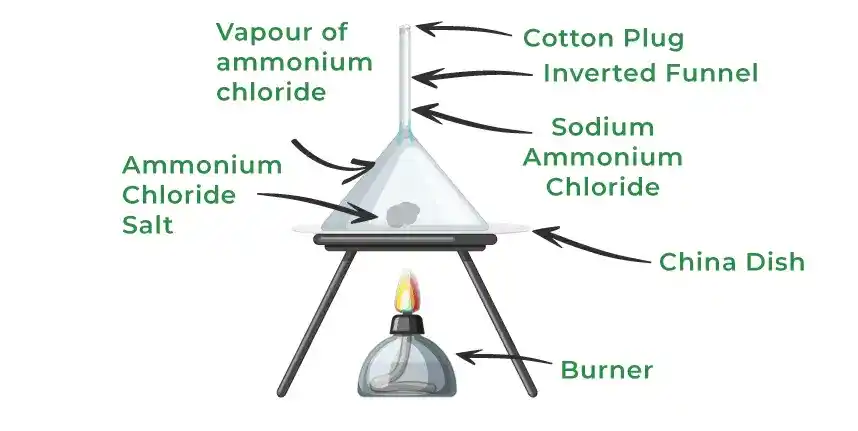
- Take the salt and ammonium chloride combination and put it in a china dish to separate it.
- Next, set an upside-down funnel on the china dish with a cotton stopper at the end to stop volatile substances' vapors from escaping.
- This combination should be heated for a while.
- The sublime ammonium chloride vapourises, cools, and then condenses back to solid form on the funnel's inner walls.
**Examples:
- Camphor slowly disappears when kept open because it changes directly from solid to vapour.
- Naphthalene balls used in cupboards, they gradually disappear due to sublimation.
**2. Evaporation
Evaporation is a technique for separating a mixture, most commonly a solution of a solvent and a soluble solid. The solution is heated until the solvent evaporates, turning into a gas and mostly leaving behind the solid residue in this method.
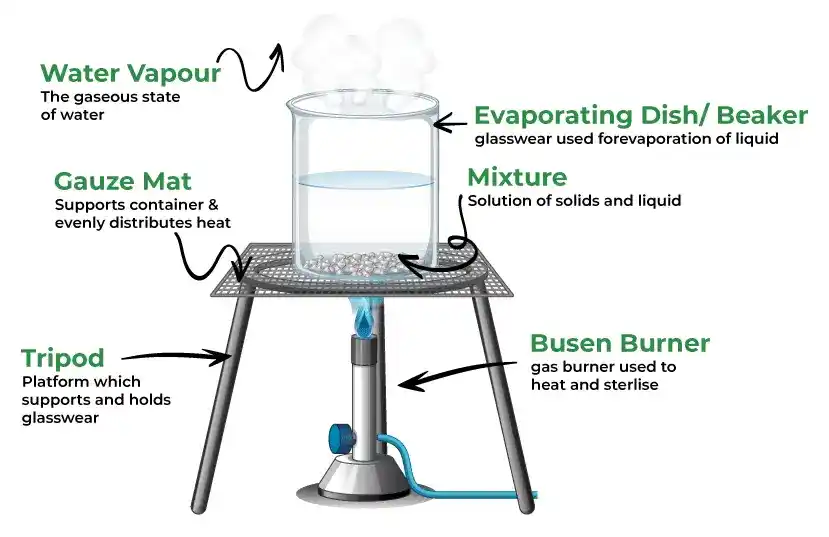
- Evaporation is a method of separating homogeneous mixtures containing one or more dissolved salts. The method separates the liquid from the solid components.
- Typically, the process entails heating the mixture until no liquid remains.
- Unless it is not necessary to isolate the liquid components, the mixture should only contain one liquid component before using this method.
- All liquid components will evaporate during the heating process, making it impossible to recover them separately.
- Evaporation is an effective method for separating a soluble solid from a liquid.
**Example: Obtaining salt from seawater.
**3. Handpicking
Handpicking is used to separate mixtures where one of the components is in small quantities. Handpicking is a technique used to separate undesirable substances such as small pieces of stone from wheat, rice, and pulses.
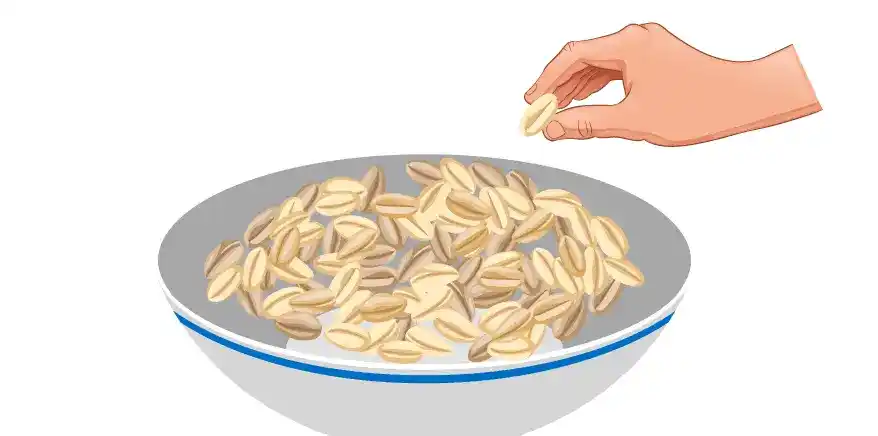
- Food grains with small pieces of stone are transported in a flat container.
- Hands pick up the stones from the grains one by one and throw them away.
- Only food grains remain after all the stone fragments have been removed.
**Example: Removing stones from rice.
**4. Threshing
When a food grain crop, such as wheat or paddy, reaches maturity, it is harvested from the field. The harvested crop is then sun-dried. We receive bundles of dried crop plant stems or stalks with grains attached at the top. A thin layer of chaff covers the grains attached to the stems or stalks. Each stalk is densely packed with chaff-covered grains. Grains are separated from stems and stalks, as well as chaff.
The process of threshing separates the grains from the stems or stalks. Threshing is beating wheat or paddy stems to separate grains from the stems and the chaff that covers the grains.
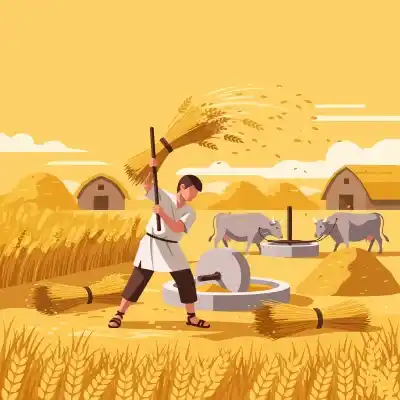
- Stalks and chaff are soft, while grains are hard.
- On beating or crushing, stalks break but grains remain unaffected.
- Grains get separated from the stems.
- Threshing can be done by beating the crop against a hard surface.
- It can also be done using cattle.
- Machines called threshers are used for threshing.
**Example: Separating paddy grains from the harvested paddy plants.
**5. Winnowing
When a farmer threshes wheat in his field, he gets a mixture of wheat grains and husk. Husk must be removed from wheat grains before they can be used. The husk is separated from the wheat grains by winnowing.
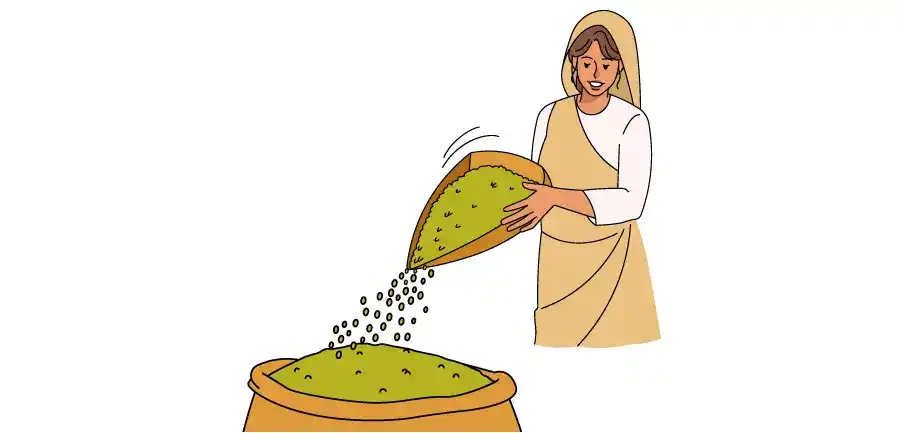
- Winnowing is the process of separating husk from grains using wind.
- It is based on the difference in weight (heavy and light particles).
- Heavier grains fall down near the source.
- Lighter husk is carried away by the wind.
- It is commonly used for grains like wheat and rice.
- It cannot separate heavy impurities like stones.
**Example: Separating husk from grains.
**6. Sieving
A sieve is a shallow container with small holes at the bottom. In some cases, an iron mesh can also be used as a sieve. Sieving is the process of parting a mixture using a sieve. Sieving is used to separate solid mixtures that contain components of varying sizes. The mixture, which contains components of varying sizes, is placed in a sieve, and the sieve is continuously moved back and forth. The larger particles of the mixture cannot pass through the sieve's small holes and thus remain trapped in the sieve.
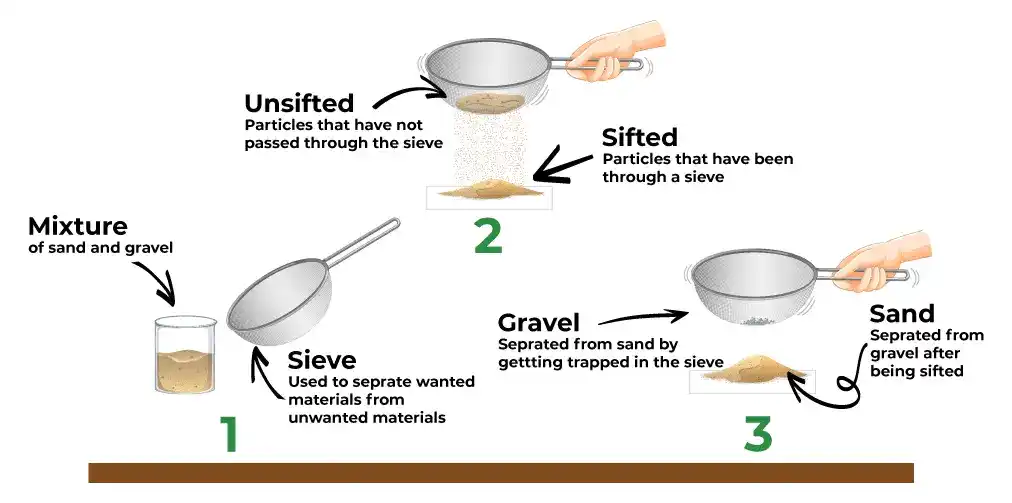
- Wheat brought from the fields still contains impurities such as stones, stalks, and husks. Impurities are removed from wheat before grinding in a flour mill via a sieving process. A bag of wheat is poured through an iron mesh slanting sieve. The wheat grains pass through the Sieve, leaving behind pieces of stone, talk, and husk.
- Sieving is used to obtain fine sand. Coarse sand with larger particles and pebbles is placed on a sieve made of a large iron held in a slanting position. Fine sand particles pass through the iron mesh but larger particles are left behind.
- Sieving is also used to separate similar objects of varying sizes. Cashew nuts of various sizes are separated in cashew nut factories through the sieving process.
**Example: Separating sand from gravel.
**7. Distillation
Distillation is used to separate liquids based on differences in their boiling points. Distillation is a purification method that involves vaporizing the constituents of a liquid mixture, then condensing and isolating them. A mixture is heated in simple distillation, and the most volatile component vaporizes at the lowest temperature. The vapor condenses back into liquid after passing through a cooled tube (a condenser). The collected condensate is known as distillate.
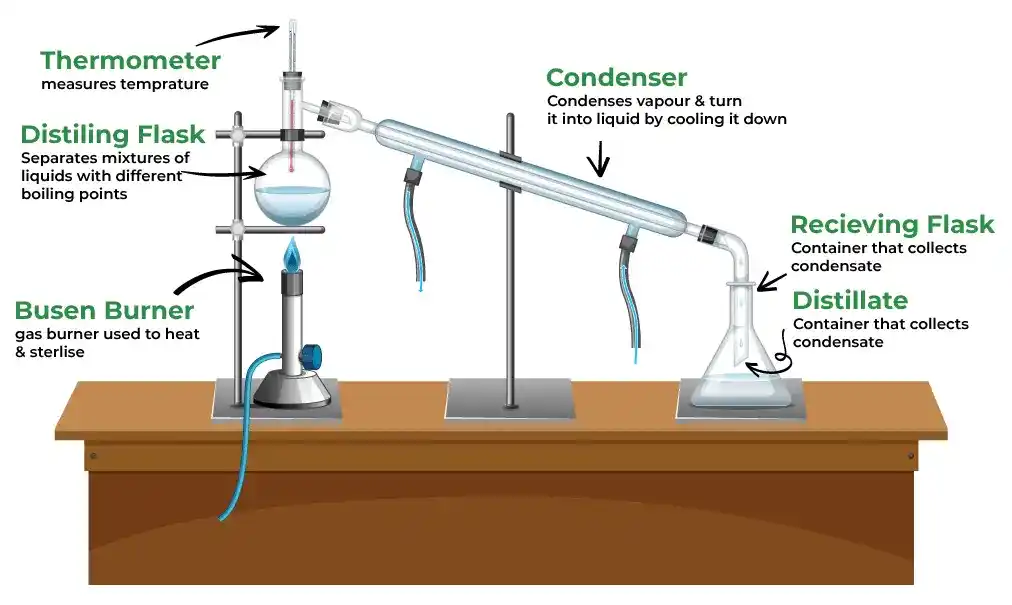
- Several important pieces of equipment are depicted in the figure above.
- A heat source, a test tube with a one-hole stopper attached to a glass elbow, and rubber tubing are all present.
- The rubber tubing is inserted into a collection tube filled with cold water.
- Other more complicated distillation assemblies can also be used, particularly to separate mixtures of pure liquids with similar boiling points.
**Example: Separating pure water from salt water.
**8. Filtration and Sedimentation
The most common method of separating a liquid from an insoluble solid is filtration. Consider the case of a sand-water mixture. In this case, filtration removes solid particles from the liquid. Various filtering agents, such as filtering paper or other materials, are commonly used.
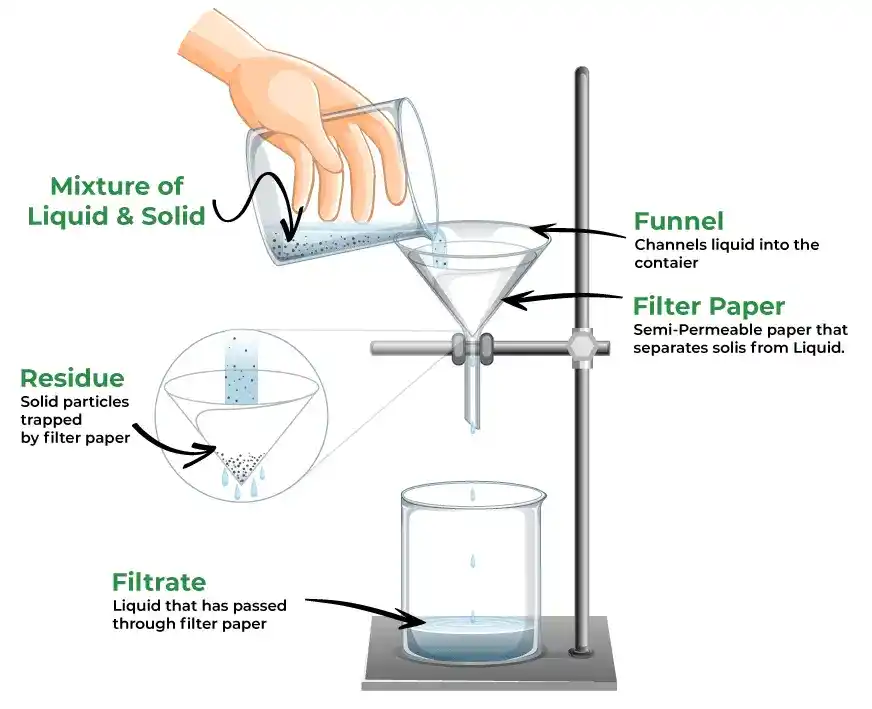
- A mixture of liquid and solid (like muddy water) is taken in a container.
- The mixture is poured into a funnel fitted with filter paper.
- The filter paper acts as a barrier that allows liquid to pass but not solid particles.
- Solid particles get trapped on the filter paper this is called residue.
- The clear liquid passes through the filter paper and collects in the beaker this is called filtrate.
- This process is called filtration, used to separate insoluble solids from liquids.
**Example: Separating tea leaves from tea.
Sedimentationis the process by which heavier impurities in a liquid, typically water, settle into the bottom of the container containing the mixture. It takes some time to complete the process.
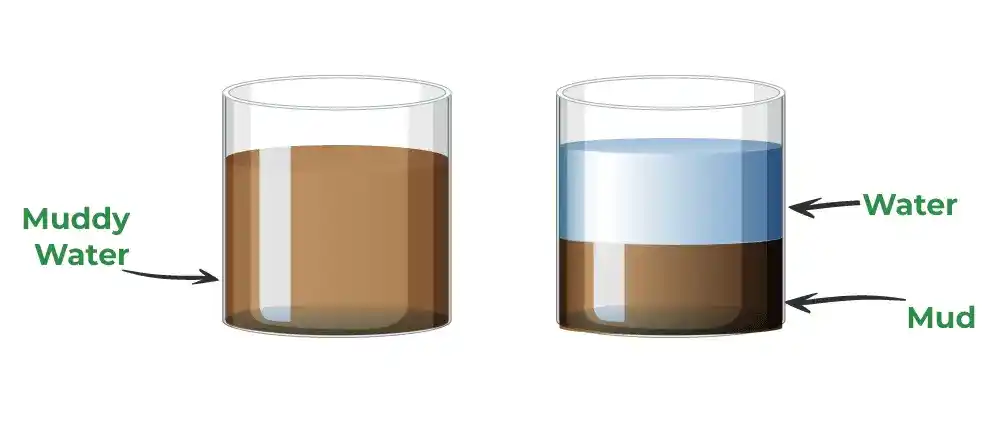
- The mixture (muddy water) is uniformly mixed.
- When left undisturbed, heavier mud particles settle down at the bottom, this is called sedimentation.
- The upper layer becomes clear water.
- The clear water is then carefully poured off without disturbing the mud, this is called decantation.
- This method separates solids from liquids based on difference in density.
**Example: Separating sand from water.
**9. Separating Funnel
This method is used with immiscible liquids (those that do not mix together). The mechanism works by exploiting the unequal density of the particles in the mixture. Using this technique, oil and water can be easily separated. In the process, a separating funnel is used.
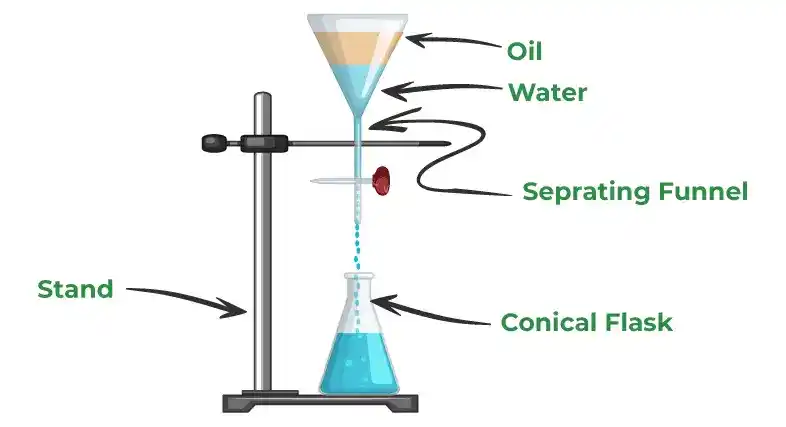
- Once the liquids are in the funnel, you must wait for them to form two layers.
- The denser liquid sinks to the bottom, while the other liquid rises to the surface.
- At the bottom, a conical flask is placed to collect the denser liquid.
- The valve allows you to control when and how much liquid is allowed to pass through to the conical flask.
**Example: Separating kerosene and water
**10. Magnetic Separation
Magnetization is a method of attracting magnetic materials. Magnetic separation is the process of separating mixtures of two solids, one of which has magnetic properties.
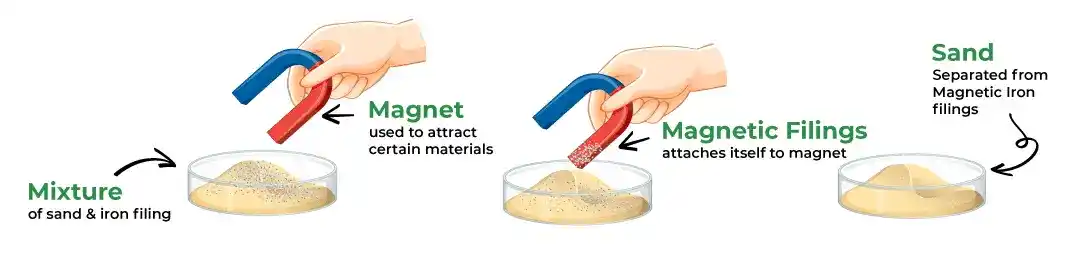
It is based on the distinction between magnetic and non-magnetic materials. Iron particles in the mixture of iron and Sulphur are attracted to the magnet and separate from the non-magnetic substance.
**Example: Separating iron filings from sand.