Some Important Compounds of Sodium (original) (raw)
Last Updated : 28 Apr, 2026
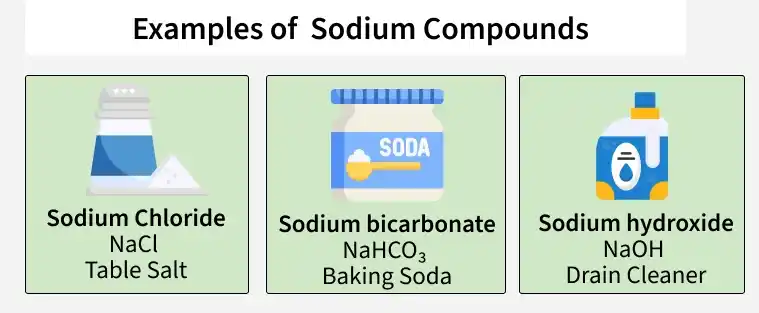
Sodium is a soft, highly reactive alkali metal, making up about 2.8% of the Earth’s crust and commonly found as sodium chloride (NaCl) in seawater.
**Key Points:
- Soft, highly reactive metal
- Symbol: Na, atomic number: 11
- Alkali metal (s-block)
- About 2.8% of Earth’s crust
- Found as sodium chloride (NaCl) in seawater
**Properties of Sodium
- Its appearance is silvery white.
- Sodium has a low melting point of 97.8°C.
- It is an extremely reactive element, and that's why it is never found in a free state.
- Sodium is able to conduct heat and electricity.
- Sodium is a very light element, even lighter than water.
- At room temperature, sodium can be easily cut with a knife.
- Due to its reactive nature, it is stored under anhydrous mineral oil.
- At low temperatures, sodium is brittle in nature.
**Uses
- Sodium is used by every human being in the form of sodium chloride, also known as common salt.
- It is used to make sodium vapor lamps.
- It is also used in the synthesis of polymers like nylon.
- One of the most common uses of sodium is in making gasoline additives.
- Sodium is also used in the formation of sodium cyanide.
- Many dyes and perfumes are also made using some amount of sodium.
- Sodium is also used for the purpose of purifying hydrocarbons.
**Important Compounds
1. Sodium Carbonate (Na₂CO₃.10H₂O)
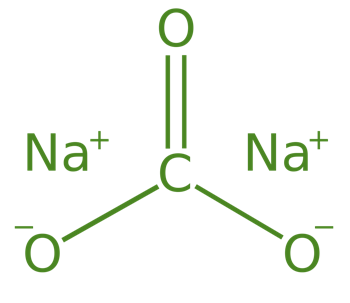
Sodium Carbonate is also known as Washing Soda, its formula is Na₂CO₃.10H₂O, and its chemical name is sodium carbonate decahydrate. Sodium Carbonate is mainly prepared by the Solvay process.
The Solvay process is a 4-step process.
**Step 1: It starts with the reaction of ammonia, water, and carbon dioxide, which results in the formation of ammonium carbonate.
2NH3 + H2O + CO2 → (NH4)2CO3
**Step 2: Now ammonium carbonate is again made to react with water and carbon dioxide to form ammonium hydrogen carbonate.
(NH4)2CO3 + H2O + CO2 → 2NH4HCO3
**Step 3: Now ammonium hydrogen carbonate is mixed with sodium chloride to get ammonium chloride and sodium hydrogen carbonate.
NH4HCO3 + NaCl → NH4Cl + NaHCO3
**Step 4: The Last step is to heat sodium hydrogen carbonate crystals to get sodium carbonate.
2NaHCO3 → Na2CO3 + CO2 + H2O
**Properties of Sodium Carbonate:
- It occurs in the form of a white crystalline solid.
- It is called decahydrate because it has 10H₂O attached to it, which can be removed by heating it.
- Sodium carbonate can be easily dissolved in water.
- If sodium carbonate is heated above 100°C, then it will change to a white-colored powder known as soda ash.
- It is alkaline in nature.
**Uses of Sodium Carbonate:
- Sodium carbonate is used for the softening of hard water.
- It is used in the soap and paint industries for the manufacturing of soaps, detergents, and paints.
- Used in the glass and textiles industries as well.
- It is also used in the manufacturing process of glass.
- The Paper industry also uses sodium carbonate in the papermaking process.
**2. Sodium Chloride
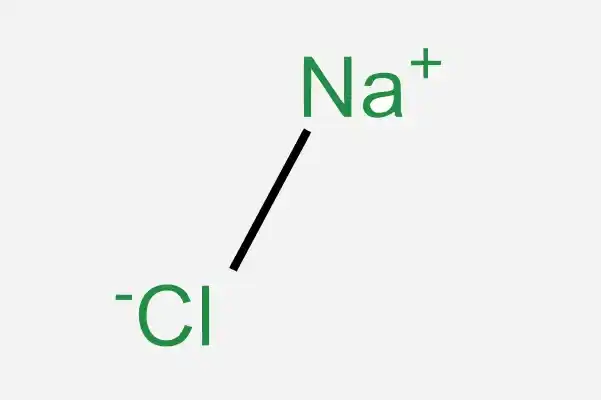
Sodium chloride, commonly known as common salt, has the chemical formula NaCl. It is mainly found in seawater and can be obtained by the process of evaporation. Commercially, it is produced through solar evaporation, and India produces around fifty lakh tonnes of sodium chloride every year for various purposes.
The salt obtained from seawater is not pure and is further refined. Sodium chloride also occurs naturally as rock salt beneath the Earth’s surface, formed over millions of years.
**Properties
- Sodium chloride forms colorless crystals.
- It is easily soluble in water.
- It has a high melting point of about 801°C.
- Its aqueous solution conducts electricity.
- It has a cubic close-packed structure.
- It is odorless and has a salty taste.
- It is insoluble in oil.
**Uses
- Used as a food ingredient and flavoring agent.
- Acts as a preservative, especially for meat.
- Used in the manufacture of chemicals like caustic soda and washing soda.
- Its solution helps in transmitting nerve signals in the human body.
- Used in saline solutions, such as eye drops and medical treatments.
- Helps maintain blood pressure when given as a saline solution.
- Used for cleaning and removing grease stains.
**3. Sodium Hydroxide
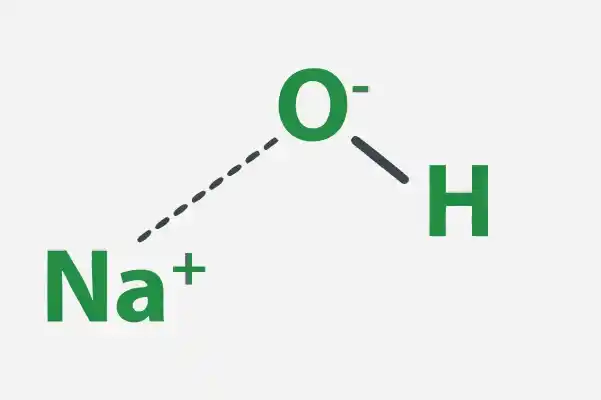
Sodium hydroxide, also known as caustic soda, has the chemical formula NaOH. It is prepared by the electrolysis of sodium chloride solution (brine) using the modern Chlor-alkali process (membrane cell).
In this process, an inert electrode (usually titanium) acts as the anode and steel acts as the cathode. A selective membrane separates the two compartments and prevents mixing of products.
During electrolysis, hydrogen gas is released at the cathode, chlorine gas is released at the anode, and sodium hydroxide remains in the solution.
**At Cathode: 2H_2O + 2e^- \rightarrow H_2 + 2OH^-
**At Anode: 2Cl^- \rightarrow Cl_2 + 2e^-
Now sodium amalgam is treated with water to get sodium hydroxide or caustic soda along with hydrogen gas and mercury.
2NaCl + 2H_2O \rightarrow 2NaOH + H_2 + Cl_2
**Properties
- White, solid in appearance
- Highly soluble in water and alcohol
- High melting point (318.4°C)
- High boiling point (~1390°C)
- Insoluble in ether
- Corrosive and toxic in nature
**Uses
- Mainly used in the soap manufacturing process.
- It can be used to clean drains in its concentrated form.
- Used to refine petroleum in the petroleum industry.
- Sodium hydroxide plays an important role in the Bayer process, which is used to produce aluminum.
- Can be used for the extraction of zinc and plating of tin.