States of Matter (original) (raw)
Last Updated : 21 Apr, 2026
All the things around us are made up of matter. Matter is anything that has mass, and it occupies space. All matter in the universe is made up of tiny particles called atoms, and the atom is itself made up of other small particles called Electrons, Protons, and Neutrons. The matter has various states, and they can be easily converted into other states by providing or removing energy from the matter.
The matter can be broadly divided into three states:
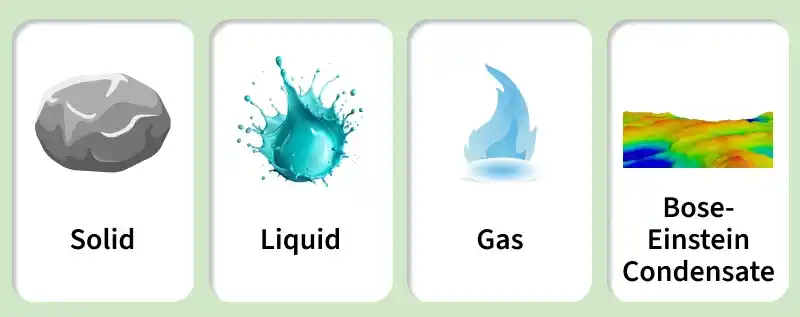
- **Solid: Possesses a definite shape and volume because its particles are closely packed and fixed in position.
- **Liquid: Has a definite volume but no fixed shape, as its particles can move and take the shape of the container.
- **Gas: Has neither a definite shape nor a volume since its particles are widely spaced and move freely in all directions.
Besides these, two other states of matter exist:
- **Plasma: Plasma is a form of high-energy matter that is present in stars and lightning.
- **Bose-Einstein Condensate: When the temperature is extremely low, particles move very slowly, and actions of particles are unified; this kind of state is known as the Bose-Einstein Condensate.
1. Solid State
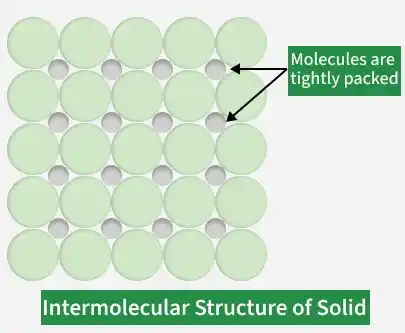
- The particles are highly packed in a solid.
- The particles do not have much or nearly no intermolecular space.
- The strong intermolecular forces bind the particles together and allow them to vibrate at their fixed positions only.
Properties
- Properties of Solids
- Solids have a definite shape.
- Solids are characterized by a certain volume.
- There is minimal intermolecular space between the particles in solids.
- Solids have high intermolecular forces of attraction.
- The solids contain low-kinetic-energy particles when compared to liquids and gases.
- The particles are tightly packed, making solids difficult to compress.
- The solid usually has a high degree of density.
**Examples: Ice, Sugar, Rock, Wood, Iron.
2. Liquid State
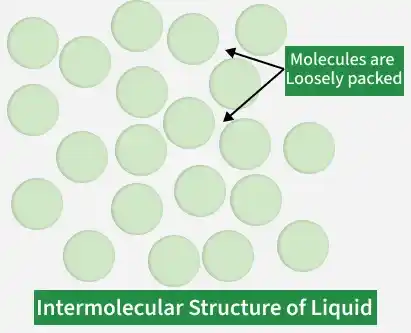
- The particles in a liquid are not compact to each other, and they can move freely through each other.
- The intermolecular space between the particles is more than that of solids.
- Due to this fact, liquids are able to flow freely and to alter shape.
Properties
- The volume of liquids is constant.
- The form of a liquid will be influenced by the container it is poured in.
- Fluidity is observed in liquids, and this implies that the liquids can flow.
- Liquids cannot be easily compressed.
- Intermolecular forces of attraction are moderate in the liquids, and they are neither too strong as in solids nor too weak as in gases.
- Liquid particles are given higher kinetic energy as compared to solids but lower kinetic energy as compared to gases.
**Examples: Water, Milk, Blood, Oil.
3. Gaseous State
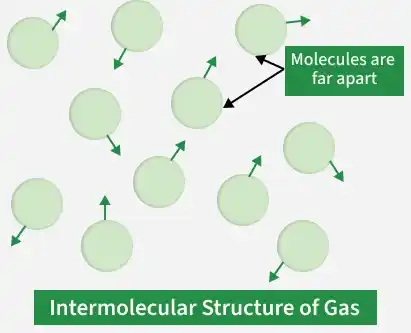
- Particles are very far apart from each other and move freely in all directions.
- The gases are neither in a definite shape nor in a definite volume.
- Due to the loosely packed particles, gases are very compressible.
Properties
- Gases lack a specific shape, but they assume an outline of the vessel containing them.
- Gases lack precise volume, and they begin to fill in the whole container.
- Due to large intermolecular spaces, gases are easily compressible.
- Intermolecular space is very large in gases as compared to liquids and solids.
- Gas intermolecular forces of attraction are very feeble.
- The density of gases is low in comparison with that of solids and liquids.
- The diffusion rate of gases is high, and therefore gases mix with other gases.
- Among the three states of matter, the particles of gases have the maximum kinetic energy.
**Examples: Air, Oxygen gas, Nitrogen gas, Carbon dioxide.
4. Plasma
- The fourth state of matter is known as plasma.
- It is not widely available in our day-to-day environment.
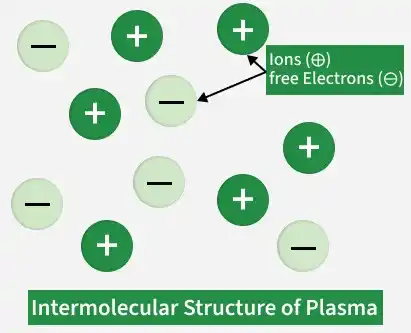
- Plasma is made of high-energy particles, such as free electrons and ions.
- Kinetic energy of the particles in the plasma is very high.
- High voltage electricity through gases, particularly noble gases, may be passed to obtain the plasma state.
- Plasma is capable of conducting electricity because of the charged particles.
- Naturally, plasma occurs in the Sun and other stars, where the temperature is very high.
- Some artificial sources that are around us have it as well.
**Examples: Neon signs, CFL, Lightning, Stars and the Sun.
5. Bose-Einstein Condensates of Matter
- It was discovered in 1995 by scientists by cooling certain gases to extremely low temperatures.
- This state of matter is formed by supercooling atoms of rubidium to a temperature very close to absolute zero (0 K).
- At such extremely low temperatures, the motion of particles becomes almost negligible.
- The kinetic energy of the particles approaches zero, and the particles begin to behave as a single unit.
- In this state, matter shows unusual properties such as superfluidity, meaning it can flow without any resistance.
- Bose–Einstein Condensate is mainly used for scientific research to study quantum effects.
- At present, it has no common practical applications in daily life.
Comparison of the Five States of Matter
| Property | Solid | Liquid | Gas | Plasma | Bose–Einstein Condensate (BEC) |
|---|---|---|---|---|---|
| Shape | Definite | No definite shape | No definite shape | No definite shape | No definite shape |
| Volume | Definite | Definite | No definite volume | No definite volume | Definite |
| Intermolecular Space | Very less | More than solids | Very large | Very large | Extremely less |
| Intermolecular Force | Very strong | Moderate | Very weak | Very weak | Very strong |
| Movement of Particles | Vibrate at fixed position | Slide past each other | Move freely | Move very fast | Almost no movement |
| Kinetic Energy | Lowest | More than solids | Highest | Very high | Almost zero |
| Compressibility | Not compressible | Slightly compressible | Highly compressible | Highly compressible | Not compressible |
| Diffusion | Very slow | Slow | Very fast | Very fast | Negligible |
| Occurrence | Common | Common | Common | Rare | Very rare |
| Examples | Ice, wood, iron | Water, milk, oil | Air, oxygen, nitrogen | Stars, lightning, neon signs | Supercooled rubidium atoms |