Change of State of Matter (original) (raw)
Last Updated : 22 Apr, 2026
A change of state of matter refers to a physical process in which a substance shifts from one form solid, liquid, or gas to another without any change in its chemical composition. These transformations are usually reversible and occur when the energy of particles changes due to variations in temperature or pressure. As energy is added or removed, the arrangement and movement of particles alter, resulting in a different physical state.
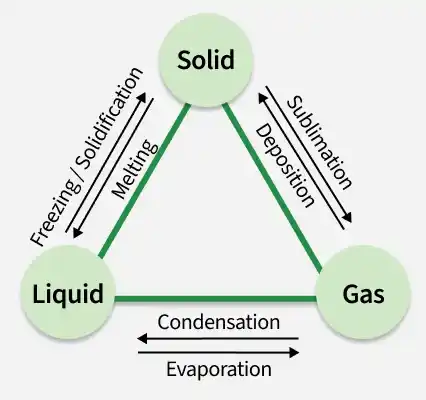
**Examples: melting, freezing, evaporation, condensation, sublimation, and deposition.
These transitions occur when heat is added or removed, or when pressure is altered, causing particles to rearrange and behave differently. By controlling temperature and pressure, matter can move between states, illustrating how physical conditions influence its properties without changing its chemical nature.
Effect of Temperature on Change of State of Matter
The change in state of matter depends on the nature of the substance and the initial conditions under which the change occurs. As matter is heated or cooled, the kinetic energy of its particles changes, which can cause a change in its state.
1. Solids into Liquid (Melting)
- The thermal transformation of a solid to become a liquid is referred to as melting.
- This energy aids the particles to overcome the attractions they have on each other leading to melting of the solid resulting in the production of a liquid.
**Melting Point:
The melting point is a temperature at which a solid melts at atmospheric pressure.
**Example: Ice melts to water at 0 o C.
\text{Solid} \xrightarrow{\text{Melting}} \text{Liquid}
2. Liquid into Gas (Boiling)
- Change of liquid into gas quickly by heating is the process known as boiling or vaporization.
- Boiling allows particles to obtain sufficient energy to be released out of the liquid phase into the gas formation.
**Boiling Point:
This temperature at which a liquid can boil to transform into gas at atmospheric pressure is referred to as the boiling point.
**Example: Water boils at 100°C.
\text{Liquid} \xrightarrow{\text{Boiling}} \text{Gas}
**3. Gas into Liquid (Condensation)
- Cooling down gas to convert it into liquid is known as condensation.
- The cooling of gas causes the particles in them to lose their kinetic energy and they begin moving towards each other which results in the formation of a liquid.
- The opposite process of boiling is condensation.
**Example: Water vapour forming droplets on a cold glass.
\text{Gas} \xrightarrow{\text{Condensation}} \text{Liquid}
**4. Liquid to Solid Change(Freezing)
- Transforming a liquid into a solid by cooling is referred to as freezing or solidification.
- During freezing, the kinetic energy of the particles decreases, and the particles slow down and become fixed in position.
- The other way of melting is called freezing.
**Example: Water freezes to form ice at 0°C.
\text{Liquid} \xrightarrow{\text{Freezing}} \text{Solid}
**5. Solid to Gas Change(Sublimation)
- This is referred to as sublimation the process in which a solid directly converts into gas without passing through the liquid state.
- Weak intermolecular forces do exist in some solids, and these solids are able to sublime on heating.
- The examples of substances, which pass through the process of sublimation: Ammonium chloride ,Iodine, Camphor etc.
**Example: Camphor or naphthalene balls slowly disappear in air.
\text{Solid} \xrightarrow{\text{Sublimation}} \text{Gas}
**6. Gas to Solid Change (Deposition / Desublimation)
- Deposition or desublimation is the process whereby a gas is directly converted into a solid without going through the liquid phase.
- It is an inverse of sublimation.
**Example: Formation of frost from water vapour
\text{Gas} \xrightarrow{\text{De-sublimation}} \text{Solid}
Interconversion of Three States of Matter
- The three states of matter solid, liquid, and gas can be converted from one state to another. This process is called interconversion of states of matter.
- Interconversion of states of matter is a reversible and physical process because the chemical composition of the substance does not change.
- The state of matter can be changed by changing temperature or pressure.
- When a solid is heated, the kinetic energy of its particles increases and the solid changes into a liquid.
- When a gas is cooled, it changes into a liquid, and further cooling converts the liquid into a solid.
- Pressure is also an important factor in the change of state, especially in gases.