Synthetic and Natural Fibers (original) (raw)
Last Updated : 23 Jul, 2025
**Synthetic and Natural Fibers- All the people in the surrounding area surrounded by different materials suited for different purposes. Clothes belong to different textures, that is, some of which have a shiny appearance; while some of them are dull in look and feel. The clothes are composed of fabrics, which in turn are made up of fibers. **The nature and material of the clothes depend upon the nature of the fiber. For instance, glasses and polyethene's are made up of plastic.
Table of Content
- Fibers
- Natural Fiber
- Advantages of Natural Fibers
- Examples of Natural Fibers
- Difference Between Animal and Plant Fibers
- Applications of Natural Fibers
- Synthetic Fibers
- Types of Synthetic Fibers
- Characteristics of Synthetic Fibers in comparison to Natural Fibers
- Advantages of Synthetic Fibers
- Disadvantages of Synthetic Fibers
- Polymers
- Properties of Polymers
- Polymer fibers
- Synthetic Polymers in Everyday Use
- Sample Problems
Fibers
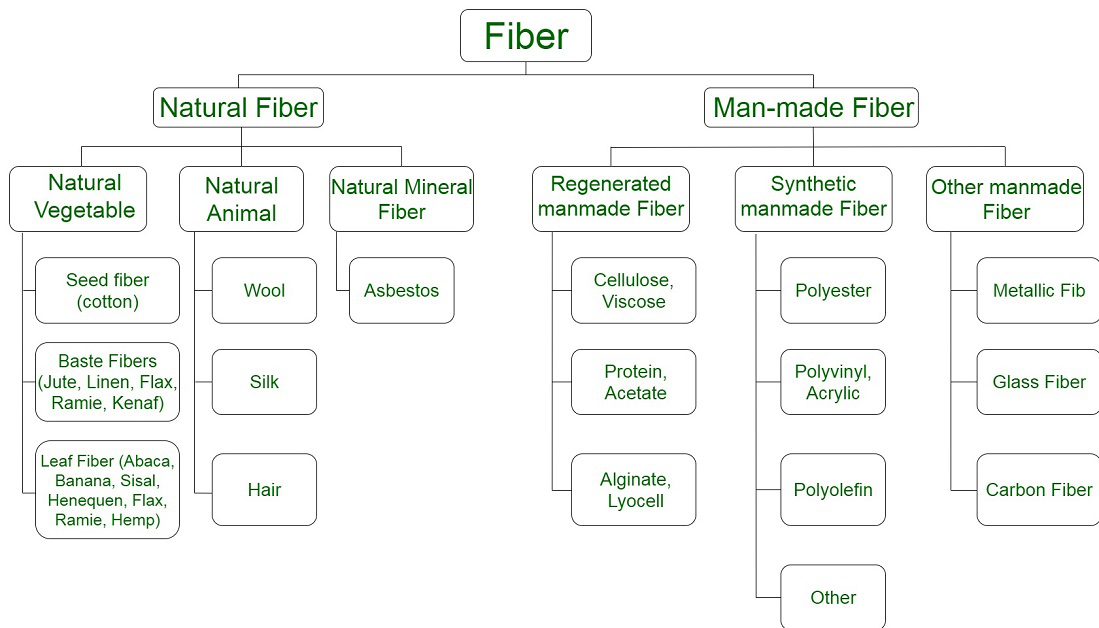
Fibers are obtained from **natural sources, that is, plants and animals. For instance, cotton, wool, and silk. However, some of them may be derived artificially. The fibers made by humans are called synthetic or man-made fibers. They are not derived from natural sources. **Some examples of synthetic fibers are nylon, rayon, polyester, etc. Technically, these fibers are usually formed as a chain of small units, called chemical substances which are stacked together. Synthetic fibers and plastics are composed of particles or molecules called polymers.
A polymer, therefore, is a large molecule derived by combining many small molecules. These small molecules individually are called monomers. **The process of deriving a polymer from monomers is called polymerization.
**Check: Type of Fabric
**Natural Fiber
**Natural fibers are hair like raw materials, which originate from **animal, vegetable, or mineral sources. It is basically an agglomeration of cells in which the diameter is negligible as compared to the length. They are easily convertible into non-woven fabrics, that is felt or paper or, woven cloth upon spinning into yarns. **A large variety of these fibers find their usage in textile products or other industrial purposes.
**Advantages of Natural Fibers
- Good sweat absorbents.
- Available in a variety of textures.
- Easy to wear and carry in hot and humid climates.
- Flexible and relatively strong.
- High elasticity - On subjecting to high tension, they partially or completely return to their original length when the tension is removed.
**Examples of Natural Fibers
**Natural fibers can be classified into two broad categories – Plant fibers and animal fibers.
- **Plant Fibers
A material that is composed of thin and continuous strands is known as fiber. Plant fibers are elongated most commonly **sclerenchyma supportive plant cells with thick cellulose walls with a well-organized structure.
Plants including **cotton, jute, flax, and hemp are used to obtain plant fibers. Many plant fibers are produced as field crops.
| Category | **Types |
|---|---|
| **Seed fiber | The fibers collected from the seeds of various plants are known as seed fibers. |
| **Leaf fiber | Fibers collected from the cells of a leaf are known as leaf fibers, for example, banana, pineapple (PALF), etc. |
| **Bast fiber | Bast fibers are collected from the outer cell layers of the plant's stem. These fibers are used for durable yarn, fabric, packaging, and paper. Some examples are flax, jute, kenaf, industrial hemp, ramie, rattan, and vine fibers. |
| **Fruit fiber | Fibers collected from the fruit of the plant, for example, coconut fiber (coir). |
| **Stalk fiber | Fibers from the stalks of plants, e.g. straws of wheat, rice, barley, bamboo, and straw. |
- **Animal Fibers
Most of the proteins such as **collagen, keratin, and fibroin; examples including natural fibers silk, wool, catgut, and alpaca form a major section of animal fibers. Mostly the animal fibers fall into two categories in terms of the source they are captured from :- **Animal hair -Wool taken from hairy mammals. **For instance, sheep's wool, goat hair (cashmere, mohair).
- **Silk fiber - Fiber is collected from the secretions of the glands of insects during the preparation of cocoons.
**Difference Between Animal and Plant Fibers
| **Animal Fibers | **Plant Fibers |
|---|---|
| Extracted from animals. | Extracted from plants, |
| Composed of proteins. | Composed of cellulose. |
| Need not be harvested for fiber extraction. | Plant fibers need to be harvested. |
| Lesser strength. | Greater strength |
| **Examples: Silk, wool, etc | **Examples: Jute, cotton, etc. |
**Factor affecting the **nature of Natural Fibers are:
- **Age of fiber - The properties of the fiber are inversely proportional to the age of the fiber. **For instance, newer young fibers are stronger and elastic than older ones.
- **Strain rate sensitivity - Owing to their viscoelastic nature, most of the natural fibers display strain rate sensitivity. Spider silk has elastic regions that together contribute to its strain rate sensitivity. Stiffness of the bone increases with an increase in strain rate. **This process is known as strain hardening.
- **The moisture content of the fiber.
**Applications of Natural Fibers
**Natural fibers find their applications in a variety of fields are,
- **Construction Industry: Glass fibers, for instance, are widely used in the construction industry for the manufacture of certain construction materials.
- **Industrial Value: Many natural fibers like silk, wool, angora, and camel hair owe to a great industrial value. Cotton fibers, for example, are widely used in textile industries.
- **Medicines: Natural fibers aid in the manufacture of biomaterials.
- **Environment Cleansing: Chitin, for instance, can be used for the elimination of certain toxic pollutants obtained from the industrial water discharge.
**Check: Fibre to Fabric
**Synthetic Fibers
**Synthetic fibers are man-made fibers accounting for about half of the total fiber usage. They are composed of small molecules originating from synthesized polymers. The compounds forming these fibers are derived from raw materials such as petroleum-based chemicals or petrochemicals. The polymerization process turns these raw materials into a chemical bonding two adjacent carbon atoms. Differing synthetic fibers are formed from a variety of chemical compounds.
Synthetic fibers find their applications in fiber and textile technology. The major dominant synthetic fibers are - **nylon, polyester, acrylic, and polyolefin, which account for about 98 percent by volume of synthetic fiber production. 60 percent accountability is handed over to polyester alone. Most of these fibers are recognized as potentially valuable commercial products.
**Semi-Synthetic Fibers
**Semi-synthetic fibers are formed from naturally occurring fibers. The naturally occurring fibers are subjected to a chemical process, which involves harvest, broking down, and then reconstruction of natural fibers using cellulose. **Cellulose is an organic compound found in abundance in plants. It is first extracted from the plants, made soluble, and then spun into fiber to make fabrics.
**Types of Synthetic Fibers
- **Rayon
Rayon is manufactured from wood pulp. Owing to its high resemblance to silk, rayon is also termed artificial or synthetic silk. In comparison to natural silk, it is cheaper and can also be dyed in several colors. - **Nylon
Nylon was the first commercially synthesized silk-like fiber. Nylon is manufactured from coal, water, and air. - **Polyester
**Polyester is a highly popular man-made fiber used for making clothes. Owing to its name, it is made up of repeating units of a chemical called ester. - **Acrylic
Acrylic is a highly popular man-made fiber. Owing to its high resemblance to wool, acrylic is also termed artificial or synthetic wool. In comparison to natural wool, it is cheaper and can also be dyed in several colors.
**Characteristics of Synthetic Fibers in comparison to Natural Fibers
- Large durability.
- Stronger.
- Cheaper
- Easy maintenance and wash.
**Advantages of Synthetic Fibers
- Good elasticity.
- Easy blending with other fibers.
- Non-shrinking property.
- Highly absorbent
- They don’t wrinkle up easily.
- Less expensive.
- Readily available and durable.
- Handle heavy load without breaking.
**Disadvantages of Synthetic Fibers
- Owing to their low melting point, the synthetic fibers are subjected to heat with caution. For example, while ironing.
- Less absorbent properties make these fibers uncomfortable to wear during hot and humid days. They stick to the body in a humid climate.
- Since these fibers are non-biodegradable in nature, they have serious environmental impacts.
- They are prone to catch fire very easily.
**Also Check:
**Polymers
**Polymers can be termed as a combination of repeating units. Polymers are composed up of small subunits to form large molecules, also known as macromolecules. Polymers may be natural, formed from plants and animals, or synthetic, which are man-made. The word polymers are composed of two words, POLY means many, and MER meaning units. Different polymers display a large number of unique physical and chemical properties. Some examples of natural polymers are silk, wool, cellulose (cotton). Some examples of synthetic polymers are nylon, Teflon polyester, polyethylene, etc.
Polymers can be created using the process of **polymerization. Polymerization uses constituent elements called monomers stacked together to form polymer chains, that is, the formation of 3-dimensional networks to form polymer bonds.
**Types of Polymers - Polymers can be categories into two major types: naturally occurring and synthetic or man-made are,
- **Natural
Natural polymeric materials are derived from plants and animals. Some examples are shellac, amber, wool, and natural rubber. Another known natural polymer, that is cellulose, is the main constituent of wood and paper. - **Synthetic
Synthetic polymeric materials are not derived from plants and animals. These polymers are in huge demand worldwide, nearly 330 million of which are manufactured every year. Some examples include **polyethylene, polypropylene, PVC, synthetic rubber, Bakelite, neoprene, nylon, PVB, and others.
**Properties of Polymers
- **Physical Properties - Polymers display some rare physical properties :
- The chain length and cross linking of the polymer is directly proportional to its tensile strength. Therefore, tensile strength increases by increasing the cross-linking.
- Polymers display a rare property when subjected to heating, that is they change state from crystalline to semi-crystalline, but do not melt.
- **Chemical Properties - The chemical properties of the polymers enable them to withstand bonding with other molecules strongly :
- Polymers are bestowed with hydrogen bonding and ionic bonding providing them a better cross-linking strength.
- High flexibility is ensured due to dipole-dipole bonding of the side chains.
- Polymers supporting Van der Waals forces linking their chains are known to be weak in nature. However, they provide the polymer a low melting point.
- **Optical Properties
Polymers find their usage in spectroscopy and analytical applications, that is the design of lasers. This is because of their ability to modify their refractive index concerning temperature, notably visible in PMMA and HEMA: MMA.
**Polymer fibers
Polymer fibers are fibers based on synthetic chemicals, for instance, petrochemical sources. They can be considered as a subset of man-made fibers. These fibers are derived from the following sources:
- Polyamide-nylon
- Elastolefin
- Polyolefins (PP and PE) olefin fiber
- PET or PBT polyester
- Polyurethane fiber
- Polyvinylchloride fiber (PVC) vinyon
- Phenol-formaldehyde (PF)
- Acrylic polyesters, such as the pure polyester PAN fibers are converted to carbon fiber by roasting them in a low oxygen environment. Carbon fibers can be considered as a type of resin-based fiber which is not thermoplastic.
- Aromatic polyamides (aramid) - These polymers have a quality of not melting even when subjected to high temperatures. Also, these fibers have strong bonding between polymer chains. For example Twaron, Kevlar, and Nomex.
- Polyethylene (PE). For instance, Dyneema or Spectra.
- Elastomers. For instance, spandex. In the latest trend, the urethane fibers are starting to act as a replacement for the spandex technology
**There are various kinds of polymer fibers:
- Coated fibers provide static elimination, silver-coated to provide anti-bacterial properties. For instance, Nickel coated fibers.
- Coextended fibers are composed of two distinct polymers, most commonly as a core-sheath or side-by-side.
- Aluminium-coated fibers provide RF deflection for a spool of continuous glass tow. It is known as radar chaff.
**Synthetic Polymers in Everyday Use
Synthetic polymers find their usage in daily life, in the form of textiles and fabrics, Teflon in non-stick pans, and polyvinyl chloride in pipes. A common usage is seen in the form of PET bottles with are composed up of a synthetic polymer, polyethylene terephthalate. The tires are manufactured from the Buna rubbers. Also, the plastic covers are composed up of synthetic polymers like polythene. However, synthetic fibers contribute much to environmental issues, owing to their non-biodegradable nature. Also, they are mostly synthesized from petroleum causing an overhead to the economy. **Therefore, bioplastics **are an alternative, though they are more expensive.
**Related Links:
Sample Problems
**Problem 1: Differentiate between natural and synthetic polymers?
**Solution:
Following are the differences between natural and synthetic polymers:
**Natural Polymers **Synthetic Polymers Found naturally in our environment. Produced artificially by humans. They occur naturally. Do not occur naturally. Manufactured from biological processes. Manufactured from chemical processes. Easily degradable by biological process. Hard to degrade by natural processes.
**Problem 2: How are synthetic fibers manufactured?
**Solution:
Synthetic fibers composed of small molecules synthesized polymers. They are extracted from raw materials such as chemicals based on petroleum or petrochemicals. They are composed of small constituent molecules, known as monomers.
**Problem 3: List properties and uses of the fiber rayon.
**Solution:
Properties of the fiber rayon are:
- Versatile fiber.
- Dyed in different colors.
Uses of the fiber rayon are:
- Making apparel like shirts, blouses, etc.
- Make furnishings and upholstery.
**Problem 4: Write the difference between Natural and Synthetic fibers?
**Solution:
**Following are the differences between natural and synthetic fibers:
**Natural fibers **Synthetic fibers Manufactured naturally. Man-made fibers Natural color Can be dyed in different colors Spinneret is not necessary Spinneret is necessary for the production of filament Chances of having dust or impurities No dust or impurities Less durable More durable
**Problem 5: Why is it advised not to wear synthetic clothes while working in a laboratory or working with fire in the kitchen?
**Solution:
The synthetic fibers melt on heating. This is actually a disadvantage with synthetic fibers. If the cloth catches fire it can be very disastrous. The fabric melts and sticks to the body of the person wearing it. It is therefore advised not to wear synthetic clothes while working in a laboratory or working with fire in the kitchen.
**Problem 6: Describe nylon. Write its uses and properties.
**Solution:
Nylon is the strongest synthetic polymer amongst all the synthetic fibers. It is manufactured from coal, water, and air. It is also a polymer of amides.
Uses of Nylon
- Used in toothbrushes, combs, etc.
- Owing to its elasticity, it is used to make socks and stockings.
- Used for making apparel.
Properties of Nylon
- Resistant to moths and fungi.
- Absorbs less water.
- High tensile strength.
- Durable.