Ionic Compounds (original) (raw)
Last Updated : 31 Mar, 2026
Ionic compounds are a class of chemical substances formed when atoms transfer electrons from one atom to another. This transfer of electrons produces positively charged ions (cations) and negatively charged ions (anions). The strong electrostatic attraction between these oppositely charged ions holds them together, forming an ionic compound.
Ionic compounds are usually formed between a metal and a non-metal. Metals tend to lose electrons to form positive ions, while non-metals gain electrons to form negative ions. Ionic compounds have some characteristic properties such as high melting and boiling points, crystalline structure, and the ability to conduct electricity in molten or aqueous (dissolved in water) state.
**Examples: sodium chloride (NaCl), magnesium oxide (MgO), and calcium chloride (CaCl2).
Properties
Ionic compounds are formed by the strong electrostatic attraction between positive and negative ions. Because of this strong attraction, they show some special physical and chemical properties.
**1) Physical State (Hard and Crystalline Solids)
- Ionic compounds are usually hard, solid substances at room temperature.
- Their ions are arranged in a regular three-dimensional crystal lattice structure, which makes them strong and stable.
**Example: Sodium chloride (NaCl) forms white crystalline solids commonly known as table salt.
**2) High Melting and Boiling Points
- Ionic compounds have high melting and boiling points because a large amount of energy is required to break the strong electrostatic forces between the oppositely charged ions.
**Example: NaCl melts at about 801°C, which is much higher than many covalent compounds.
**3) Solubility in Water
- Most ionic compounds are soluble in water but insoluble in organic solvents like benzene or petrol.
- Water molecules surround the ions and separate them, allowing the compound to dissolve.
**Example: NaCl dissolves easily in water but does not dissolve in kerosene or petrol.
**4) Electrical Conductivity
- Ionic compounds do not conduct electricity in the solid state because the ions are fixed in their positions in the crystal lattice.
- However, they conduct electricity when molten (melted) or dissolved in water because the ions become free to move and carry electric charge.
**Example: Molten NaCl or NaCl dissolved in water can conduct electricity.
**5) Brittleness
Ionic compounds are brittle in nature. When force is applied, the layers of ions shift, bringing ions with the same charge close to each other. This causes strong repulsion and the crystal breaks.
**Example: A crystal of NaCl breaks easily when hit with a hammer.
**6) Strong Electrostatic Forces
Ionic compounds contain strong electrostatic forces of attraction between positive and negative ions, which makes them stable and gives them their characteristic properties.
**Example: The strong attraction between Na+ and Cl⁻ ions forms the stable ionic compound NaCl.
Structure of ionic compounds
- Ionic compounds have a regular and well-organized three-dimensional arrangement of ions called a crystal lattice structure.
- In this structure, positive ions (cations) and negative ions (anions) are arranged alternately and are held together by strong electrostatic forces of attraction.
- In ionic compounds, there are no individual molecules.
- Instead, a large number of oppositely charged ions are arranged in a repeating pattern throughout the crystal.
- This arrangement makes the compound stable, solid, and strong.
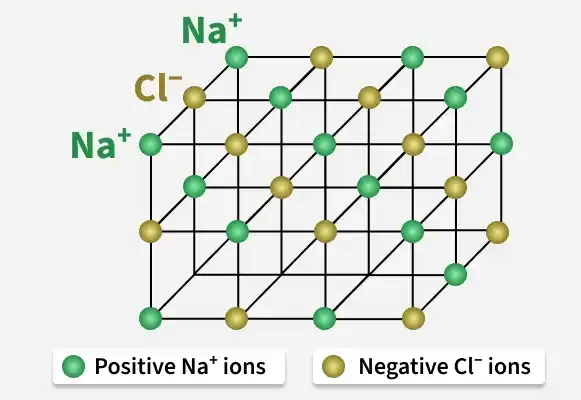
In sodium chloride (NaCl), each Na+ ion is surrounded by six Cl -ions, and each Cl⁻ ion is surrounded by six Na+ ions in a regular cubic arrangement. This type of structure is known as a crystal lattice.
Formation of Ionic Compound
- Ionic compounds are formed when one atom transfers one or more electrons to another atom.
- This transfer of electrons usually occurs between a metal atom and a non-metal atom.
- The metal atom loses electrons to form a positively charged ion (cation), while the non-metal atom gains electrons to form a negatively charged ion (anion).
- After the transfer of electrons, the oppositely charged ions attract each other through a strong electrostatic force of attraction.
- This force is called an ionic bond, and it holds the ions together to form an ionic compound.
- The ions arrange themselves in a crystal lattice structure, making the compound stable.
**Example: NaCl, MgCl2
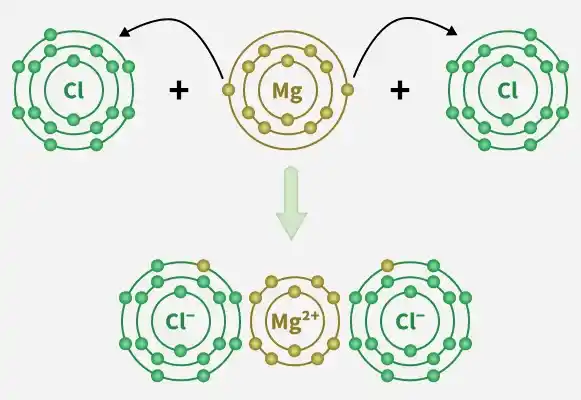
Examples of Ionic Compounds
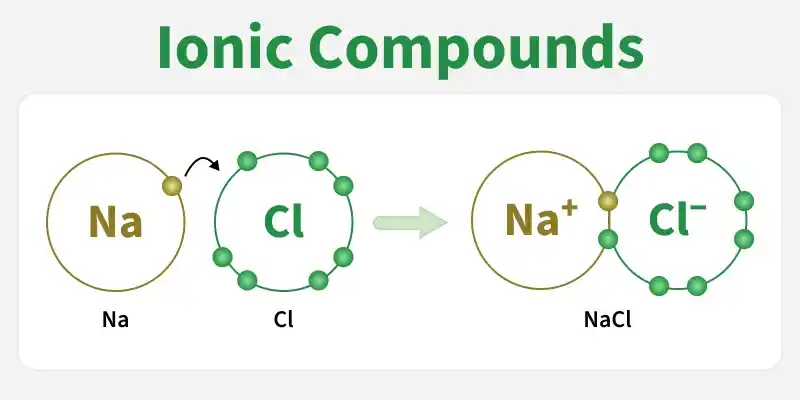
**1) Sodium Chloride (NaCl)
**a) Electron configuration of Sodium (Na):
- Sodium has one electron in its outermost shell.
Na(2,8,1)
- To become stable, sodium loses one electron.
Na→ Na++ e-
Thus, sodium becomes a sodium ion (Na⁺).
**b) Electron configuration of Chlorine (Cl):
- Chlorine has seven electrons in its outermost shell.
Cl(2,8,7)
- To complete its octet, chlorine gains one electron.
Cl + e− →Cl-
Thus, chlorine becomes a chloride ion (Cl⁻).
**c) Formation of Ionic Compound
- The Na⁺ ion and Cl⁻ ion attract each other due to electrostatic force and form sodium chloride (NaCl).
Na++Cl- → NaCl
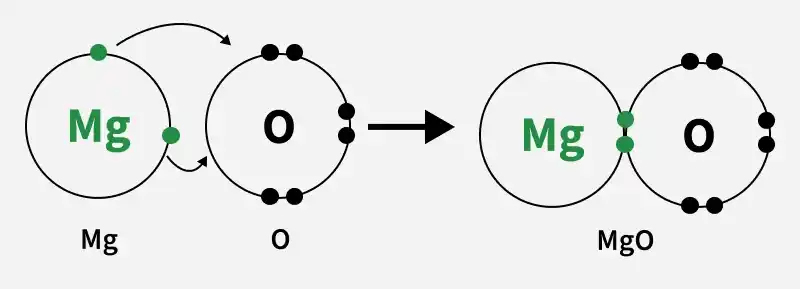
**2) Magnesium Oxide ( MgO)
**a) Electron configuration of Magnesium (Mg):
- Magnesium has two electrons in its outermost shell.
Mg (2, 8, 2)
- To become stable, magnesium loses two electrons:
Mg → Mg 2+ + 2e −
Thus, magnesium becomes a magnesium ion (Mg²⁺).
**b) Electron configuration of Oxygen (O):
- Oxygen has six electrons in its outermost shell.
O (2, 6)
- To complete its octet, oxygen gains two electrons:
O + 2e − → O 2-
Thus, oxygen becomes an oxide ion (O 2-).
**c) Formation of Ionic Compound:
- The Mg2+ ion and O 2- ion attract each other due to strong electrostatic force and form magnesium oxide:
Mg 2+ + O 2- → MgO