Why does Carbon Always Form Covalent Bonds (original) (raw)
Last Updated : 8 Apr, 2026
Carbon is an element that forms a vast number of compounds and serves as the basis of organic chemistry. It has four electrons in its outermost shell and cannot easily gain or lose electrons due to the high energy required. As a result, carbon completes its octet by sharing electrons with other atoms. This sharing of electrons is known as covalent bonding, and thus, most carbon compounds are covalent in nature.
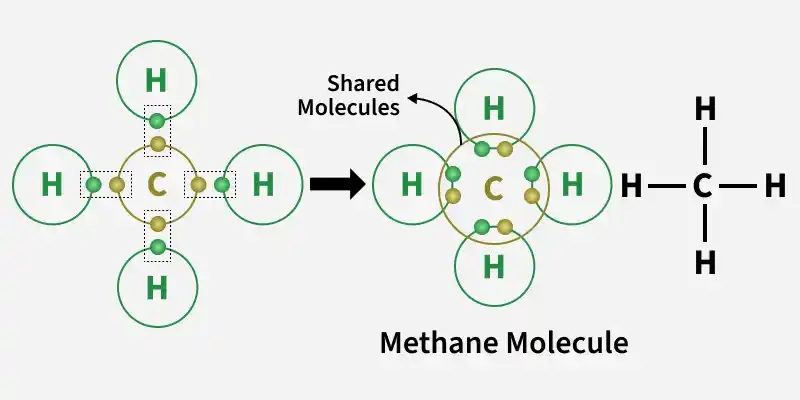
**Example:
In methane CH4 one carbon atom shares its four electrons with four hydrogen atoms, forming four covalent bonds. This helps carbon complete its octet (eight electrons) in the outermost shell.
Covalent Bonds
- A Covalent Bond is a type of chemical bond that is formed when two atoms share one or more pairs of electrons with each other.
- This sharing of electrons helps the atoms achieve a stable electronic configuration (usually an octet in the outermost shell).
- Covalent bonds are generally formed between non-metal atoms, where neither atom can easily lose or gain electrons.
- Instead, they share electrons so that both atoms can complete their outer shells.
**Example: H2O
- In this molecule, the Oxygen atom has six electrons in its outer shell and needs two more electrons to complete its octet.
- Each Hydrogen atom has one electron and needs one more electron to achieve a stable configuration.
- The oxygen atom shares one electron with each hydrogen atom.
- As a result, two shared pairs of electrons are formed, creating two covalent bonds between oxygen and hydrogen atoms.
- Thus, both oxygen and hydrogen atoms achieve a stable electronic configuration, forming the molecule H2O.
Electronic Configuration of Carbon
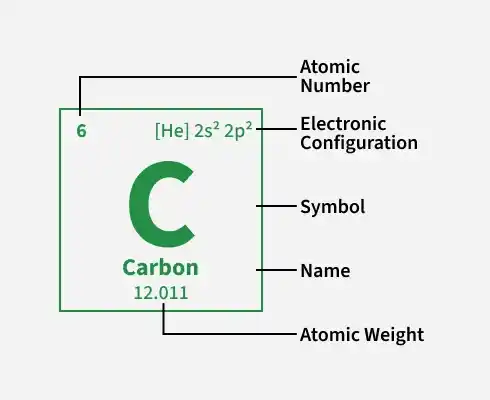
Carbon has an atomic number of 6, which means it has 6 electrons in its atom. These electrons are arranged in different energy levels or shells according to their energies.
The electronic configuration of carbon is:
1s2 2s2 2p2
- The first shell (K shell) can hold a maximum of 2 electrons.
- Therefore, 2 electrons are present in the 1s orbital.
- The second shell (L shell) can hold up to 8 electrons.
- In carbon, 4 electrons are present in this shell: 2 electrons in the 2s orbital and 2 electrons in the 2p orbital
The distribution of electrons in shells is:
K=2, L=4
**Valence Electrons
- The electrons present in the outermost shell are called valence electrons.
- Carbon has 4 valence electrons in its outer shell.
- Because carbon needs four more electrons to complete its octet, it usually shares electrons with other atoms, forming covalent bonds.
Formation of Covalent Bond
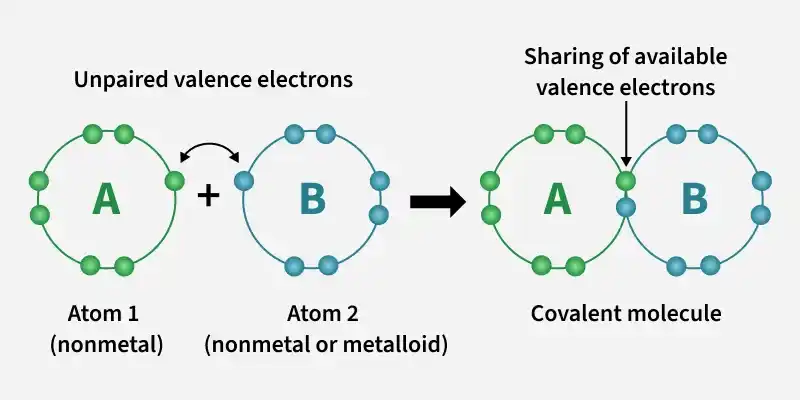
The Covalent Bond is formed when atoms share electrons in order to achieve a stable electronic configuration. The formation of a covalent bond takes place in a few simple steps.
**1. Approach of Atoms: First, two atoms come close to each other so that their outermost electrons can interact.
**2. Requirement of Electrons: Each atom needs a certain number of electrons to complete its duplet or octet and become stable.
**3. Sharing of Electrons: The atoms share one or more pairs of electrons with each other instead of losing or gaining electrons.
**4. Formation of Covalent Bond: The shared pair of electrons forms a covalent bond between the atoms, which holds them together in a molecule.