Introduction to Parsers (original) (raw)
Last Updated : 29 May, 2026
Parsing is also known as syntactic analysis, is the process of analyzing a sequence of tokens to determine their grammatical structure according to the rules of a language. It organizes tokens into a parse tree or syntax tree, which represents the structural relationship between different parts of the input.
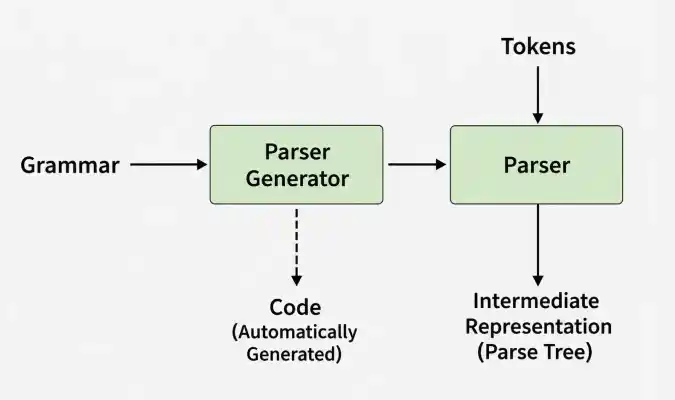
Parsing
- Converts tokens into a structured parse tree
- Helps understand the grammatical structure of text or code
- Ensures the input follows syntax rules
- Used in compilers, interpreters, and NLP applications
- Supports further tasks like semantic analysis and code execution
Role of Parser
A parser performs syntactic and semantic analysis of source code by converting tokens into a structured intermediate representation while identifying errors in the code.
- Checks whether code follows grammar and syntax rules
- Supports context-sensitive analysis such as type checking
- Generates parse trees or Abstract Syntax Trees (ASTs)
- Detects and reports syntax errors clearly
- Attempts basic error recovery during parsing
Types of Parsing
The parsing is divided into two types
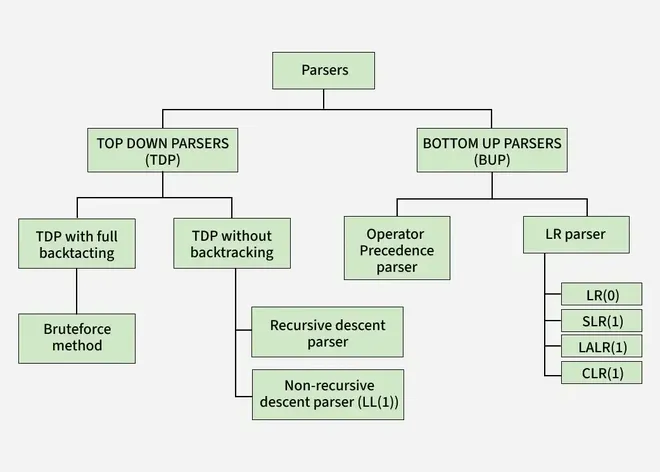
Types of Parsers
1. Top-Down Parsing
Top-down parsing builds the parse tree from the start symbol toward the input symbols.
- Starts from the start symbol
- Expands non-terminals using production rules
- Uses leftmost derivation
- Also known as recursive descent or predictive parsing
- Easier to implement for simple grammars
Types of Top-Down Parsing
**With Backtracking
- Tries multiple production rules
- Backtracks if one rule fails
- Flexible but slower
**Without Backtracking
- Does not retry other rules once a choice is made.
- Faster and more efficient.
- Works only for suitable grammars (e.g., LL grammars).
2. Bottom-Up Parsing
Bottom-up parsing builds the parse tree from input symbols toward the start symbol.
- Starts from the input string
- Reduces substrings into non-terminals
- Uses rightmost derivation in reverse
- Also known as Shift-Reduce Parsing
- Efficient for complex grammars and compiler design
Types of Bottom-Up Parsing
Bottom-Up vs Top-Down Parser
| Feature | Top-Down Parsing | Bottom-Up Parsing |
|---|---|---|
| Direction | Builds the parse tree from root to leaves | Builds the parse tree from leaves to root |
| Derivation | Uses leftmost derivation | Uses rightmost derivation in reverse |
| Working Approach | Starts from the start symbol | Starts from the input string |
| Efficiency | Simpler but can be slower with backtracking | More efficient for complex grammars |
| Complexity | Easier to implement | More complex to implement |
| Example Parsers | Recursive Descent Parser, LL Parser | Shift-Reduce Parser, LR Parser |