Architecture of Internet of Things (IoT) (original) (raw)
Last Updated : 13 Nov, 2025
To understand how smart devices communicate and function together, learning about the Architecture of the Internet of Things (IoT) is essential. It defines how sensors, networks and cloud systems interact to collect, process and exchange data efficiently.
- The IoT architecture acts as the foundation for all connected devices and applications.
- Each layer has a distinct role, from sensing real-world data to delivering intelligent actions.
- A clear structure ensures scalability, security and smooth device communication.
This architecture forms the backbone of IoT systems, powering everything from smart homes to industrial automation.
Architecture
The architecture of Internet of Things consists of four different layers i.e. Sensing Layer, Network Layer, Data processing Layer and Application Layer.
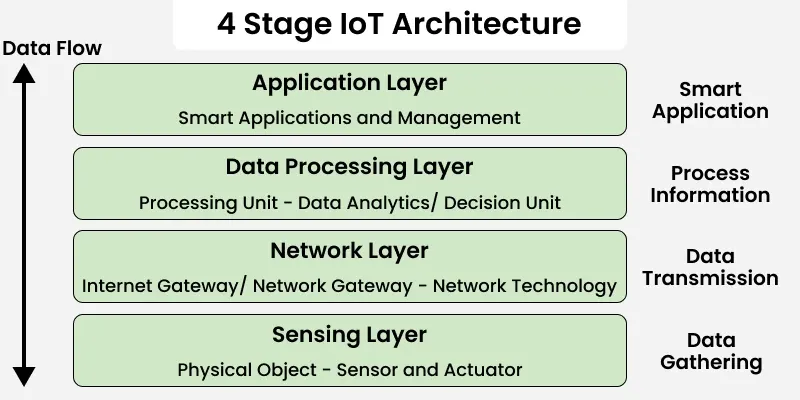
Architecture of IoT
1. Sensing Layer
This is the bottom-most layer responsible for detecting physical conditions from the environment.
**Functions
- Collects raw data such as temperature, humidity, motion, sound or pressure.
- Senses changes in the surroundings through embedded components.
- Initiates actions using actuators when required.
**Components
- Sensors like humidity, gas, infrared, ultrasonic
- Actuators like motors, switches, valves
- Microcontrollers and RFID tags
**Communication: Transfers sensed data to the network layer via wired or wireless links.
2. Network Layer
This layer provides connectivity and communication between IoT devices and cloud systems.
**Functions
- Transmits collected sensor data to processing platforms securely.
- Supports device-to-device and device-to-server communication.
- Handles addressing, routing and data forwarding.
**Technologies
- Wi-Fi, Bluetooth, Zigbee, LoRaWAN
- Ethernet and satellite networks
- Supporting Devices
- Routers and switches
3. Data Processing Layer
This layer analyzes, filters and interprets data received from network devices.
**Functions
- Cleans and formats raw sensor data for meaningful insights.
- Applies analytics to detect patterns or abnormalities.
- Stores data for historical analysis or reporting.
**Components
- IoT cloud platforms
- Data lakes and warehouses
- Stream processing and machine learning engines
**Output
- Predictive alerts and reports
- Anomaly detection signals
- Decision rules for automation
4. Application Layer
This top-most layer interacts directly with end users and business systems.
**Functions
- Provides interfaces to monitor and control IoT devices remotely.
- Displays visual analytics through dashboards and charts.
- Triggers automated actions based on processed insights.
**Components
- Mobile applications
- Web dashboards and portals
- Visualization and alerting tools
**Capabilities
- Remote device management
- Real-time condition monitoring
- Integration with enterprise applications
Applications
Some applications of IoT architecture are:
- **Smart Agriculture: Automates irrigation schedules, monitors soil conditions and analyzes crop health using real-time sensor readings.
- **Asset Tracking: Monitors the movement of vehicles, shipments and equipment using GPS telemetry and beacon signals.
- **Smart Grids: Balances power distribution, forecasts consumption patterns and reduces transmission losses dynamically.
- **Home Automation: Controls lighting, door locks, appliances and climate settings based on user behavior patterns.
- **Industrial Automation: Predicts machinery faults, schedules maintenance and improves production accuracy in factories.
Advantages
Some advantages of IoT architecture are:
- **Scalability: Supports the integration of additional devices and sensors as business requirements grow without major architectural redesigns.
- **Resource Efficiency: Minimizes power consumption and maintenance overhead by optimizing operations through data-driven control.
- **Real-Time Insights: Provides instant visibility of ongoing processes using live sensor streams to enable faster responses.
- **Interoperability: Allows cross-vendor device communication through open protocols to improve connectivity in diverse environments.
- **Predictive Analytics: Forecasts equipment failures and workload fluctuations using AI models to reduce unexpected downtime.
Disadvantages
Some disadvantages are:
- **Security Vulnerabilities: Connected devices are susceptible to cyberattacks, unauthorized access and data breaches due to weak security layers.
- **High Initial Costs: Implementing sensors, gateways and communication infrastructure requires significant upfront investment.
- **Compatibility Challenges: Different vendor standards and communication protocols create difficulties in integrating heterogeneous systems.
- **Network Dependency: Connectivity issues can interrupt data flow and disrupt real-time operations across remote deployments.
- **Complex Maintenance: Large-scale IoT deployments require continuous monitoring, regular updates and specialized management tools.