Classification of Computer Network on basis of Architecture (original) (raw)
Last Updated : 22 Sep, 2025
Network Architecture is the design of a computer or communication network that shows how devices, software, protocols, and media work together. It defines the physical and logical structure, task allocation, and connectivity between clients like laptops and servers. Simply put, it provides the rules and tools for smooth communication, managed by network architects.
Network Architect vs Network Administrator vs Network Engineer
- **Network Administrator: They take care of a network that's already set up. They handle day-to-day tasks like fixing problems, adding users, and making sure everything runs smoothly.
- **Network Engineer: They're like the builders and fixers. They create networks based on designs, make changes when needed, and troubleshoot any issues that pop up.
- **Network Architect: They're the big planners. They design how a network should look and work. They create the blueprint that the engineers follow to build the network
Types of Network Architecture
Computer networks can be classified based on architecture into two primary types:
- Peer-to-Peer Architecture
- Client/Server Architecture
- Hybrid Networks
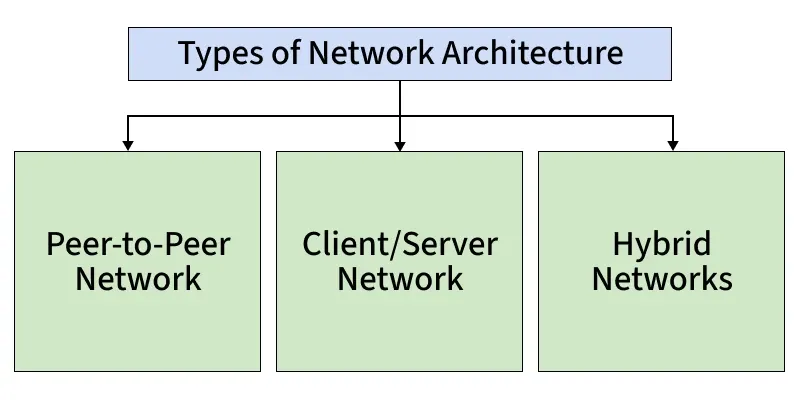
Types of Network Architecture
1. Peer-to-Peer Architecture
In a P2P network, computers (peers) are directly connected, usually via the Internet, to share files and resources without a central server. Each computer acts as both client and server, with equal roles and responsibilities. Tasks are distributed across all devices, making P2P suitable for small setups (up to about 10 computers). Since there’s no strict client-server division, peers can both send and receive data directly. P2P networks are commonly used in business, education, and military applications.

Peer-to-Peer Architecture
**Advantages of Peer-to-Peer Architecture
- P2P network is less costly and cheaper. It is affordable.
- P2P is very simple and not complex. This is because all computers that are connected in network communication in an efficient and well-mannered with each other.
- It is very easy and simple to set up and manage as installation and setup is less painless and computer manages itself. This is because of built-in support in modern operating systems.
**Disadvantages of Peer-to-Peer Architecture
- It is more difficult to manage security policies consistently.
- Each peer demands individual care and control.
- As the network expands in size, it may become inefficient.
2. Client/Server Architecture
CSN (Client/Server Network) is type of computer network in which one of centralized and powerful computers (commonly called as server) is hub to which many of personal computers that are less powerful or workstations (commonly known as clients) are connected. It is type of system where clients are connected to server to just share or use resources. These servers are generally considered as heart of system. This type of network is more stable and scalable as compared to P2P network. In this architecture, system is generally decomposed into client and server processor or processes.

Client/Server Architecture
**Advantages of Client/Server Architecture
- A special Network Operating System (NOS) is provided by server to provide resources to many users that request them.
- It is also very easy and simple to set up and manage data updates. This is because data is generally stored in centralized manner on server.
- The server usually controls resources and data security.
**Disadvantages of Client/Server Architecture
- If the server fails, clients may lose access to services.
- Setting up servers requires a higher investment in hardware and software.
- Managing servers requires skilled personnel.
3. Hybrid Networks
Hybrid networks combine elements of both client-server and peer-to-peer architectures. They leverage the centralized control of client-server networks and the decentralized resource sharing of P2P networks. An example is a torrent network, where a central tracker (server) coordinates peers, but file sharing occurs directly between peers. Hybrid networks are used in applications requiring both centralized management and distributed resource sharing.
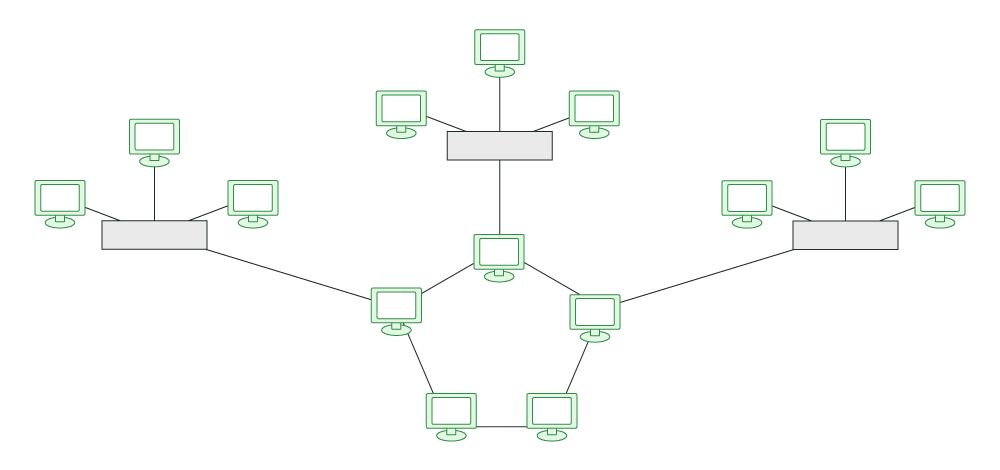
Hybrid Network
**Advantages of Hybrid Networks:
- Combines the benefits of centralized control and decentralized resource sharing.
- Flexible, allowing adaptation to different use cases and requirements.
- Can provide redundancy and fault tolerance by distributing tasks across peers and servers.
**Disadvantages of Hybrid Networks:
- Complex to design and maintain due to the combination of two architectures.
- May face security challenges from both client-server and P2P components.
- Higher costs compared to pure P2P networks due to the need for server infrastructure.
What Does a Computer Network Architect Do?
A computer network architect is responsible for designing and building communication networks for organizations. Their main tasks include:
- **Designing, Modeling, Testing, and Troubleshooting Networks: This involves creating plans for networks, testing them out, and solving any problems that arise.
- **Testing and Inspecting Existing Networks: You'll need to examine current networks to ensure they're working correctly and identify any issues that need fixing.
- **Upgrading Networks (Hardware and Software): Keeping networks up-to-date by improving both the physical equipment and the software they run on.
- **Analyzing and Fixing Security Weaknesses: Identifying and resolving any vulnerabilities in networks to keep them safe from cyber threats.
- **Developing Technical Documentation: Creating detailed guides and instructions for building and maintaining networks.
- **Installing and Maintaining Hardware Components: Setting up and looking after the physical parts of networks, like routers, cables, and adapters.
What Skills Does a Computer Network Architect Need?
To be successful as a computer network architect, you need a mix of technical and interpersonal skills. Here's what you should have:
- **Design and Modeling Skills: You'll be creating and visualizing network systems, so being adept at designing and modeling is crucial.
- **Cybersecurity Knowledge: Ensuring network security is paramount. You must be alert against threats and know how to support the network against potential attacks.
- **Technical Equipment Proficiency: Understanding the hardware components of networks like servers, routers, and modems is essential for implementing effective designs.
- **Soft Skills: In addition to technical prowess, you'll need soft skills to excel. Problem-solving skills are vital for troubleshooting issues that arise in complex networks. Effective communication skills are necessary for collaborating with other IT professionals and sometimes providing training to users