Difference between AMQP and HTTP Protocols (original) (raw)
Last Updated : 15 Jul, 2025
AMQP (Advanced Message Queuing Protocol) and HTTP (Hypertext Transfer Protocol) are two communication protocols used in distributed systems, however, they perform different functions and have different properties. In this article, we are going to discuss the differences between AMQP and HTTP protocols.
**What is AMQP?
AMQP is an acronym used for the Advanced Message Queuing Protocol. It is a protocol that is used for communication between applications. It is a lightweight, protocol that supports the applications for data transfer. This protocol is used for its scalability and modularity with the technologies.
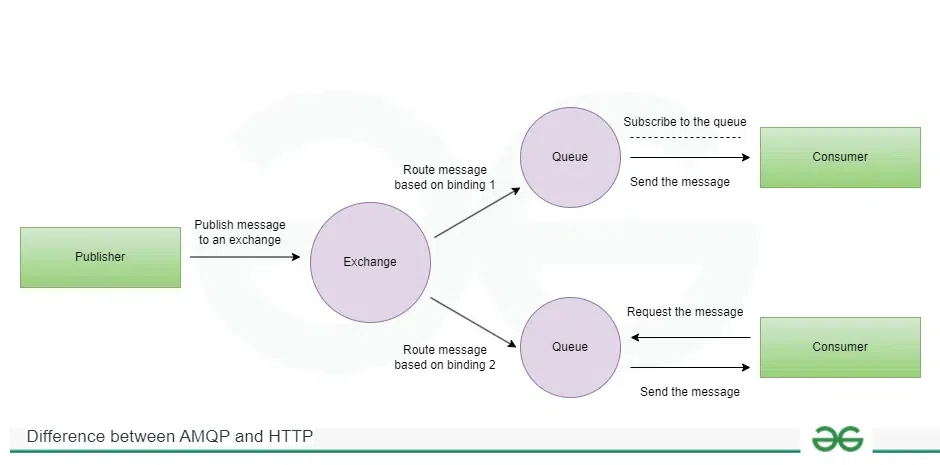
AMQP
Components of AMQP
- **Exchanges: The exchange is responsible for fetching messages and properly arranging them in the appropriate queue
- **Channel: A channel is a multiplexed virtual connection between AMQP peers that is built into an existing connection.
- **Message Queue: It is a unique entity that connects messages to their resources or points.
- **Binding: Bindings are a set of predetermined instructions for queuing and exchanging. It manages message transmission and delivery.
- **Virtual Host: Vhost is a platform that provides isolation capabilities within the broker. Multiple vhosts may be functional at the same time, depending on the users and their access rights.
Layers of AMQP
- **Function Layer: The function layer handles basic file transfer transactions, message queues, access, and control streaming.
- **Transport layer: Framing content data representation and error management.
**What is HTTP?
HTTP is an acronym used for Hypertext Transfer Protocol. It is a protocol that is used for communication between client and server. This protocol is responsible for the response from the server side to the client response. It is a base protocol for the communication of web services.
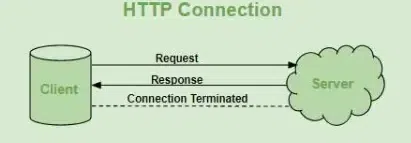
HTTP
**Characteristics of HTTP
- **Stateless: Each request is independent, and the server doesn’t retain previous interactions’ information.
- **Text-Based: Messages are in plain text, making them readable and debuggable.
- **Client-Server Model: Follows a client-server architecture for requesting and serving resources.
- **Request-Response: Operates on a request-response cycle between clients and servers.
- **Request Methods: Supports various methods like GET, POST, PUT, DELETE for different actions on resources.
**Difference Between AMQP and HTTP
| Basis | AMQP | HTTP |
|---|---|---|
| Full Form | Advanced Message Queuing Protocol. | Hyper Text Transfer Protocol. |
| Developed by | It was developed by JPMorgan Chase. | It was developed by Tim Berners-Lee. |
| Communication Nature | It has asynchronous communication nature. | It has synchronous communication nature. |
| Usage | It is easy to setup and manage. | It is user centric and it can be used in every aspect. |
| Message Delivery | It has guaranteed message delivery. | It has no guarantee for message delivery. |
| Interface | It provides publish/subscribe interface. | It provides point to point interface. |
| Fault Tolerance | AMQP protocol can bear the server broke issue on its own. | HTTP protocol is not capable to react to the server breakdown issue. |
| Segmentation | It has the property of segmentation and can process messages into slots. | It does not has this capability to treat each message as segments. |
| Protocol Characteristics | It is specific protocol used for specific purposes. | It is general purpose protocol and is used for multiple purposes. |
| Advantages | It is fast, flexible and cost effective protocol. | It is well known, efficient and multi-purpose protocol. |
Conclusion
AMQP and HTTP are separate communication protocols for distributed systems. AMQP, created by JPMorgan Chase, was designed for asynchronous communication with guaranteed message delivery and fault tolerance, making it perfect for specialized, scalable systems. Tim Berners-Lee created HTTP, a synchronous, general-purpose protocol extensively used for web services. While it is known for its simplicity and efficiency, it lacks guaranteed message delivery and fault tolerance. Because of their distinct qualities, each protocol serves a unique set of use cases.