Difference between GSM and CDMA (original) (raw)
Last Updated : 11 Jul, 2025
Over the years, different ways to communicate through mobile networks have developed. Two of the most important technologies that help phones connect to these networks are CDMA and GSM. **GSM stands for Global System for Mobile Communication, while CDMA stands for Code Division Multiple Access. Both of them serve the same basic purpose of enabling wireless communication, but operates differently. One of the key differences between CDMA and GSM is that GSM uses SIM cards to connect to a mobile phone with its network, whereas CDMAdoes not need any SIM card and operates on Electronic Serial Number(ESN). Understanding the differences between GSM and CDMA can help in choosing the right technology for different mobile network requirements.
What is GSM
A digital mobile communication standard called GSM, or Global System for Mobile Communication, is used to send and receive speech and data signals over a network. GSM uses TDMA ( Time division Multiple Access ) and FDMA(Frequency Division Multiple Access) to divide each frequency band into time slots for communication and transmitting the signals.It is also referred to as the second-generation standard for telecommunication or mobile networks and uses wedge spectrum. Other wireless services standard such as UMTS (Universal Mobile Radio System), EDGE (Enhanced Data Rates for GSM Evolution), and GPRS (General Packet Radio Service) have been evolved as a result of the GSM standard. It operates on three different radio frequencies and among these frequencies 900 MHz band frequency is used by the Original GSM system, and the 1800 MHz band frequency is used to provide the added support for increasing customers. The 1900MHz band is specifically used in the US (United States).

Advantages of GSM
- **Global Compatibility: GSM is used all around the world, so you can use your phone in different countries without changing your SIM card.
- **Better International Roaming: GSM makes it easier to use your phone in other countries because it supports international roaming.
- **SIM Card Flexibility: With GSM, you can change phones easily by just swapping the SIM card, without losing your number or service.
- **Strong Security Features: GSM has strong security, so your calls and data are safer.
- **Good Coverage in Urban Areas: GSM has great coverage in cities, so you can make calls and use data reliably.
- **Supports SMS and MMS: GSM supports both text (SMS) and picture (MMS) messaging, which are popular ways to communicate.
Disadvantages of GSM
- **Lower Data Speeds: GSM networks, especially older versions, have slow internet speeds compared to newer networks like 4G or 5G.
- **Limited Capacity: When many people use the network at the same time, especially in crowded areas, the network can get overloaded, causing dropped calls or slower speeds.
- **Limited Security: GSM has weaker security compared to newer networks, meaning it's easier for hackers to intercept calls or messages.
- **Interference and Signal Quality: In rural or less developed areas, GSM networks might have weaker signals, leading to poor call quality or dropped calls.
- **Incompatibility with Newer Technologies: GSM isn't compatible with newer technology like 4G or 5G, so it can't offer faster speeds or improved features.
- **Hardware Costs: Upgrading or expanding a GSM network can be costly because it needs specific, older equipment that isn’t as efficient as newer solutions.
What is CDMA
CDMA stands for Code Division Multiple Access which is also a radio telecommunication standard similar to GSM. It is based on the spread spectrum technology and makes optimal use of the available bandwidth. CDMA is a digital cellular technology that uses code-division multiplexing to allow multiple users to share the same frequency band by assigning a unique code to each communication. Unlike GSM, which divides frequencies, CDMA uses the same frequency for all users. The CDMA provides one of the most secure modes of communication due to its spread spectrum property. It is used in frequency bands ranging from 800MHz to 1900MHz.
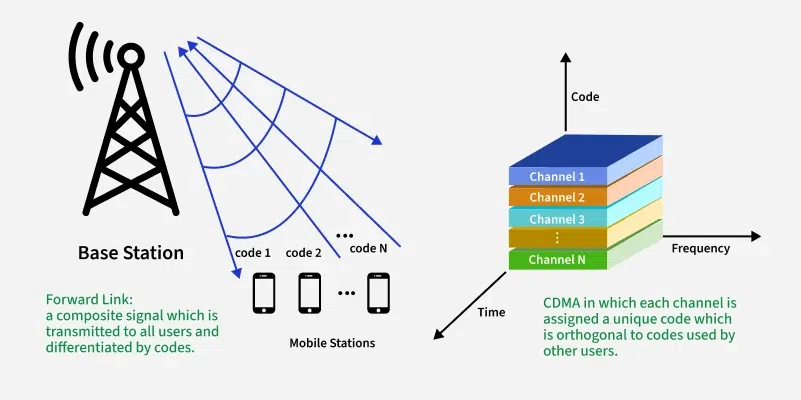
CDMA
Advantages of CDMA
- **Better Call Quality: CDMA gives better call quality because it uses a special code for each call, so there’s less interference.
- **More Efficient Use of Spectrum: : More people can use the same frequency at the same time without disturbing each other, making it more efficient.
- **Better Coverage: CDMA works better in areas with weak signals, like rural or remote places.
- **High Capacity: CDMA can handle more calls and data traffic in busy areas, like cities, without slowing down.
- **Strong Security: CDMA is more secure because it encrypts calls, making it harder for hackers to listen in.
- **No Need for SIM Cards: CDMA phones don’t need a SIM card, so you’re often tied to a single carrier’s devices.
- **Longer Battery Life: CDMA phones use less battery when they’re not in use, meaning they last longer on a single charge.
Disadvantages of CDMA
- **Limited Global Roaming: CDMA is not supported everywhere in the world, so it’s harder to use your phone abroad.
- **Device Compatibility: CDMA phones are often locked to one carrier, so it’s harder to switch networks without getting a new phone.
- **Limited Data Speeds: CDMA networks tend to have slower data speeds compared to newer technologies like 4G.
- **Complex Network Upgrades:It’s harder and more expensive to upgrade CDMA networks to newer technologies like 4G or 5G.
- **Shorter Battery Life During Active Calls: While CDMA phones have longer standby time, they tend to use more battery during active calls compared to GSM devices.
Differences Between GSM and CDMA
| Parameters | GSM | CDMA |
|---|---|---|
| **Abbreviations | Global System for Mobile communication. | Code Division Multiple Access. |
| **Technology used | FDMA(Frequency Division Multiple Access) & TDMA (Time Division Multiple Access). | CDMA(Code Division Multiple Access). |
| **Availability | GSM is globally widely used and available. | CDMA is available in fewer countries and carriers. |
| **Data speed rate | Slower Speed | Faster Speed |
| **Features | GSM supports transmitting data and voice both at once. | CDMA does not support this feature. |
| **Customer Information | Stored in a SIM card. | Stored in a headset or phone itself |
| **Encryption | Basic encryption | Stronger encryption. |
| **Secure | GSM offers less secure communication. | CDMS offers secure communication. |
| **Roaming | GSM enables worldwide roaming. | CDMA enables limited roaming. |
| **Signal Detection | May struggle in remote or rural areas | Can perform better in areas with weak signal |
| **SIM Card | There is always a requirement of SIM card for a GSM device to function. | There are no such requirements for CDMA phones. |
| **Flexibility | High flexibility | less flexibility |
| **Type of Spectrum | GSM technology operates on a wedge spectrum known as carrier. | CDMA technology is based on spread spectrum technology. |
| **MIMO (Multiple Input Multiple Output) method | Not commonly used in older versions | Supported in newer versions |