Difference between Guided and Unguided Media (original) (raw)
Last Updated : 12 Jul, 2025
Network media or transmission media refer to the physical pathways through which data is transmitted from one device to another within a network. These ways can be wired or wireless. The selection of media depends on factors like distance, speed, and interference. In this article, we will discuss the difference between Guided and Unguided media.
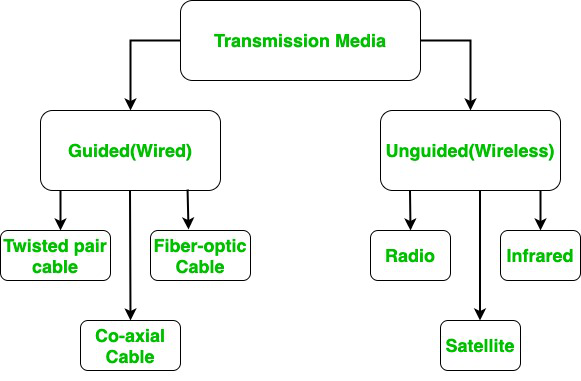
**Guided Media
Guided or Wired media allows signal energy enclosed and guided within a physical medium. This media is used either for point-to-point links or a shared link with various connections. In guided media, interruption is generated by outputs in the adjacent cables. Proper covering of guided media is required to reduce the interruption problem.
- **Twisted Pair Cable: It is made up of insulated copper wires twisted together that's why it called is as twisted pair cable. Mostly used in telephone networks and Ethernet cables. It is affordable.
- **Coaxial Cable: In coaxial cable one central conductor surrounded by insulation, a metallic shield, and an exterior cover. This type of cable used in television networks and for long-distance communication lines. It provides better protection against interruption than twisted pair cables.
- **Optical Fiber: This cable uses light signals to transfer data. Made up of glass or plastic fibers, it provides very high bandwidth and low signal reduction, making it ideal for long-distance and high-speed data transmission. It immune to electromagnetic obstruction but more expensive than copper cables.
**Unguided Media
In the unguided media, the signal energy propagates through a wireless medium. Wireless media is used for radio broadcasting in all directions. Microwave links are chosen for long-distance broadcasting transmission unguided media. Interference is also a problem in unguided media, overlapping frequency bands from competing signals can alter or eliminate a signal.
- **Radio Waves: Are used for wireless communication networks over large range distances, such as in broadcasting, cellular networks, and Wi-Fi. It can travel through walls and have a wide coverage area.
- **Microwaves: It provide high-frequency radio waves used for one-to-one communication. Used in satellite and terrestrial communication.
- **Infrared: Uses light signals just below the visible spectrum. Infrared is used for nearby communication, such as remote controls and short-range data transfer (e.g., between a laptop and a mobile device).
- **Satellite Communication: Satellite communication used for broadcasting, GPS, and global communications.
Difference between the Guided Media and Unguided Media
| Guided Media | Unguided Media |
|---|---|
| The guided media is also called wired communication or bounded transmission media. | The unguided media is also called wireless communication or unbounded transmission media. |
| The signal energy propagates through wires in guided media. | The signal energy propagates through the air in unguided media. |
| Used to perform point-to-point communication. | Unguided media is generally suited for radio broadcasting in all directions. |
| It is affordable. | It is costly. |
| Discrete network topologies are formed by the guided media. | Continuous network topologies are formed by the unguided media. |
| Signals are in the form of voltage, current, or photons in the guided media. | Signals are in the form of electromagnetic waves in unguided media. |
| By adding more wires, the transmission capacity can be increased in guided media. | It is not possible to obtain additional capacity in unguided media. |
| It sends out a signal that indicates which way to go. | It does not indicate which way to travel. |
| For a shorter distance, this is the best option. | For longer distances, this method is used. |
| It is unable to pass through walls. | It can pass through walls. |
Conclusion
Transmission media are components of modern communication systems, helping the exchange of information across various channels. The selection of transmission medium effects the performance, speed, and reliability of communicating networks. Guided media offer high bandwidth and secure data transmission over long distances, while unguided media provide flexibility and ease of deployment, especially in areas where physical cabling is impractical. With ongoing technological advancements new transmission media and enhancements will likely appear, further enhancing the capabilities and efficiency of communication networks. Gaining knowledge of the principles and applications of transmission media is crucial for anyone involved in the field of telecommunications and information technology, ensuring optimal network design and operation.