IGRP Routing Protocol (original) (raw)
Last Updated : 23 Jul, 2025
The Interior Gateway Routing Protocol (IGRP) is a proprietary distance vector routing protocol developed by Cisco Systems in mid-1980s. It uses a distance-vector algorithm to find the best path to a destination in a host network or an autonomous system.
Each router in the network maintains a routing table containing information about the best path to reach different networks.
Unlike older protocols like Routing Information Protocol (RIP), IGRP overcomes several limitations, particularly the ability to support larger networks and utilize multiple metrics to choose the optimal path.
IGRP Interior Gateway Routing Protocol
IGRP is primarily used to exchange routing information between routers within a single autonomous system (AS). It is considered classful and uses a composite metric for determining the best path, which allows for more accurate routing decisions compared to RIP.
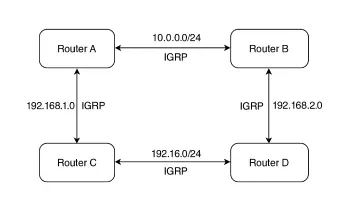
IGRP
Features of IGRP Routing Protocol
The following are the characteristics of the IGRP (Interior Gateway Routing Protocol):
- **Composite Metric:
IGRP uses a composite metric that considers bandwidth, delay (by default), reliability, load, and Maximum Transmission Unit (MTU) to calculate the best path. This is a significant improvement over RIP, which only uses hop count as its metric. - **Distance Measurement:
Each hop represents one router between the source and destination. IGRP allows a maximum of 255 hops, far surpassing RIP’s limit of 15 hops. The default hop count is 100, though this can be adjusted depending on network requirements. - **Routing Table:
Every router maintains a routing table that holds information about the distance to each network and the direction (next hop) to reach that network. This helps in efficient routing decision-making. - **Updates and Timers:
- **Routing Updates: IGRP sends routing updates every 90 seconds by default. This is a more bandwidth-efficient interval than RIP's 30-second updates.
- **Hold-down Timer: If a route is marked as invalid, IGRP uses a hold-down timer (set to 280 seconds by default) to prevent routing loops and suppress updates for the failed route until the timer expires.
- **Invalid Timer: IGRP classifies a route as invalid after 270 seconds of no updates (three times the update timer).
- **Flush Timer: The route is removed from the routing table after 630 seconds (seven times the update timer).
- **Triggered Updates: IGRP supports triggered updates, which allow for faster convergence when network changes occur.
- **Classful Protocol:
IGRP is classful, meaning it does not support Variable Length Subnet Masks (VLSM). It only sends updates based on fixed-length subnet masks (FLSM) and classful network boundaries, such as /8, /16, /24. - **Routing Domain:
All routers within an IGRP network must be in the same Autonomous System (AS). The AS number must be configured for IGRP routers to communicate with each other.
Functions of IGRP
The IGRP performs a variety of functions:
IGRP was designed to address the limitations of RIP, including its maximum hop count of 15 and its reliance on hop count as the only metric for path selection. The primary functions of IGRP include:
- **Routing Information Exchange: IGRP exchanges routing information between routers within the same AS. It broadcasts routing updates every 90 seconds, providing information about the state of the network.
- **Route Selection: IGRP calculates the best route based on multiple metrics, such as bandwidth, delay, reliability, and load, to determine the most optimal path to a destination.
- **Network Convergence: Upon any network or topology change, IGRP promptly broadcasts routing updates, ensuring routers converge to the optimal path quickly.
- **Loop Prevention: The hold-down timer and invalid timer help prevent routing loops, ensuring that outdated or invalid routes are not used to forward packets.
Advantages of IGRP
- **Improved Metric: IGRP’s use of a composite metric (including bandwidth, delay, reliability, load, and MTU) allows it to select better routes than RIP, which relies solely on hop count.
- **Scalability: It allows for up to 255 hops, providing better scalability than RIP, which is limited to 15 hops.
- **Simplicity: It is relatively simple to configure and manage, making it suitable for small to medium-sized networks.
- **Efficient Updates: The default 90-second update interval reduces the amount of bandwidth consumed by routing updates, compared to RIP’s more frequent 30-second updates.
- **Loop Avoidance: The hold-down timer and triggered updates help in preventing routing loops, ensuring a more stable network environment.
Disadvantages of IGRP Routing Protocol
- **Classful Routing: IGRP does not support **VLSM, which limits its functionality in networks where subnets require more flexible address planning. It can only handle classful networks.
- **Slow Convergence: It is slower to converge compared to more modern protocols like **EIGRP or **OSPF. This can be a drawback in larger networks or rapidly changing environments.
- **Routing Loops: While it has mechanisms like hold-down timers to reduce routing loops, it is still prone to them, especially in large networks with frequent changes.
- **Routing Updates: It sends full routing table updates, which can consume significant bandwidth when there are changes in the network, especially in large-scale networks.
- **No Support for Multiple Paths: Unlike some more modern protocols (e.g., **EIGRP), IGRP does not support multiple paths for the same destination, potentially reducing fault tolerance.