Integrated Services Digital Network (ISDN) (original) (raw)
Last Updated : 19 Sep, 2025
The Integrated Services Digital Network (ISDN) is a set of communication protocols that enable the simultaneous digital transmission of voice, video, data, and other network services over traditional Public Switched Telephone Network(PSTN) connections. ISDN aims to enable end-to-end digital connectivity to serve a diverse set of services.
- It provides a packet-switched connection for data in increments of 64 kilobit/s.
- It provided a maximum of 128 kbit/s bandwidth in both upstream and downstream directions.
- A greater data rate was achieved through channel bonding.
- Generally, ISDN B-channels of three or four BRIs (six to eight 64 kbit/s channels) are bonded.
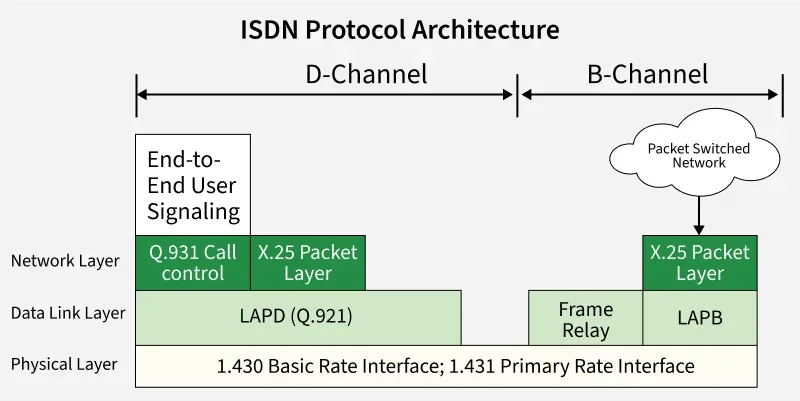
ISDN Protocol Architecture
**Note: ISDN is a circuit-switched telephone network system, but it also provides access to packet-switched networks that allow digital transmission of voice and data. This results in potentially better voice or data quality than an analog phone can provide.
History of ISDN
Before the Integrated Services Digital Network (ISDN), the telephone system was seen as a way to transmit voice, with some special services available for data. The main feature of ISDN is that it can integrate speech and data on the same lines, which were not available in the classic telephone system.
- In the context of the OSI model, ISDN is employed as the network in data-link and physical layers but commonly ISDN is often limited to usage to Q.931 and related protocols.
- These protocols introduced in 1986 are a set of signaling protocols establishing and breaking circuit-switched connections and for advanced calling features for the user.
- ISDN provides simultaneous voice, video, and text transmission between individual desktop videoconferencing systems and group video conferencing systems.
Types of ISDN Interfaces
Basic Rate Interface (BRI)
- There are two data-bearing channels ('B' channels) and one signaling channel ('D' channel) in BRI to initiate connections.
- The B channels operate at a maximum of 64 Kbps while the D channel operates at a maximum of 16 Kbps. The two channels are independent of each other.
- **Example: one channel is used as a TCP/IP connection to a location while the other channel is used to send a fax to a remote location.
- In iSeries ISDN supports a basic rate interface (BRl). The basic rate interface (BRl) specifies a digital pipe consisting of two B channels of 64 Kbps each and one D channel of 16 Kbps.
- This equals a speed of 144 Kbps. In addition, the BRl service itself requires an operating overhead of 48 Kbps. Therefore a digital pipe of 192 Kbps is required.
Primary Rate Interface (PRI)
- Primary Rate Interface service consists of a D channel and either 23 or 30 B channels depending on the country you are in. PRI is not supported on the iSeries.
- A digital pipe with 23 B channels and one 64 Kbps D channel is present in the usual Primary Rate Interface (PRI).
- Twenty-three B channels of 64 Kbps each and one D channel of 64 Kbps equals 1.536 Mbps.
- The PRI service uses 8 Kbps of overhead also. Therefore PRI requires a digital pipe of 1.544 Mbps.
Broadband-ISDN (B-ISDN)
- Narrowband ISDN has been designed to operate over the current communications infrastructure, which is heavily dependent on the copper cable however B-ISDN relies mainly on the evolution of fiber optics.
- According to CCITT B-ISDN is best described as 'a service requiring transmission channels capable of supporting rates greater than the primary rate.
ISDN Services
ISDN provides a fully integrated digital service to users. These services fall into 3 categories- bearer services, teleservices, and supplementary services.
Bearer Services
- Transfer of information (voice, data, and video) between users without the network manipulating the content of that information is provided by the bearer network.
- There is no need for the network to process the information and therefore does not change the content.
- Bearer services belong to the first three layers of the OSI model. They are well defined in the ISDN standard.
- They can be provided using circuit-switched, packet-switched, frame-switched, or cell-switched networks.
Teleservices
- In this, the network may change or process the contents of the data.
- These services correspond to layers 4-7 of the OSI model. Teleservices rely on the facilities of the bearer services and are designed to accommodate complex user needs.
- The user need not be aware of the details of the process.
- Teleservices include telephony, teletex, telefax, videotex, telex, and teleconferencing.
- Though the ISDN defines these services by name yet they have not yet become standards.
Supplementary Service
- Additional functionality to the bearer services and teleservices are provided by supplementary services.
- Reverse charging, call waiting, and message handling are examples of supplementary services which are all familiar with today's telephone company services.
Working of ISDN
The ISDN works based on the standards defined by ITU-T (formerly CCITT). The Telecommunication Standardization Sector (ITU-T) coordinates standards for telecommunications on behalf of the International Telecommunication Union (ITU) and is based in Geneva, Switzerland. The various principles of ISDN as per ITU-T recommendation are:
- To support switched and non-switched applications
- To support voice and non-voice applications
- Reliance on 64-kbps connections
- Intelligence in the network
- Layered protocol architecture
- Variety of configurations
Advantages of ISDN
- ISDN channels have a reliable connection.
- ISDN is used to facilitate the user with multiple digital channels.
- It has faster data transfer rate.
- Efficient use of bandwidth
- Improved call quality
- It provides Greater flexibility
- Integrated services
Disadvantages of ISDN
- ISDN lines costlier than the other telephone system.
- It requires specialized digital devices.
- It is less flexible.
- Limited coverage
- High installation and maintenance costs
- Limited features
Read Related article Difference between ISDN & PSTN