Difference Between ISDN and PSTN (original) (raw)
Last Updated : 23 Jul, 2025
In this article, we will cover communication protocols that are used for the transmission of data and voice. We will have a look at what is ISDN and PSTN. Then we will look at the differences between them. After this, we will look at the advantages, disadvantages and applications of both.
Table of Content
- What is ISDN?
- PSTN
- Difference between ISDN and PSTN
- Advantages and Disadvantages of ISDN and PSTN
- Applications of ISDN and PSTN
What is ISDN?
ISDN is an abbreviation used for Integrated Services Digital Network. ISDN is a digital communication technology. In this technology, speech and data are transferred with the help of existing phone lines. ISDN technology offers faster data transfer rates and higher quality of calls.
The ISDN technology is digital in nature. It is mainly used by big organizations or companies where there is a need for faster data transfer rates, and improved quality of calls. The ISDN technology can provide many simultaneous line connections at a time. It can handle 10-30 line connections at a time.
Operation of ISDN
The operation of ISDN consists of the following stages:-
- At first, the operation of ISDN is done with the help of the digital domain. It makes use of digital signals to perform the task of transmitting data, voice and other multimedia content.
- The ISDN operate using two types of interfaces. The first interface which is used is BRI, which provides a channel bandwidth of 128 Kbps. It consists of two bearer channels and one delta channel. The other interface which is used is PRI, which provides a channel bandwidth of 64 Kbps. It consists of multiple Bearer channels and one Delta Channel.
- When the user initiates a call, the ISDN establishes a digital connection between the calling parties and the called parties. The establishment of digital connection involves signaling to establish, maintain and terminate connections between the ISDN terminals.
- The Bearer channel which was used does the task of carrying of actual data of the user, like voice or other digital information.
- While the Delta channel is primarily used for signaling and control purposes.
- The ISDN utilizes circuit-switching and packet-switching modes for the transmission. Circuit-switched mode is used to allocate dedicated channels for the duration of the call. While packet-switched mode is the transmission of data in the form of packets.
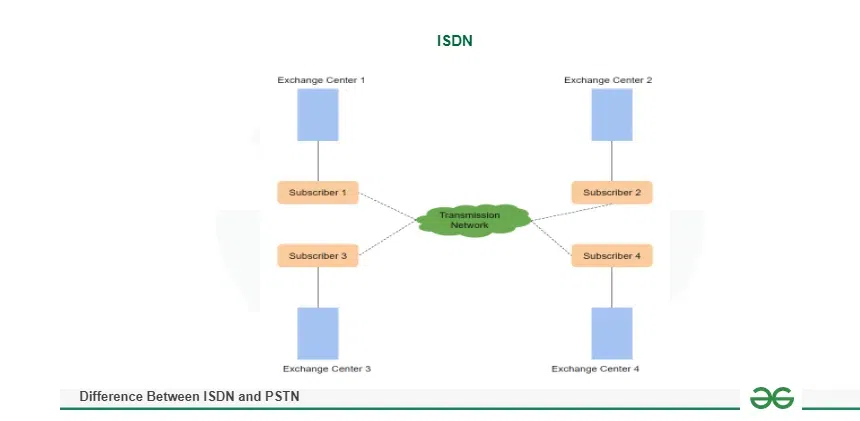
ISDN
PSTN
PSTN is an abbreviation used for Public Switched Telephone Network. PSTN is a traditional communication technology. In this technology, the speech and data are transferred through the copper cables. PSTN is basically a complex network which consists of telecommunication switches, transmission lines, and many other equipment. It was primarily used for transportation of voice and fax signals over long distances. The PSTN technology is analog in nature. It is used in smaller businesses or companies. The PSTN technology does not offer simultaneous line connection. It can handle only one line connection at a time.
Operation of PSTN
The operation of PSTN consists of following stages
- At first, the operation of PSTN is done with the help of Analog domain. It makes use of analog signals to perform the task of transmitting voice signals. The voice signals are converted into analog signals, then it is transmitted over the copper wires and then at the receiving end it gets converted back to voice signals.
- The operation of PSTN is carried over a circuit-switched network topology.
- Whenever a call is initiated, a particular and dedicated path is set up between the calling and the called parties. This setup of dedicated path helps in ensuring real-time communication. This also ensures the continuous transmission of voice signals.
- It also makes use of hierarchical network of exchanges or switches to handle calls. There are various types of exchanges like local exchanges handle call within a specific local area, while long-distance exchanges handle call within a large geographic area.
- It uses in-band signaling for the purpose of call setup, supervision and teardown.
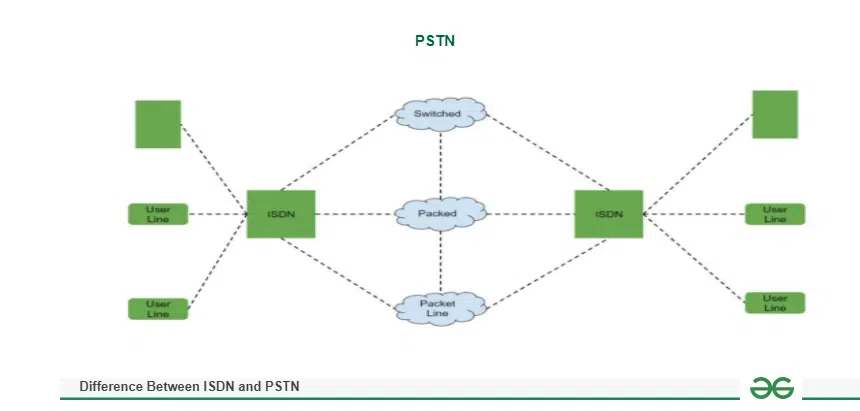
PSTN
Difference between ISDN and PSTN
The differences between ISDN and PSTN are following
| Feature | ISDN | PSTN |
|---|---|---|
| Data Transfer rate | Higher Data Transfer rates. | Lower Data Transfer rates. |
| Simultaneous connections | Allow multiple simultaneous connections. | Allow Single simultaneous connections. |
| Cost | Higher cost | Lower cost |
| Transmission protocol | Digital Transmission protocol | Analog Transmission protocol. |
| Quality of Service | Better quality of service | Lower quality of service |
| Data Transmission | Supports both Data and voice transmission. | Supports only voice transmission. |
| Number of Channels | It can have 10-30 channels. | It only have 1 channel. |
| End-to-end connection | End-to-end connection is possible in ISDN. | End-to-end connection is not possible in PSTN. |
| Technology Used | Digital | Analog |
| Speed | up to 128 Kbps(BRI) or 2 Mbps (PRI) | up to 56 Kbps |
| Flexibility | More flexibility and offers services like data, voice, video, etc. | Limited flexibility and offers service of voice communication. |
| Availability | Available in some areas. | Widely available |
| Bandwidth | higher bandwidth capacity | lower bandwidth capacity. |
Advantages and Disadvantages of ISDN and PSTN
Given Below are the Advantages and Disadvantages of ISDN and PSTN
Advantages of ISDN
- ISDN provides you with a faster data transmission rate. It has the capacity to carry 128kbps over the network.
- ISDN provides you a better quality of signal and a better quality of call.
- It can transfer various forms of data. It supports voice, video, fax information and data transmission on the same cable at a time.
- It also provides various phone call features which include call forwarding, call waiting, directed call pickup, etc.
Advantages of PSTN
- The infrastructure offered by PSTN is highly reliable and more secure to online threats and disruptions.
- The voice quality offered by PSTN is much improved and better than others.
- PSTN is very much useful in case of emergency services as it provides accurate information when emergency situation arises.
- PSTN technology is widely available in most regions including remote regions where internet access is limited.
Disadvantages of ISDN
- It has little flexibility. Since the traditional ISDN uses physical cables to operate. So, to facilitate remote working or company expansions it faces issue.
- The installation and the setting up of cables is so much time consuming and tedious task.
- Since, it requires the installation and setting up of cables, so it takes more cost and can be expensive.
- ISDN networks are not available at every geographical locations and if we make changes this can take more times to implement.
Disadvantages of PSTN
- The services offered by PSTN is much more expensive especially in case of long-distance or international calls.
- It provides limited features when compared to other systems.
- It offers limited flexibility as it is difficult to integrate with other platforms or applications.
- The maintenance and repairing of PSTN technology is costly and may consume more time.
Applications of ISDN and PSTN
Given Below are the Applications of ISDN and PSTN
Application of ISDN
- It provide you the flexibility to make couple of telephone call simultaneously.
- It is also utilized in some video phones which connect to the ISDN network and helps to make a video call.
- It is widely used in the broadcast industry to transport the audio signals from one station to another station.
- Another usage of ISDN network is in Video conferencing which is done on a single ISDN line.
Application of PSTN
- It provides reliable voice communication even in areas with weak internet access.
- It is also used to establish communication for Fax Services.
- PSTN technology are used in security and alarm systems to connect it with the monitoring centers.
- It is also used for out-of-band management by providing a separate communication channel to access and troubleshoot the equipment effectively.
Conclusion
In conclusion, ISDN and PSTN are the communication protocols which are used for transmission of data and voice. ISDN is a digital technology and offers more faster data transfer rate, provide improved quality of call. While PSTN is a analog technology and transfers voice over the copper cables. These technology is not that much as fast as ISDN offers. It has less data transfer rate and lower quality of call.