Message switching techniques (original) (raw)
Last Updated : 26 Sep, 2025
Message Switching is a switching technique where the entire message is sent as a single unit from one node to another without a dedicated path between the sender and receiver. Each intermediate node stores the message temporarily and then forwards it to the next node until it reaches its destination. Communication occurs hop by hop, with messages being the smallest unit of transfer. This method allows data to be transmitted even when direct connections are not available, making it a flexible network approach.
Key Features of Message Switching
1. Store-and-Forward
- Each intermediate node must store the entire message before forwarding it.
- Transmission occurs only if the next link and node are available; otherwise, the message waits in storage until resources are free.
2. Message Delivery
- Messages are transmitted as complete units, with a header containing routing information (source and destination addresses).
- Communication is hop by hop until the message reaches its destination.
3. Network Components
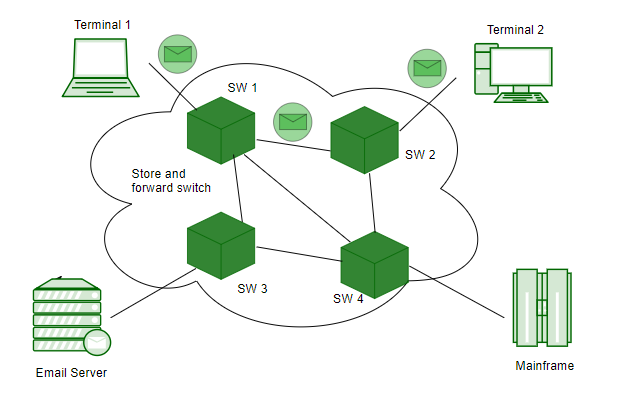
A message-switching network consists of:
- Transmission links (channels)
- Store-and-forward switching nodes
- End stations (source and destination devices)
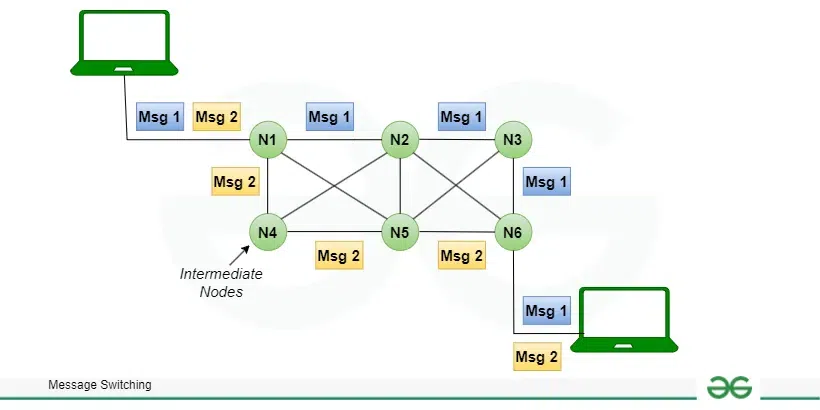
Message Switching
Message switching network consists of transmission links (channels), store-and-forward switch nodes, and end stations as shown in the following picture:
Advantages of Message Switching
- As message switching is able to store the message for which communication channel is not available, it helps in reducing the traffic congestion in the network.
- In message switching, the data channels are shared by the network devices.
- It makes traffic management efficient by assigning priorities to the messages.
- It allows for infinite message lengths.
Disadvantages of Message Switching
- **Not suitable for real-time applications: Storing messages at intermediate nodes causes delays.
- **High storage requirement: Every intermediate node needs large storage capacity.
- **Delivery uncertainty: Complex system can make it unclear if messages are correctly delivered.
- **No dedicated path: Communication is less reliable because sender and receiver are not directly connected.
Applications of Message Switching
- **Email systems: Messages are sent and stored at intermediate nodes until delivered.
- **Fax transmission: Data is stored and forwarded through multiple nodes.
- **Telex networks: Text messages are transmitted hop by hop.
- **Store-and-forward messaging in networks: Used in systems where direct connections are not always available.