Routing Tables in Computer Network (original) (raw)
Last Updated : 12 Jul, 2025
A Router is a networking device that forwards data packets between computer networks. This device is usually connected to two or more different networks. When a packet arrives at a router, it examines destination IP address of the received packet and makes routing decisions accordingly. Routers use _Routing Tables to determine which interface the packet will be sent out. A routing table lists all networks for which routes are known. Each router’s routing table is unique and stored in the RAM of the device.
What is a Routing Table?
A routing table is a set of rules, often viewed in table format, that is used to determine where data packets traveling over an Internet Protocol (IP) network will be directed. All IP-enabled devices, including routers and switches, use routing tables. See below a Routing Table:
| **Destination | Subnet Mask | Interface |
|---|---|---|
| 128.75.43.0 | 255.255.255.0 | Eth0 |
| 128.75.43.0 | 255.255.255.128 | Eth1 |
| 192.12.17.5 | 255.255.255.255 | Eth3 |
| Default | 0.0.0.0 | Eth2 |
The entry corresponding to the _default gateway configuration is a network destination of 0.0.0.0 with a network mask (netmask) of 0.0.0.0. The Subnet Mask of default route is always 0.0.0.0 .
**Entries of an IP Routing Table
A routing table contains the information necessary to forward a packet along the best path toward its destination. Each packet contains information about its origin and destination. Routing Table provides the device with instructions for sending the packet to the next hop on its route across the network. Each entry in the routing table consists of the following entries:
- **Network ID: The network ID or destination corresponding to the route.
- **Subnet Mask: The mask that is used to match a destination IP address to the network ID.
- **Next Hop: The IP address to which the packet is forwarded
- **Outgoing Interface: Outgoing interface the packet should go out to reach the destination network.
- **Metric: A common use of the metric is to indicate the _minimum number of hops (routers crossed) to the network ID.
Routing table entries can be used to store the following types of routes:
- Directly Attached Network IDs
- Remote Network IDs
- Host Routes
- Default Route
- Destination
When a router receives a packet, it examines the destination IP address and looks up into its **Routing Table to figure out which interface packet will be sent out.
**How are Routing Tables Populated?
There are 3 ways to maintain Routing Table:
- Directly connected networks are added automatically
- Using Static Routing
- Using Dynamic Routing
These Routing tables can be maintained manually or dynamically. In _dynamic routing, devices build and maintain their routing tables automatically by using routing protocols to exchange information about the surrounding network topology. Dynamic routing tables allow devices to "listen" to the network and respond to occurrences like device failures and network congestion. Tables for _static network devices do not change unless a network administrator manually changes them.
**Route Determination Process (Finding Subnet ID using Routing Table)
Consider a network is subnetted into 4 subnets as shown in the above picture. The IP Address of the 4 subnets are:
200.1.2.0 (Subnet a) 200.1.2.64 (Subnet b) 200.1.2.128 (Subnet c) 200.1.2.192 (Subnet d)
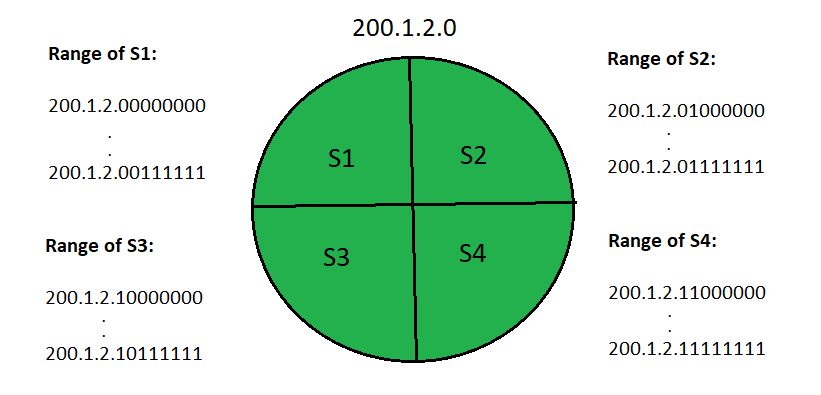
Then, Routing table maintained by the internal router looks like:
| Destination | Subnet Mask | Interface |
|---|---|---|
| 200.1.2.0 | 255.255.255.192 | a |
| 200.1.2.64 | 255.255.255.192 | b |
| 200.1.2.128 | 255.255.255.192 | c |
| 200.1.2.192 | 255.255.255.192 | d |
| Default | 0.0.0.0 | e |
To find its correct subnet (subnet ID), the router performs the bitwise ANDing of destination IP Address mentioned on the data packet and all the subnet masks one by one.
- If only one match occurs, the router forwards the data packet on the corresponding interface.
- If there are multiple matches, the router forwards the data packet on the interface corresponding to the longest subnet mask.
- If no match occurs, the router forwards the data packet to the interface corresponding to the default entry.