Transmission Modes (original) (raw)
Last Updated : 26 Feb, 2026
Transmission Modes describe how data is exchanged between two devices over a communication channel. They specify whether information moves in a single direction or in both directions, and whether devices can transmit at the same time.
- Defines the pattern of communication
- Determines sender and receiver roles
- Influences speed and performance
- Used in networking and telecommunication systems
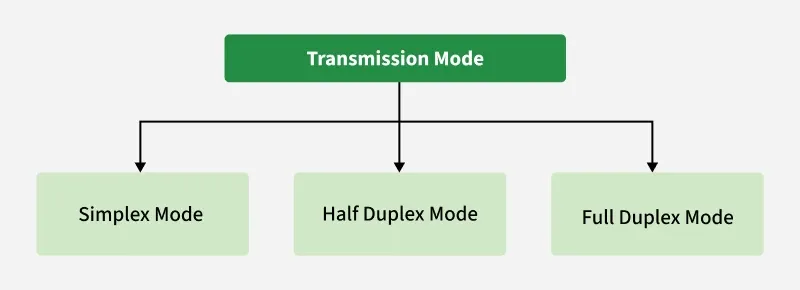
Transmission Modes
**Note: It is also known as a communication mode. Buses and networks are designed to allow communication to occur between individual devices that are interconnected
Simplex Mode
Simplex Mode is a transmission mode in which communication occurs in only one direction, from a sender to a receiver, without any possibility of reverse data flow.
- One device acts only as transmitter
- The other device acts only as receiver
- No feedback or acknowledgment is supported

**Example: Keyboard and traditional monitors. The keyboard can only introduce input, the monitor can only give the output.
**Advantages
- Simple and easy to implement
- Lower installation and maintenance cost
- Utilizes the entire bandwidth for sending
- Suitable for broadcast-type applications
**Disadvantages
- No error reporting from receiver
- Not suitable for interactive systems
- Cannot confirm successful delivery
- Limited use in modern two-way communication systems
Half-Duplex Mode
Half-Duplex Mode is a transmission mode in which communication can occur in both directions, but only one device can transmit at a time. The devices take turns sending and receiving data over the same channel.
- Supports bidirectional communication
- Uses a single shared communication channel
- Transmission occurs alternately between devices

**Example: Walkie-talkie in which message is sent one at a time and messages are sent in both directions.
**Advantages
- More flexible than one-way communication
- Cost-effective compared to full-duplex systems
- Efficient use of a single channel
- Suitable for controlled communication environments
**Disadvantages
- Cannot send and receive simultaneously
- Possible delay due to turn-based transmission
- Performance decreases with heavy traffic
- Risk of collision if control mechanisms fail
Full-Duplex Mode
Full-Duplex Mode is a transmission mode in which communication takes place in both directions at the same time. Both connected devices can transmit and receive data simultaneously without waiting for each other.
- Enables simultaneous two-way data exchange
- Uses separate channels or divided bandwidth
- Common in real-time communication systems

**Example: Telephone Network in which there is communication between two persons by a telephone line, through which both can talk and listen at the same time.
**Advantages
- Faster data transfer rate
- No waiting time between transmissions
- Improved communication efficiency
- Suitable for interactive applications
**Disadvantages
- Higher installation cost
- Requires more complex hardware
- Greater bandwidth requirement
- Increased system configuration complexity