URI Full Form (original) (raw)
Last Updated : 6 May, 2026
URI stands for Uniform Resource Identifier. It is a technical term used for all resources connected to the World Wide Web. URIs established the protocols over the Internet to connect resources. It is a sequence of characters that identifies a logical or physical resource. Usually, but not always, connected to the internet.
- A URI is used to distinguish one resource from another.
- URIs allow internet protocols to facilitate interactions between and among these resources.
- The strings of characters incorporated in a URI serve as identifiers, such as a scheme name and a file path.
**How Uniform Resource Identifiers Work
URI used an extensible way to identify internet resources. There may be different types of resource identifiers that can be used for the same context, regardless of the mechanism used to access those resources.
URI is used to identify different types of resources, like:
- Electronic Documents
- Webpages
- Images
- Information Sources with a consistent purpose
URI vs URL
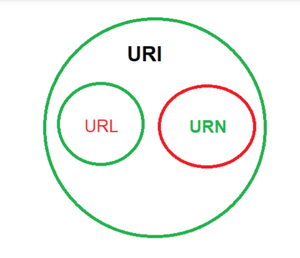
A frequent source of misunderstanding is the difference between a URI and a URL. Not every URI is a URL, even if all URIs are URLs.
- URI: A **Uniform Resource Name, or URN. Any identifier that serves as a resource's unique identifier falls under this larger category.
- URL: A particular kind of **Uniform Resource Identifier (URI) is a URL (Uniform Resource Locator), which describes the main access mechanism (e.g., network location) of a resource and offers a way to locate it.
Significance of URI
URIs are important because they allow resources to be identified consistently across the internet. Consistent communication across many platforms and systems is made possible by this standardization. Since URIs make it possible to precisely locate and access resources, they are essential to the way the web works. It would be difficult to browse the enormous amount of information accessible on the internet without URIs.
Not every URI is a URL, but every URL is a URI.
**Type of URI
There are two type of URI:
- **Fragment URI (URN): URN stands for Universal Resource Name. it refer the location of the content using anchor Identifier. URNs are URL but not vice Versa. There is a prefix URN for all the URNs. When you specify “access mechanism, location’’ And URI becomes URL.
- **Relative URI (URL): URL stands for Uniform Resource Locator. URI is the super set of URL. It may contain URN or Fragment URI that define the document inside the content. URL has Information about how to fetch / acquire a resources from its location. URLs always begins with a protocol (Most obvious, HTTP). It will Have the details about the host name and also have the path. A URL is used When a client is raising a request to the server for the services.