What is Modulation? (original) (raw)
Last Updated : 27 Mar, 2026
Process by which data is converted into electrical/digital signals for transferring that signal over a medium is called modulation. It increases strength for maximum reach of the signals.
- The process of extracting data from the transmitted signal is called demodulation.
- Modem is a device that performs both modulation and demodulation processes.
- The most commonly altered characteristics of modulation include amplitude, frequency, and phase.
- **Carrier signal: The signals that contain no information but have a certain phase, frequency, and amplitude are called carrier signals.
- **Modulated signals: The signals that are the combination of the carrier signals and modulation signals are modulated signals. The modulated signal is obtained after the modulation of the signals.
Types of Modulation
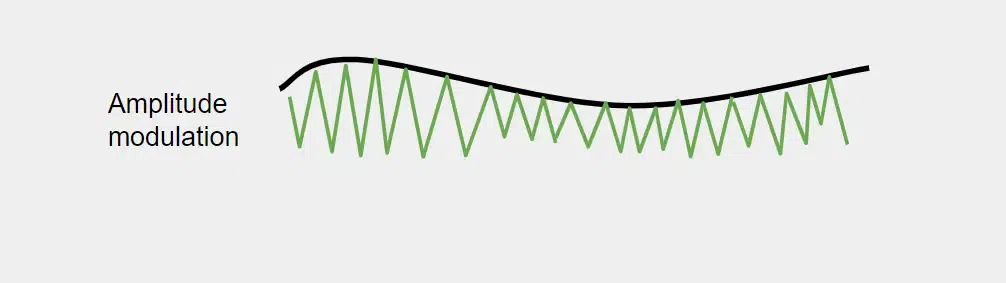
- **Amplitude Modulation: It is a type of modulation in which only the amplitude of the carrier signal is varied to represent the data being added to the signals whereas the phase and the frequency of the signal are kept unchanged.
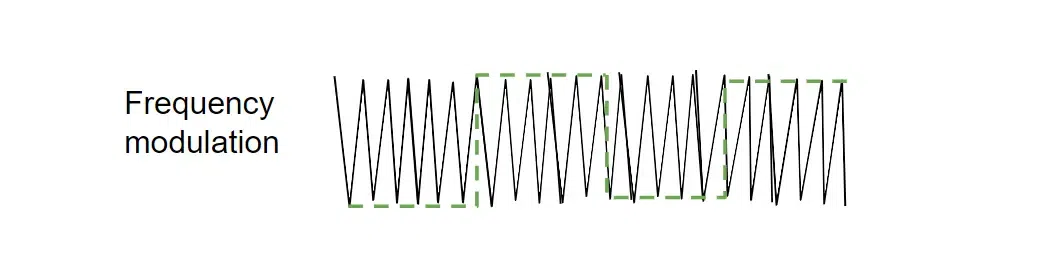
- **Frequency Modulation: It is a type of modulation in which only the frequency of the carrier signal is varied to represent the frequency of the data whereas the phase and the amplitude of the signals are kept unchanged.
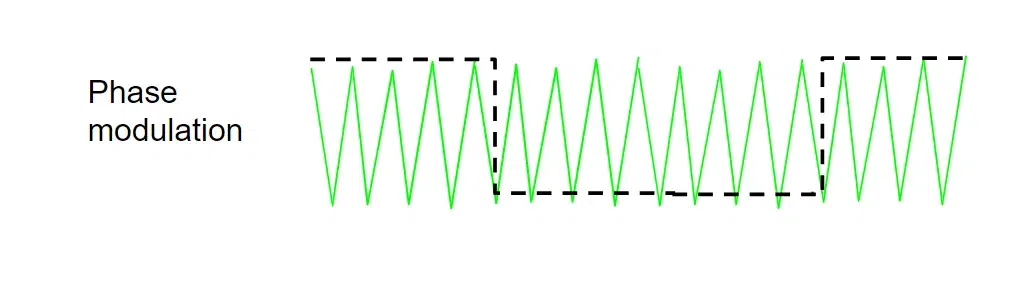
- **Phase Modulation: It is a type of modulation in which the phase of the carrier signal is varied to represent the data being added to the signal. Different information values are represented by different phases. For example: '1' may be represented by 0° while '0' by 180°.
- **Polarisation Modulation: Polarisation modulation involves varying the angle of rotation of an optical carrier signal to reflect transmitted data.
- **Pulse-Code Modulation: An analog signal is sampled to generate a data stream, which is then utilized to modulate a digital carrier signal.
- **Quadrature Amplitude Modulation (QAM): Quadrature amplitude modulation employs two AM carriers to encode two or more bits in a single transmission.
Need for Modulation
- **Size of Antenna: As we know that the size of the antenna is inversely proportional to the frequency of the radiated signal and antenna size must be 1/10th of the wavelength. If the frequency signals are more than 5KHz in that case it is quite impossible to set up an antenna of that size. So, by using the modulation technique the size of the antenna is reduced.
- **Wireless Communication: Modulation provides a wireless connection to transmit the signals to a longer distance. Earlier we used wire systems (like the telephone) to transfer information with the help of telephonic wires but it was not possible to spread the wires all over the world for communication. By using the modulation technique, the cost of wire is saved and even information can be transferred to longer distances faster.
Working
Data can be added to the carrier signal by varying its amplitude, frequency, and phase. Basically, modulation is applied to electromagnetic signals like radio waves, optics, and computer networks. It can also be applied to direct current that can be treated as a degenerate carrier wave with a fixed amplitude and frequency of 0 Hz by turning it off and on as in a digital current loop and in Morse code telegraphy.
Modulation in Communication
Multiple carriers of various frequencies can frequently be sent across the same medium, with each carrier modulated by a separate signal. For Example Wi-Fi employs individual channels to transmit and receive data from several customers at the same time. A carrier signal is used to decrease the wavelength for more effective transmission and reception. Because the ideal antenna size is one-half or one-quarter of a wavelength, an audio frequency of 3000 Hz needs a wavelength of 100 kilometers and a 25-kilometer antenna. Instead, with a 100 MHz FM carrier and a wavelength of 3 meters, the antenna would only need to be 80 cm long.
Advantages
- It reduces the size of the antenna.
- It reduces the cost of wires.
- It prohibits the mixing of signals.
- It increases the range of communication.
- It improves the reception quality.
- It easily multiplexes the signals.
- It also allows the adjustment of the bandwidth.
Disadvantages
- The cost of the equipment is higher.
- The receiver and the transmitter are very complicated.
- For better communication, the antennas for the FM system must be kept closed.
- It is not efficient for large bandwidth.
- Power wastage takes place.
Duty Cycle
In wireless communications, the duty cycle is the percentage of time the wireless network emits RF signals. As a result, the duty cycle is an important factor when measuring a person's exposure to electromagnetic radiation. The actual duty cycle differs based on the network's data load and speed. As a result, the duty cycle can be changed by whether the network is used for Voice Over Internet Protocol(VoIP), streaming videos, or videos.
Demodulation
The Demodulation is the process of extracting the original information from a modulated carrier wave. It is an important function used in the communication systems which allows the recovery of transmitted data at the receiver end. Demodulation is the technique to recover the original signal from the modulated signal. The demodulation is done with the help of a demodulator. A demodulator will convert the carrier variation of amplitude, frequency, or phase back to the message signal. There are three different types of demodulators for converting the AM (amplitude modulation), FM (frequency modulation), and PM (phase modulation) modulation schemes.
Modulation vs Demodulation
| Modulation | Demodulation |
|---|---|
| The process by which data is converted into electrical/digital signals for transferring that signal over a medium is called modulation. | The process of extracting data from the transmitted signal is called demodulation. |
| Modulation is connected from transmitting end. | Demodulation is connected from Receiving end. |
| Modulation converts digital signal to analog signal. | Demodulation converts analog signal to digital signal. |
| The transmission of frequency in modulation goes low to high. | The transmission of frequency in demodulation goes high to low. |
| In modulation, the circuit used is modulator. | In demodulation, the circuit used is demodulator. |