X.509 Authentication Service (original) (raw)
Last Updated : 11 Apr, 2026
X.509 represents a digital certificate based on the ITU standard defining the format of PKI certificates, serving as a certificate-based authentication framework for secure transactions and protection of private information, widely used for managing security and identity in computer networks and internet communications.
**Working of X.509 Authentication Service Certificate
- Public key certificates form the core of authentication, issued by a trusted certification authority for each user.
- Certificates are stored in directory servers for easy access and retrieval by users.
- Standard is based on ASN.1, enabling the structured representation of certificate data.
- Uses a public and private key pair for encryption and decryption of messages.
- A certificate acts like an identity proof attached to the user for authentication.
- Provides higher security compared to passwords, reducing the risk of theft or misuse.
- Authentication occurs by presenting a certificate to access protected resources.
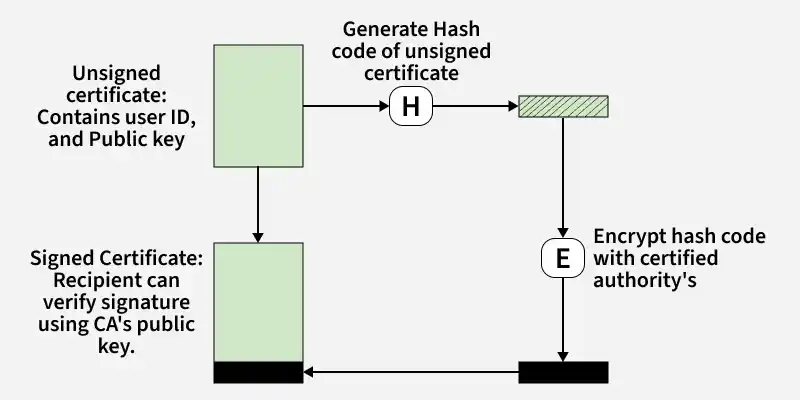
Public Key certificate use
Format of X.509 Authentication Service Certificate:
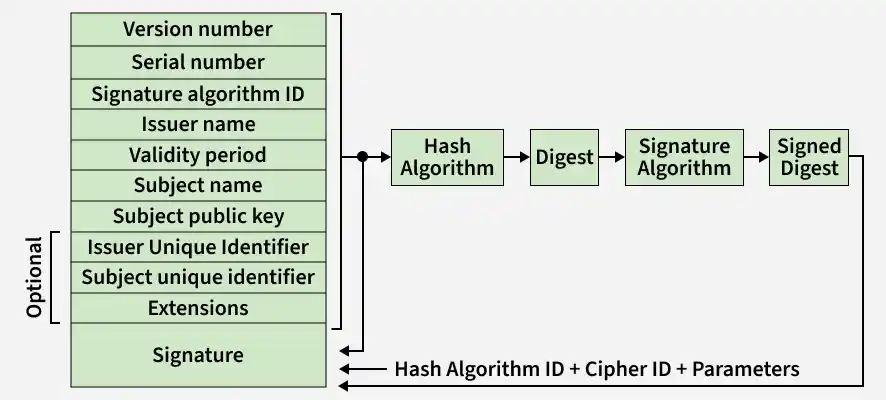
**The certificate includes the elements given below:
- **Version number: Specifies version of X.509 standard used for certificate.
- **Serial number: Unique number assigned by certificate authority to identify certificate.
- **Signature Algorithm Identifier: Algorithm used for signing certificate.
- **Issuer name: Specifies X.509 name of certificate authority that issued and signed certificate.
- **Period of Validity: Defines validity period of certificate.
- **Subject Name: Specifies name of user to whom certificate is issued.
- **Subject’s public key information: Specifies subject public key along with identifier of associated algorithm.
- **Extension block: Contains additional standard information.
- **Signature: Contains hash of all other fields encrypted using certificate authority private key.
**Characteristics of X.509 Authentication Certificates
- **Standardized Format: Follows ITU-T standard, ensuring interoperability across systems and platforms.
- **Based on Public Key Cryptography: Contains a public key for secure encryption, authentication, and digital signing.
- **Issued by a Certificate Authority (CA): Signed by a trusted CA that verifies and authenticates the certificate holder’s identity.
- **Includes Identity Information: Stores details like Common Name, Organization, Country, and optionally Email Address.
- **Defined Validity Period: Includes start and expiration dates; becomes invalid after expiry unless renewed.
- **Supports Revocation Mechanisms: Can be revoked before expiry using CRLs or OCSP if compromised or misused.
- **Supports Trust Hierarchies: Enables trust chains through root and intermediate CAs in a scalable structure.
- **Digitally Signed: Digitally signed by the CA to ensure the certificate’s authenticity and integrity.
**Applications of X.509 Authentication Service Certificate:
- **Document Signing and Digital Signatures: X.509 certificates are used to verify the authenticity and integrity of digital documents through digital signatures.
- **Web Server Security (TLS/SSL Certificates: They are essential for securing websites using Transport Layer Security (TLS) or Secure Sockets Layer (SSL), enabling HTTPS and encrypting communication between web browsers and servers.
- **Email Certificates: X.509 certificates provide email encryption and authentication, ensuring the confidentiality and authenticity of email communication (e.g., using S/MIME).
- **Code Signing: Used to digitally sign software, ensuring code integrity and verifying identity of software publisher.
- **Secure Shell Protocol (SSH) Keys: Although SSH typically uses a different key format, X.509 certificates can be used in certain environments for enhanced SSH authentication.
- **Digital Identities: X.509 certificates are a fundamental component in establishing digital identities for users, devices, and services in secure systems.