Difference between RAM and Cache (original) (raw)
Last Updated : 15 Jul, 2025
Memory is important in modern computing systems because it allows for efficient and quick data processing. Random Access Memory (RAM) and cache memory are two common types of memory used in computers. Both serve separate purposes and are required for a computer's maximum performance. RAM is the primary memory that stores data and programs currently in use by the CPU, whereas cache memory is a smaller, quicker memory component that saves frequently requested data to accelerate processing. This document delves into the characteristics, similarities, and differences between RAM and cache memory, providing a thorough explanation of their responsibilities in a computer system.
**1. Random Access Memory (RAM)
Random Access Memory (RAM) is used to store the programs and data being used by the CPU in real time. The data on the random access memory can be read, written, and erased any number of times. RAM is a hardware element where the data being currently used is stored. It is a volatile memory. Two types of RAM are Static RAM, or (SRAM), and Dynamic RAM, or (DRAM).
**Features of RAM memory
- Volatile memory: RAM is a volatile memory, which means that its contents are lost when the computer is turned off or restarted.
- Random access: RAM allows the CPU to access any location in memory directly, without having to access it sequentially.
- Capacity: RAM has a larger capacity than cache memory and can store more data and instructions.
- Speed: While RAM is slower than cache memory, it is still much faster than storage devices like hard drives.
- Types: There are different types of RAM, including SDRAM, DDR, DDR2, DDR3, DDR4, and DDR5. Each type has different specifications, such as speed and voltage requirements.
**2. Cache Memory
The cache is a smaller and fast memory component in the computer which is inserted between the CPU and the main memory. To make this arrangement effective. The cache needs to be much faster than the main memory. This approach is more economical than the use of fast memory devices to implement the entire main memory.
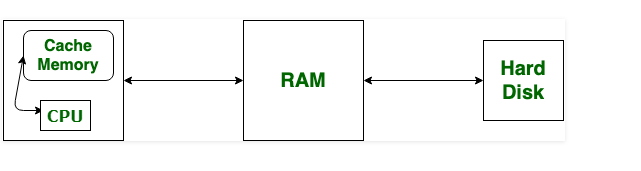
**Features of Cache memory
- **Volatile Memory: Cache memory is a volatile memory, which means that its contents are lost when the computer is turned off or restarted.
- **Temporary Storage: Cache memory is used to store frequently accessed data and instructions temporarily, so that they can be accessed more quickly by the CPU.
- **Speed: Cache memory is much faster than RAM, as it is located closer to the CPU and has a smaller capacity.
- **Types: There are different levels of cache memory, including L1, L2, and L3 cache. Each level has different specifications, such as size and access speed.
Similarities
- **Both Are Temporary: Both RAM and cache memory are temporary storage locations for data and instructions that the CPU needs to access quickly. Both types of memory lose their contents when the power is turned off or when the computer is shut down.
- **Speed: Both RAM and cache memory are faster than storage devices like hard drives or solid-state drives. This is because they provide random access to data, allowing for quicker retrieval times compared to the sequential access of hard drives. Additionally, RAM and cache memory are located closer to the CPU, further enhancing their access speeds.
- **Performance: Both RAM and cache memory help to improve the performance of a computer. RAM allows the computer to run more programs and processes simultaneously, while cache memory allows the CPU to access frequently used data and instructions quickly.
- **Levels: Both RAM and cache memory come in different levels. RAM can have different speeds and capacities, and cache memory can have different levels (such as L1, L2, and L3 cache) and sizes.
**Difference Between RAM and Cache
| RAM | CACHE |
|---|---|
| RAM is a volatile memory that could store the data as long as the power is supplied. | Cache is a smaller and fast memory component in the computer. |
| The size of RAM is greater. | The size of cache memory is less. |
| It is expensive but not as expensive as Cache. | It is expensive than RAM. |
| It holds programs and data that are currently executed by the CPU. | It holds frequently used data by the CPU. |
| It is not fastest as compared to cache. | It is faster. |
| RAM is faster than a hard disk, floppy disk, compact disk, or just any form of secondary storage media. | Cache memory increase the accessing speed of CPU. |
| CPU reads Cache Memory data before reading RAM. | CPU reads RAM data after reading Cache Memory. |
| It can be internal and external both. | It is generally internal. |
| Types of RAM-Static RAM (SRAM)Dynamic RAM (DRAM) | Types of Cache-L1 (Level 1) cache or Primary cacheL2 (Level 2) cache or Secondary cacheL3 (Level 3) cache |
| RAM is a short-term digital storage used to keep data and software that is now being used by the CPU. | It is located in close proximity to CPU, thus storing copies of data or instructions from frequently accessed locations of main memory in order to provide high-speed access by the processor. |
Conclusion
RAM and Cache are both essential components of a computer system that have different characteristics, purposes, and performance capabilities. RAM is the main memory of a computer that stores the operating system, applications, and data, while Cache is a small amount of memory that is used to store frequently accessed data and instructions to speed up processing time. Cache memory is faster but has a smaller capacity than RAM, and it is more expensive. RAM, on the other hand, is cheaper and has a larger capacity.