Different Classes of CPU Registers (original) (raw)
Last Updated : 12 Jul, 2025
CPU registers are high-speed memory units essential for efficient program execution, enabling quick access to frequently used values involved in processing. They play a crucial role in data manipulation, memory addressing, and tracking processor status. While accessing instructions from RAM is faster than from a hard drive, it's still not quick enough for the CPU, which is why registers are used to store and retrieve data faster. They work in coordination with the CPU's memory to optimize processing, with cache memory being the next step in speed, though still slower than registers. Each class of CPU registers, from general-purpose to status and control registers, supports specific tasks to ensure smooth and rapid execution of operations.
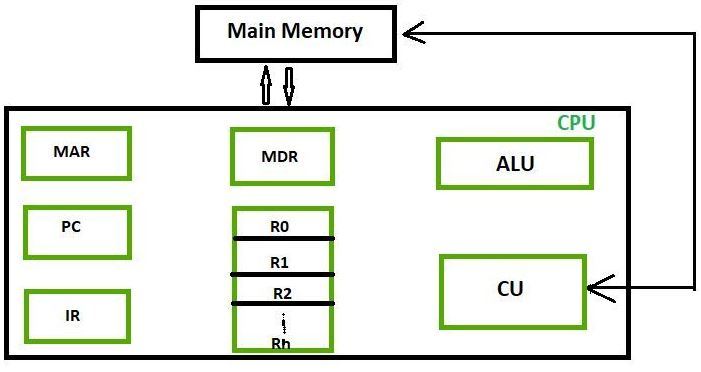
Different Types Of CPU Registers
There are several types of registers available in the CPU for different purposes let's discuss each one by one:
- **Accumulator : This is the most frequently used register used to store data taken from memory. It is indifferent numbers in different microprocessors.
- **Memory Address Registers (MAR) : It holds the address of the location to be accessed from memory. MAR and MDR (Memory Data Register) together facilitate the communication of the CPU and the main memory.
- **Memory Data Registers (MDR) : It contains data to be written into or to be read out from the addressed location.
- **General Purpose Registers : These are numbered as R0, R1, R2....Rn-1, and used to store temporary data during any ongoing operation. Its content can be accessed by assembly programming. Modern CPU architectures tend to use more GPR so that register-to-register addressing can be used more, which is comparatively faster than other addressing modes .
- **Program Counter (PC) : Program Counter (PC) is used to keep the track of the execution of the program. It contains the memory address of the next instruction to be fetched. PC points to the address of the next instruction to be fetched from the main memory when the previous instruction has been successfully completed. Program Counter (PC) also functions to count the number of instructions. The incrementation of PCs depends on the type of architecture being used. If we are using a 32-bit architecture, the PC gets incremented by 4 every time to fetch the next instruction.
- **Instruction Register (IR): The IR holds the instruction which is just about to be executed. The instruction from the PC is fetched and stored in IR. As soon as the instruction is placed in IR, the CPU starts executing the instruction, and the PC points to the next instruction to be executed.
- **Stack Pointer (SP): The stack PCs pointer points to the top of the stack, which is a part of the memory used to store function calls and other operations.
- **Flag Register: A flag register , also known as a status register or condition code register, is a special type of register in a computer's central processing unit (CPU) used to indicate the status of the CPU or the outcome of various operations such as Zero Flag, Carry flag, Sign Flag, Overflow Flag, Parity Flag, Auxiliary Carry Flag, and Interrupt Enable Flag.
- **Condition code register ( CCR ): Condition code registers contain different flags that indicate the status of any operation. For instance, let's suppose an operation caused the creation of a negative result or zero, then these flags are set high accordingly. and the flags are
- Carry C: Set to 1 if an add operation produces a carry or a subtract operation produces a borrow; otherwise cleared to 0.
- Overflow V: Useful only during operations on signed integers.
- Zero Z: Set to 1 if the result is 0, otherwise cleared to 0.
- Negate N: Meaningful only in signed number operations. Set to 1 if a negative result is produced.
- Extend X: Functions as a carry for multiple precision arithmetic operations.
These are generally decided by ALU.
So, these are the different registers that are operating for a specific purpose.
Size of CPU Register
The number and size of the register in the CPU depend on the processor design and can have an important impact on its performance and capabilities on the CPU. Now, let's discuss the different sizes of the register available in the CPU:
- **8-bit registers: These can store 8 bits of data, which is the same as 1 byte. They are used for simple arithmetic and data manipulation.
- **16-bit registers: These hold 16 bits of data, or 2 bytes. These registers are found in older processors or certain systems that need 16-bit operations.
- **32-bit registers: These can store 32 bits of data or 4 bytes. They are common in many processors and can handle larger data sizes and more complex calculations than 8-bit or 16-bit registers.
- **64-bit registers: These hold 64 bits of data, or 8 bytes. Modern processors often use these, providing more computational power and better memory-addressing capabilities.
Most modern computers use 32-bit or 64-bit registers, and that's why we call them 32-bit or 64-bit processors. This terminology refers to the width of the processor's registers and how much data it can handle at once.
In some specialized processors, you might see even larger registers like 128-bit or 256-bit. These are used for specific tasks such as vector processing or cryptography where dealing with large data sets and parallel processing is important.
Purpose of Registers
Registers play a very important role in computers, and they are used by CPU for various purposes.
- **Storing Instruction: Registers are used to store the instruction from programs before the CPU follows them. This helps the computer quickly find and follow the steps it needs to take.
- **Holding Answer: When the computer does math calculations or other tasks, the register stores the temporary answer.
- **Quick Access to Important Stuff: Registers are like the computer's quick-access shelves. They keep important things nearby, so the computer can grab them fast without going far away to get them. It's like keeping your favorite tools on a shelf right next to you, instead of in a faraway closet.
So, registers are like the computer's quick-access memory, helping it work faster and smarter.