First Generation Of Computer (original) (raw)
Last Updated : 23 Jul, 2025
Imagine a time before smartphones, laptops, or even calculators as we know them. That's the era when the very first electronic computers were born, during the 1940s and 1950s. These machines, known as **first-generation computers, were truly groundbreaking, even though they seem very different from the computers we use today.
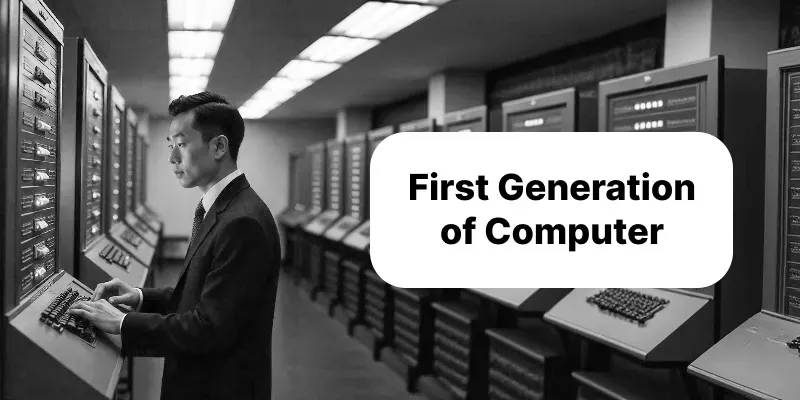
The first generation of computers (1940s-1950s) used vacuum tubes.
What were First-Generation Computers?
The technology behind the first-generation computers was a fragile glass device, which was called a vacuum tube. These computers were very heavy and really large. They are not reliable, programming on them was a tedious task as they used low-level programming language and used no Operating System. First-generation computers were used for calculation, storage, and control purposes. Punch cards were used to improve the information for external storage.
**What is a Vacuum Tube?
A vacuum tube, also sometimes called an electron tube or valve, is a device that controls the flow of electrical current within a sealed glass enclosure where most of the air has been removed (creating a "vacuum"). By applying electrical signals to different parts of the tube (called electrodes), the flow of electrons can be controlled. In first-generation computers, vacuum tubes acted as electronic switches, enabling the machines to perform calculations.
Examples of First Generation Computer
****1. ENIAC (**Electronic Numerical Integrator and Computer - **1945)
- **What it was: The very first general-purpose _electronic computer. It was initially built for military calculations. Imagine a machine with around 17,000 vacuum tubes that filled an entire room!
- **Why it was important: ENIAC showed the world the potential of programmable digital computers. It was a huge leap forward.
*2. UNIVAC I (Universal Automatic Computer I*1951)
- **What it was: The first computer that was made and sold commercially. It was designed for both business and scientific uses.
- **Why it was important: UNIVAC I marked the beginning of computers being used in everyday business operations.
**3. Colossus (1943)
- **What it was: A secret British machine built during World War II to help break German codes.
- **Why it was important: Colossus played a vital role in the Allied efforts during the war by helping to decipher enemy messages.
**4. IBM Harvard Mark I (1944)
- **What it was: A large computer that used both electrical and mechanical parts. It was used for military and scientific calculations.
- **Why it was important: The Mark I was an important step in the development of computing, particularly for scientific and defense applications.
**5. ABC (Atanasoff-Berry Computer) (1937-1942)
- **What it was: One of the earliest attempts at building an electronic digital computer. It was designed to solve algebraic equations.
- **Why it was important: The ABC introduced some key ideas that would be used in later computer
**Characteristics of First-Generation Computers
| Characteristic | Description |
|---|---|
| Core Technology | Utilized vacuum tubes for processing and switching |
| Physical Size | Massive machines, often filling entire rooms |
| Power Consumption | High power usage with significant heat generation |
| Processing Speed | Slow operation due to the limitations of vacuum tube technology |
| Programming Method | Programmed using machine language (binary code) and punched cards |
| Input/Output Method | Relied on **punch cards for input and output |
| Reliability | **Unreliable due to frequent breakdowns of vacuum tubes |
| Cost | **Extremely expensive to build, maintain, and operate |
| Memory Storage | **Magnetic drum memory for temporary data storage |
| Primary Use | Used for **military calculations, scientific research, and cryptography |
| Examples of the first generation | IBM 650, IBM 701, ENIAC, UNIVAC1, etc. |
Advantages of First Generation Computer
- Computers can process large amounts of data quickly.
- They help in automating tasks, saving time and effort.
- They offer accurate results and minimize human errors.
- Computers can store vast amounts of information in digital form.
- They allow easy access to information and communication through the internet.
- They have made various tasks like calculations, research, and design more efficient.
**Disadvantages of First-Generation of Computers
- They can be expensive to purchase and maintain.
- Computers can become slow or malfunction due to software or hardware issues.
- Prolonged use of computers can cause health problems like eye strain and poor posture.
- They are dependent on electricity, so power outages can cause interruptions.
- Computers can be vulnerable to viruses and hacking, leading to data loss.
- Excessive reliance on computers might reduce face-to-face communication skills.
**Conclusion
Even though first-generation computers had more drawbacks than advantages, their importance cannot be overstated. They were the very first steps in the digital revolution! Because of the lessons learned from these early machines, the **second generation of computers was developed, which used smaller, more reliable components called **transistors. The first generation of computers, using their amazing vacuum tubes, truly changed the world of technology forever.