LCD Full Form (original) (raw)
Last Updated : 12 Jul, 2025
What is the Full form of LCD?
The full form of LCD is **Liquid Crystal Display. it is a passive device, which means that it does not deliver any light to display characters, animations, videos, etc. LCD uses fluorescent tubes to lighten the picture, but can’t provide a clearer picture as LED delivers.
What is LCD?
LCD stands for Liquid Crystal Display. It is a flat panel display technology, mainly used in TVs and computer monitors, nowadays it is used for mobile phones also. These LCDs are completely different from that old CRT displays, it uses liquid crystals instead of cathode ray in its primary form of operation.

In LCD display, it consists of millions of pixels made of crystal and arranged in a rectangular grid. In LCD it has backlights that provide light to each pixel. Each pixel has a red, green, and blue (RGB) sub-pixel that can be turned on or off. When all of the sub-pixels are turned off, then it's black and when all the sub-pixels are turned on 100%, then it's white.
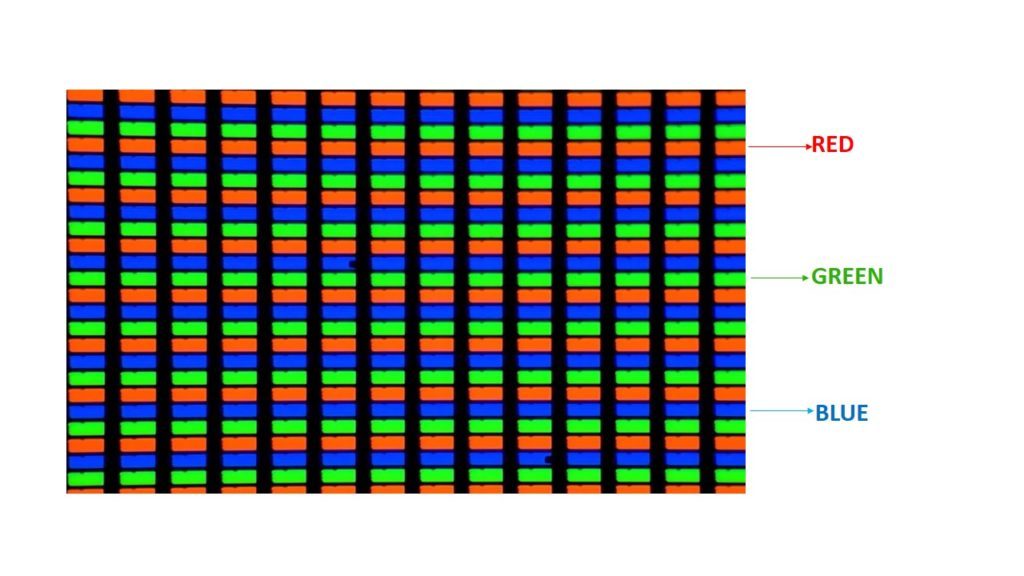
LCD is a combination of two states of matter, the solid and the liquid. The solid part is crystal and this liquid and crystal together make the visible image. LCD consists of two layers which are two polarized panels- filters and electrodes. LCD screen works by blocking the light rather than emitting the light. There are two types of pixel grids in LCD:
- **Active Matrix Grid- It is a newer technology. In smartphone with LCD display uses this technology.
- **Passive Matrix Grid- It is an older technology. Some older devices used this technology.
History of LCD
The LCD display was first built in the year 1964 in RCA Laboratories by _George Heilmeier who was an electrical engineer in the RCA lab.
At first in the year 1888, liquid crystal was discovered by _Friedrich Reinitzer by extracted cholesterol from carrots, who was an Austrian botanist. In that time liquid crystal was used in research and experimental works. Then by the year 1936, liquid crystal was used in a practical application and known as _Liquid Crystal Light Valve which is used in wireless telegraphy.
Then in the year 1962, a researcher of RCA _Richard Williams generated some patterns in a thin layer of liquid crystal material by applying voltage on it, which is known as electro-optical effects. After all these things finally in 1964 LCD was invented.
The first modern LCD was produced in the year 1972, by _International Liquid Crystal Company (ILIXCO) owner _James Fergason. This LCD was made using passive grid technology. In the year 1995 Hitachi and NEC were the first manufacturers of active matrix LCDs. These LCDs are based on IPS(In Plane Switching) technology. After all this, by the year 1996 SAMSUNG, TOSHIBA has came to market.
Different Types of LCD
There are mainly four types of LCD are available.
1. Twisted Nematic (TN)
Which are cheap but have fast response times. TN screens, on the other hand, have low contrast ratios, viewing angles, and color contrasts. The use of TN LCDs in many types of displays across industries has resulted in their widespread manufacture.
2. Panel Switching displays (IPS Panels)
When compared to TN LCDs, In Panel Switching displays (IPS Panels) have significantly higher contrast ratios, viewing angles, and color contrast. When compared to TN LCDs, In Panel Switching displays provide superior picture quality, bright color precision, and difference.
3. Vertical Alignment Panels (VA Panels)
Vertical Alignment Panels (VA Panels) are regarded as a grade intermediate between TN and IPS displays. Vertical alignment panels are seen to be a good compromise between in-plane switching panels and twisted nematic technology. When compared to TN-type displays, this type of panel has superior quality color reproduction as well as the best viewing angles.
4. Advanced Fringe Field Switching (AFFS)
A top performer in the color reproduction range when compared to IPS displays. AFFS LCD is a top performer with a wide range of color reproduction options. These monitors produce high-quality images. These displays are most typically used in high-tech applications such as viable airplane cockpits.
Working of LCD
The premise underlying LCDs is that liquid crystals are used to flip pixels on and off to expose a specific color. When an electrical current is provided to a liquid crystal molecule, the molecule tends to untwist. This produces a shift in the angle of the top polarizing filter, as well as the angle of light traveling through the molecule of the polarized glass. As a result, a little light is permitted to let the polarized glass through an individual area of the LCD.
As a result, in comparison to other places, this one will appear dark. LCDs work on the premise of blocking light rather than emitting it. When the LCDs are built, a mirror is installed on the backside. The electrode plane, which is kept on top of the device, is made of indium-tin-oxide. A polarized glass with a polarizing coating is also included on the device's bottom.
The entire region of the LCD must be contained with the use of a common electrode, and the liquid crystal matter must be above it. Then, on top, another polarizing film, and on the bottom, in the shape of a rectangle, the second piece of glass with an electrode. However, ensure that both parts are at the correct angles. When there is no current, light flows through the front of the LCD, reflecting and bouncing back with the help of a mirror. In front of the light is a screen composed of red, green, and blue pixels. To reveal a certain hue or keep a pixel dark, liquid crystals work by turning on or off a filter.
Characteristics of LCD
Main characteristics of LCD are:
- **Voltage: 3V to 12V
- **Operating temperature: Normally it ranges from 0^0C to +60^0C , but for extreme cases it varies from -40^0C to +85^0C .
- **Frequency: 30Hz to 60 Hz
- **Average Current consumption: 1.2\mu A to 6\mu A
- **Opening Time: 100 ms
Also LCD has other characteristics in terms of many areas, that are
- **Resolution: LCD is made up of liquid crystal, which is neither liquid nor solid, and this thing reflects the light in a well-formed way, lights enter into the crystal and reflect very clearly. So the image made with this liquid crystal is very accurate. LCD is a Digital display, which addresses each individual pixel using a fixed matrix of horizontal and vertical dots. LCD scales the image according to the resolution the device provided. So the quality of the image is not degraded.
- **Brightness: Brightness means the light provided by the LCD, which is nothing but the intensity of visible light, it is measured using nits. Nits is defined as one candela per square meter. In LCD brightness is very much accurate for the good resolutions and pixels.
- **Contrast Ratio: It is the ratio of the brightest color and the darkest color for a particular position of the screen provided by the display. To calculate contrast ratio(CR) see the below formula: Contrast Ratio(CR) = \frac{brightness of the screen when pixels are white} {brightness of the screen when pixels are white}
Typically the ratios of modern monitors are 1000:1 and TVs are 4000:1. - **Response Rate: Response Rate is high in LCD, it means the time required for changing colors of the pixels is very much less, so that the refresh rate is very high in LCD than CRT. There is no lagging between the pixels when the image is changed.
Advantages of LCD :
- The main advantage of LCD is, it has low in cost and energy efficient and very less power consumption.
- LCD is thinner and lighter and very flexible.
- LCD provides excellent contrast, brightness and resolution, so the picture quality is very clear like a crystal.
- Radiation of LCD monitors are much less than CRT monitors.
- LCDs can be suitable with CMOS integrated circuits so that making of LCD is very easy.
- It gives perfect sharpness at the native resolution.
- Zero geometric distortion at the native resolution of the pane.
- It provides various conveniences like portability as compared to previous technology based screens.
Disadvantages of LCD
- LCD require additional light sources for lighting the pixels, so if the light source is destroyed then the LCD is not providing any image on the display.
- LCD is less reliable display.
- The image visibility depends on light intensity
- The aspect ratio and resolution are fixed for LCD.
- LCD has an irregular intensity scale and it produce lower than 256 discrete intensity levels.
- In LCD color saturation is reduced at the low intensity level due to poor black-level.
- LCD provide limited viewing angle, it effects the brightness. if we are watching the screen by an angle then the color of the image is changed in our eyes.