Difference Between CPU Cache and TLB (original) (raw)
Last Updated : 23 Jul, 2025
The CPU Cache and Translation Lookaside Buffer (TLB) are two important microprocessor hardware components that improve system performance, although they have distinct functions. Even though some people may refer to TLB as a kind of cache, it's important to recognize the different functions they serve in a computer's memory management system.
What is CPU Cache?
A CPU cache is a fast memory that is smaller and situated closer to the processor core. Its purpose is to decrease the latency while retrieving data from RAM to the CPU registers. Frequently used data or executable instructions may be temporarily stored there, enabling the CPU to access them more quickly than when retrieving them from the slower main memory.
Types of CPU Cache
- Instruction Cache (I-Cache): Accelerates the instruction fetching process by storing executable instructions.
- Data Cache (D-Cache): Reduces the amount of time it takes to obtain data by storing it when needed by the processor.
- Data and instructions are both stored in the unified cache.
CPU Cache Hierarchy
Usually, the CPU cache is arranged in a hierarchy like this:
- L1 Cache: Located in close proximity to the CPU core, this cache is the smallest, quickest, and most costly.
- L2 Cache: Slower than L1, but somewhat bigger.
- Larger and slower than L1 and L2, the L3 cache is shared by many cores.
Advantages of CPU Cache
- shortens the time it takes to get data from main memory.
- decreases memory latency, thereby increasing CPU performance overall.
Disadvantages of CPU Cache
- restricted in size and capability.
- Cost and complexity have increased.
What is TLB (Translation Lookaside Buffer)?
In systems that employ virtual memory, a Translation Lookaside Buffer (TLB) is a kind of specialized cache that is used to accelerate the translation of virtual addresses to physical addresses. The most recent mappings from virtual memory addresses to physical memory addresses are stored there, making it possible for the Memory Management Unit (MMU) to rapidly obtain these mappings without having to consult the slower main memory page table.
TLB Operation
When a virtual address has to be translated into a physical address during address translation, TLB is involved. The MMU controls it, and by storing the page table entries in a quicker memory, it expedites the translation process.
Advantages of TLB
- accelerates the conversion of virtual to physical addresses.
- lessens the need to get page tables from slower main memory.
Disadvantages of TLB
- Restricted size—typically much less than the CPU cache.
- Needs more software and hardware support in order to be managed.
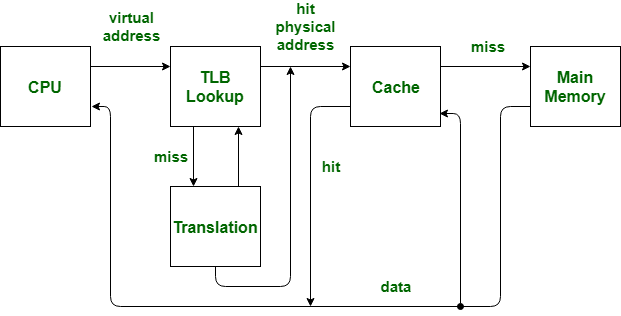
**Key Differences Between CPU Cache and TLB
| Feature | CPU Cache | **TLB |
|---|---|---|
| **Purpose | Reduces data/instruction fetching time from main memory | Speeds up the translation of virtual addresses to physical addresses |
| **Operation Time | Active during memory access by the CPU | Active during address translation by MMU |
| **Example | L1, L2, L3 Cache | L1 TLB |
| **Memory Size | Typically ranges from a few KB to several MB | Usually ranges from a few entries to a few thousand entries |
| **Speed | Much faster than main memory | Much faster than main memory |
| Miss Penalty | High, requires accessing slower memory | High, requires accessing slower memory for mapping information |
| Implementation | Pure hardware | Combination of hardware and software |
| Hit Rate | Typically high (above 95%) | Typically high (above 95%) |
Conclusion
Although they both improve the speed at which a processor may perform memory operations, CPU Cache and TLB function at distinct phases of memory management. In systems that use virtual memory, the TLB expedites the address translation process, while the CPU cache speeds up direct memory access. Comprehending their distinctions is essential for enhancing computer design and functionality.