Complex numbers in C++ | Set 1 (original) (raw)
Last Updated : 23 Jul, 2025
The complex library implements the complex class to contain complex numbers in cartesian form and several functions and overloads to operate with them. 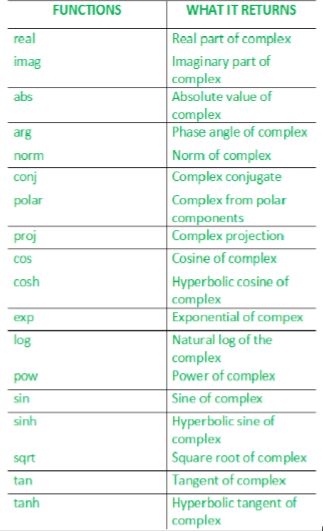
- **real() - It returns the real part of the complex number.
- **imag() - It returns the imaginary part of the complex number. CPP `
// Program illustrating the use of real() and // imag() function #include
// for std::complex, std::real, std::imag
#include
using namespace std;
// driver function
int main()
{
// defines the complex number: (10 + 2i)
std::complex mycomplex(10.0, 2.0);
// prints the real part using the real function cout << "Real part: " << real(mycomplex) << endl; cout << "Imaginary part: " << imag(mycomplex) << endl; return 0; }
`
- Output:
Real part: 10
Imaginary part: 2
**Time Complexity: O(1)
**Auxiliary Space: O(1)
- **abs() - It returns the absolute of the complex number.
- **arg() - It returns the argument of the complex number. CPP `
// Program illustrating the use of arg() and abs() #include
// for std::complex, std::abs, std::atg #include using namespace std;
// driver function
int main ()
{
// defines the complex number: (3.0+4.0i)
std::complex mycomplex (3.0, 4.0);
// prints the absolute value of the complex number cout << "The absolute value of " << mycomplex << " is: "; cout << abs(mycomplex) << endl;
// prints the argument of the complex number cout << "The argument of " << mycomplex << " is: "; cout << arg(mycomplex) << endl;
return 0; }
`
- Output:
The absolute value of (3,4) is: 5
The argument of (3,4) is: 0.927295
**Time Complexity: O(1)
**Auxiliary Space: O(1)
- **polar() - It constructs a complex number from magnitude and phase angle. real = magnitude*cosine(phase angle) imaginary = magnitude*sine(phase angle) CPP `
// Program illustrating the use of polar() #include
// std::complex, std::polar #include using namespace std;
// driver function int main () { cout << "The complex whose magnitude is " << 2.0; cout << " and phase angle is " << 0.5;
// use of polar() cout << " is " << polar (2.0, 0.5) << endl;
return 0; }
`
- Output:
The complex whose magnitude is 2 and phase angle is 0.5 is (1.75517,0.958851)
**Time Complexity: O(1)
**Auxiliary Space: O(1)
- **norm() - It is used to find the norm(absolute value) of the complex number. If z = x + iy is a complex number with real part x and imaginary part y, the complex conjugate of z is defined as z'(z bar) = x - iy, and the absolute value, also called the norm, of z is defined as :
 CPP `
CPP `
// example to illustrate the use of norm() #include
// for std::complex, std::norm #include using namespace std;
// driver function
int main ()
{
// initializing the complex: (3.0+4.0i)
std::complex mycomplex (3.0, 4.0);
// use of norm() cout << "The norm of " << mycomplex << " is " << norm(mycomplex) <<endl;
return 0; }
`
- Output:
The norm of (3,4) is 25.
**Time Complexity: O(1)
**Auxiliary Space: O(1)
- **conj() - It returns the conjugate of the complex number x. The conjugate of a complex number (real,imag) is (real,-imag). CPP `
// Illustrating the use of conj() #include using namespace std;
// std::complex, std::conj #include
// driver program int main () { std::complex mycomplex (10.0,2.0);
cout << "The conjugate of " << mycomplex << " is: ";
// use of conj() cout << conj(mycomplex) << endl; return 0; }
`
- Output:
The conjugate of (10,2) is (10,-2)
**Time Complexity: O(1)
**Auxiliary Space: O(1)
- **proj() - It returns the projection of z(complex number) onto the Riemann sphere. The projection of z is z, except for complex infinities, which are mapped to the complex value with a real component of INFINITY and an imaginary component of 0.0 or -0.0 (where supported), depending on the sign of the imaginary component of z. CPP `
// Illustrating the use of proj()
#include using namespace std;
// For std::complex, std::proj #include
// driver program int main() { std::complex c1(1, 2); cout << "proj" << c1 << " = " << proj(c1) << endl;
std::complex<double> c2(INFINITY, -1);
cout << "proj" << c2 << " = " << proj(c2) << endl;

std::complex<double> c3(0, -INFINITY);
cout << "proj" << c3 << " = " << proj(c3) << endl;
}
`
- Output:
proj(1,2) = (1,2)
proj(inf,-1) = (inf,-0)
proj(0,-inf) = (inf,-0)
**Time Complexity: O(1)
**Auxiliary Space: O(1)
- **sqrt() - Returns the square root of x using the principal branch, whose cuts are along the negative real axis. CPP `
// Illustrating the use of sqrt() #include using namespace std;
// For std::ccomplex, stdc::sqrt #include
// driver program
int main()
{
// use of sqrt()
cout << "Square root of -4 is "
<< sqrt(std::complex(-4, 0)) << endl
<< "Square root of (-4,-0), the other side of the cut, is "
<< sqrt(std::complex(-4, -0.0)) << endl;
}
`
- Output:
Square root of -4 is (0,2)
Square root of (-4,-0), the other side of the cut, is (0,-2)
**Time Complexity: O(log(n))
**Auxiliary Space: O(1)
Next article: Complex numbers in C++ | Set 2