Complex Numbers (original) (raw)
Last Updated : 22 Apr, 2026
Complex numbers are numbers that can be written in the form (a + ib), where a represents the real part and ib represents the imaginary part, a and b are real numbers, and i is an imaginary unit called "iota" that represents √-1 and i2 = -1.
**Example: 2 + 3i is a complex number in which 2 is a real number and 3i is an imaginary number. They can be written as a + ib, where a and b are real numbers that can be represented on a number line extending to infinity.
iota (i)
The iota is referred to by the alphabet ****'i.'** Iota is helpful to represent the imaginary part of the complex number. It is also very helpful to find the square root of negative numbers, as the value of i2 is -1, which is used to find the value of the square root of negative numbers.
**Example: √-9 = √i 2 3 2 = ±3i
**Power of iota (i)
The value of i2 = -1 is the fundamental aspect of a complex number.
- i = √-1
- i2 = -1
- i3 = i.i2 = i(-1) = -i
- i4 = (i2)2= (-1)2 == 1
- i4n = (i2)2n= (-1) = (-1)n = (1)n = 1
- i4n + 1 = i
- i4n + 2 = -1
- i4n + 3 = -i
Classification of Complex Numbers
As we know, the standard form of a complex number is z = (a + ib), where a, b ∈ R, and "i" is iota (an imaginary unit). So, depending on the values of "a" (called the real part) and "b" (called the imaginary part), they are classified into four types.
**1. Zero Complex Number:
- If a = 0 & b = 0, then it is called a zero complex number.
- The only example of this is 0.
**2. Purely Real Numbers:
- If a ≠ 0 & b = 0, then it is called a purely real number, i.e., a number with no imaginary part.
- All the real numbers are examples of this, such as 2, 3, 5, 7, etc.
**3. Purely Imaginary Numbers:
- If a = 0 & b ≠ 0, then it is called a purely imaginary number, i.e., a number with no real part.
- All numbers with no real parts are examples of this type of number, i.e., -7i, -5i, -i, i, 5i, 7i, etc.
**4. Imaginary Numbers:
- If a ≠ 0 & b ≠ 0, then it is called an imaginary number.
- For example, (-1 - i), (1 + i), (1 - i), (2 + 3i), etc.
Different Forms of Complex Numbers
There are various forms of complex numbers that are,
**Rectangular Form: Itisalso called Standard Form, and it is represented by(a + ib).
- Where a is the real part and b is the imaginary part.
- **Example: (5 + 5i), (-7i), (-3 - 4i), etc.
**Polar Form: It is the representation of a complex number where coordinates are represented as (r, θ), where r is the distance from the origin and θ is the angle between the line joining the point and the origin and the positive x-axis. Any complex number is represented as **r [cos θ + i sin θ].
- Where r is the modulus and θ is the argument.
- **Example: [cos π/2 + i sin π/2], 5[cos π/6 + i sin π/6], etc.
**Exponential Form: The exponential formis the representation of complex numbers using Euler's formula, and in this form, the complex number is represented by reiθ.
- Where r is the distance of a point from the origin and θ is the angle between the positive x-axis and the radius vector.
- Examples: ei(0), ei(π/2), 5.ei(π/6), etc.
**Note: All three forms of the complex numbers discussed above are interconvertible i.e., these can be converted from one form to another very easily.
Geometrical Representation of Complex Numbers
As we know, **a complex number (z = a + i b) is represented by a unique point p(a, b) on the complex plane, and every point on the complex plane represents a unique complex number.
Complex Plane
The plane on which the complex numbers are uniquely represented is called the complex plane, Argand plane, or Gaussian plane.
The complex plane has two axes:
- X-axis or Real Axis
- Y-axis or Imaginary Axis
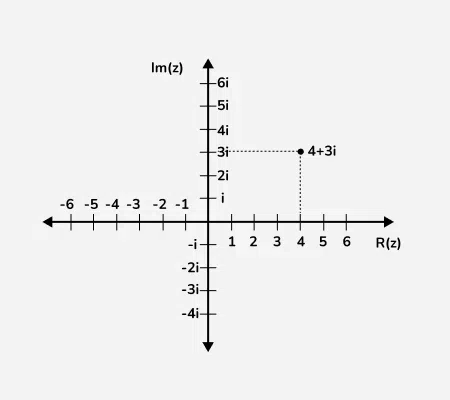
Complex plane
**X-axis or Real Axis
- All the purely real complex numbers are uniquely represented by a point on it.
- The real part Re(z) of all complex numbers is plotted concerning it.
- That's why the X-axis is also called the real axis.
**Y-axis or Imaginary Axis
- All the purely imaginary complex numbers are uniquely represented by a point on it.
- The imaginary part Im(z) of all complex numbers is plotted concerning it.
- That's why the Y-axis is also called the imaginary axis.
Steps to Represent Complex Numbers on a Complex Plane
To represent any complex number z = (a + i b) on the complex plane, follow these conventions:
- The real part of z (Re(z) = a) becomes the X-coordinate of the point p
- The imaginary part of z (Im(z) = b) becomes the Y-coordinate of the point p
And finally, z (a + i b) ⇒ p (a, b), which is a point on the complex plane.
Modulus and Argument of a Complex Number
In the complex plane, a complex number z = a + ib can be represented as a point (a, b) where a is the real part and b is the imaginary part.
The modulus of a complex number represents its absolute value and is defined as the distance between the origin and the given point in the complex plane. It is also referred to as the magnitude of the complex number.
For a complex number z = a + ib, the modulus is given by:
- ****|z| = √(a** 2 + b 2 )
The **argument of a complex number is the angle θ between its radius vector and the positive real (x) axis.
Mathematically, for z = a + ib, it is expressed as
- **θ = tan⁻¹(b/a)
Operations on Complex Numbers
The following operations can be performed on complex numbers:
**Addition: We can add two complex numbers by simply adding their real and imaginary parts separately.
**For example, (3 + 2i) + (1 + 4i) = 4 + 6i.
**Subtraction: We can subtract two complex numbers by simply subtracting their real and imaginary parts separately.
**For example, (3 + 2i) - (1 + 4i) = 2 - 2i.
**Multiplication: We can multiply two complex numbers using the distributive property and the fact that i2 = -1.
**For example, (3 + 2i)(1 + 4i) = 3 + 12i + 2i + 8i2 = 3 + 14i - 8 = -5 + 14i.
**Division: We can divide one complex number by another by simply multiplying both the numerator and the denominator by the complex conjugate of the denominator and further simplifying the expression.
**For example, (3 + 2i)/(1 + 4i) = (3 + 2i)(1 - 4i)/(1 + 4i)(1 - 4i) = (11 - 10i)/17.
Conjugate of Complex Numbers
We can easily determine the conjugate of a complex number by simply changing the sign of its imaginary part. The conjugate of a complex number is often denoted with a bar above the number, such as z ̄.
**For example, the conjugate of 3 + 2i is 3 - 2i.
Identities for Complex Numbers
For any two complex numbers z1 and z2, the following algebraic identities can be given:
- ****(z** 1 **+ z 2 ) 2 = (z 1 ) 2 **+ (z 2 ) 2 + 2 z 1 × z 2
- ****(z** 1 **– z 2 ) 2 = (z 1 ) 2 **+ (z 2 ) 2 – 2 z 1 × z 2
- ****(z** 1 ) 2 **– (z 2 ) 2 = (z 1 **+ z 2 )(z 1 **– z 2 )
- ****(z** 1 **+ z 2 ) 3 = (z 1 ) 3 **+ 3(z 1 ) 2 z 2 +3(z 2 ) 2 z 1 **+ (z 2 ) 3
- ****(z** 1 **– z 2 ) 3 = (z 1 ) 3 **– 3(z 1 ) 2 z 2 +3(z 2 ) 2 z 1 **– (z 2 ) 3
Some other formulas related to complex numbers are as follows:
- Euler's Formula shows the relation between the imaginary power of the exponent and the trigonometric ratios sin and cos and is given by
**e ix = cos x + i sin x
- De Moivre's Formula expresses the nth power of a complex number in polar form and is given by:
****(cos x + i sin x)** n = cos (nx) + i sin (nx)
Properties of Complex Numbers
There are various properties of complex numbers, some of which are as follows:
- For any complex number z = a + ib, if z = 0, then a = 0 as well as b = 0.
- For 4 real numbers a, b, c, and d such that z1 =a + ib and z2 = c + id. If z1 = z2, then a = c and b = d.
- The addition of a complex number with its conjugate results in a purely real number, i.e., z + z̄ = Real Number.
Let z = a + ib,
z + z̄ = a + ib + a - ib
⇒ z + z̄ = 2a (which is purely real)
- The product of a complex number with its conjugate results in a purely real number as well, i.e., z × z̄ = Real Number.
Let z = a + ib, then
z × z̄ = (a + ib) × (a - ib)
⇒ z × z̄= a2 - i2b2
⇒ z × z̄ = a2 + b2 ,
- Complex numbers are commutative under the operations of addition and multiplication. Let's consider two complex numbers, z1 and z2, then.
z1+z2 = z2+z1
z1 × z2 = z2 × z1
- Complex numbers are associative with the operations of addition and multiplication. Let's consider three complex numbers, z1, z2, and z3, then
(z1+z2) +z3 = z1 + (z2+z3)
(z1 × z2) × z3 = z1 × (z2 × z3)
- Complex numbers hold the distributive property of multiplication over addition as well. Let's consider three complex numbers, z1, z2, and z3, then
z1 × (z2+z3) = z1 × z2 + z1 × z3
Related Articles
Importance of Complex Numbers
Complex numbers extend the real number system to include solutions to equations that have no real solutions and also provide a complete framework for solving a wide range of mathematical problems and have numerous applications in various fields.
- **Solving Polynomial Equations: Some polynomial equations do not have real solutions. For example, the equation x² + 1 = 0 has no real solution because the square of any real number is always non-negative. However, in the complex number system, this equation has solutions x = i and x = −i.
- **Mathematical Completeness: The set of complex numbers is algebraically closed, meaning every non-constant polynomial equation with complex coefficients has a solution in the complex numbers. This is a significant advantage over the real numbers, which do not have this property.
- **Simplifying Calculations: In some cases, working with complex numbers can simplify mathematical expressions and calculations, especially in trigonometry and calculus.
- **Applications in Various Fields: Complex numbers are used extensively in engineering, physics, computer science, and other fields to model and solve real-world problems.
Solved Examples of Complex Numbers
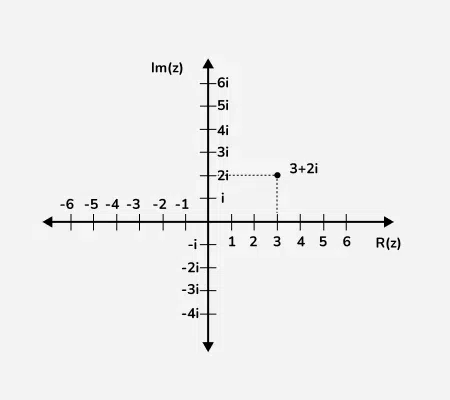
**Example 1: Plot these complex numbers, z = 3 + 2i, on the complex plane.
**Solution:
Given: z = 3 + 2 i
So, the point is z(3, 2). Now we plot this point on the below graph, here in this graph x-axis represents the real part and y-axis represents the imaginary part.
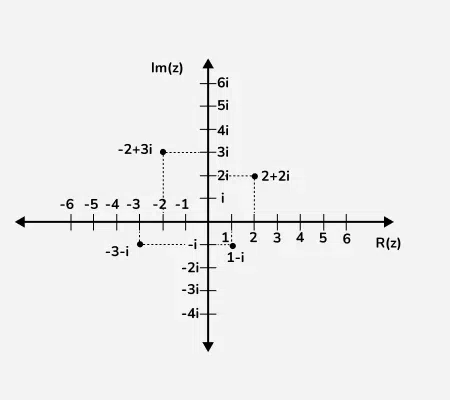
**Example 2: Plot these complex numbers, z1 = (2 + 2i), z2 = (-2 + 3i), z3 = (-3 - i), and z4 = (1 - i), on the complex plane.
**Solution:
**Given:
z1 = (2 + 2 i)
z2 = (-2 + 3 i)
z3 = (-3 - i)
z4 = (1 - i)So, the points are z1 (2, 2), z2(-2, 3), z3(-3, -1), and z4(1, -1). Now we plot these points on the below graph, here in this graph x-axis represents the real part and y-axis represents the imaginary part.
Unsolved Examples of Complex Numbers
**Example 1: Write the complex number 4 - 3i in polar form.
**Example 2: Find the modulus and argument of the complex number z = -1 + i√3.
**Example 3: If z₁ = 2 + 3i and z₂ = 1 - 2i, find z₁ × z₂ and z₁ ÷ z₂.
**Example 4: Find the conjugate of the complex number z = (3 - 4i)/(1 + 2i) and simplify.
**Example 5: Solve the equation z² + (3 - 4i)z + (5 - 12i) = 0 for z.