CSS Frameworks (original) (raw)
Last Updated : 13 Apr, 2026
CSS Frameworks are pre-written libraries that simplify and speed up the process of designing responsive, visually consistent web interfaces. They offer ready-to-use components and grid systems, helping developers avoid repetitive CSS from scratch.
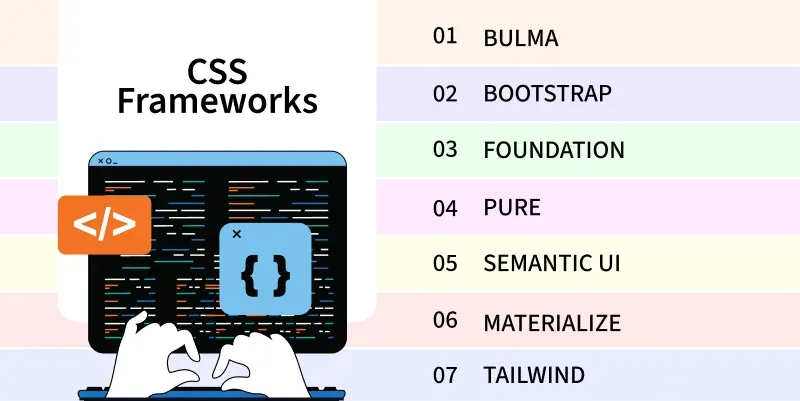
CSS Frameworks
It provides a solid foundation for buiding modern UIs with less code and better cross-browser compatiblity. They promote clean design standards, enabling faster prototyping and consistent styling across projects.
Popular CSS Frameworks
The most popular CSS Frameworks are given below:
1. Bootstrap
Bootstrap is a popular CSS framework with strong community support, offering pre-designed layouts such as buttons and navbars, along with utility classes. It is known for its strong community, pre-designed layouts, and responsive features. The current version is 5.3.2, released on 14 September 2023.
Bootstrap is the most popular CSS framework, developed by Twitter. It is used for responsive grid system and extensive components. Bootstrap allows for fast and responsive web development. It includes a 12-column grid, pre-built components like modals, dropdowns, navigation, and more, along with JavaScript-based elements.
**Features
- Responsive grid system
- Pre-designed UI components
- Cross-browser compatibility
- JavaScript plugins for interactive elements
**Note: Bootstrap is ideal for projects where speed, cross-browser compatibility, and responsiveness are crucial.
2. Tailwind CSS
Tailwind CSS is a utility-first framework that is highly customizable. Instead of offering pre-designed components, Tailwind provides a set of utility classes that can be used to build custom designs without writing much CSS.
**Features
- Utility-first approach for custom designs
- Fully customizable with a configuration file
- No predefined components, offering more control
**When to Use Tailwind CSS
- Use Tailwind when you need a flexible, customizable design without relying on pre-built components.
3. Semantic UI
Semantic UI is an open-source CSS framework with good community support, using classes to add styles to elements. It offers various components that can be easily integrated into applications to create beautiful web pages quickly.
**Features
- Intuitive, human-readable class names
- Pre-built UI components
- Customizable theming system
**When to Use Semantic UI
- Semantic UI is ideal when readability and ease of use are priorities. It's especially good for teams, as it makes the code more understandable.
4. Materialize CSS
Materialize CSS, designed by Google, makes web pages responsive and compatible for various screen sizes, including mobile and tablets. It is widely recognized for its responsiveness.
**Features
- Google Material Design-inspired components
- Pre-built elements like cards, buttons, and forms
- Responsive grid system
**When to Use Materialize CSS
- Materialize CSS is perfect for those who want to follow Google’s Material Design guidelines.
5. Bulma
Bulma is an open-source CSS framework based on Flexbox, known for its responsiveness and for minimizing the use of media queries. It is popular for being responsive and cost-effective. The current version is 0.9.4, released on 8 May 2022.
Bulma is a modern CSS framework based on Flexbox. It is a lightweight, easy to use, and customizable. It provides a clean syntax and focuses on making responsive design easier.
**Features
- Flexbox-based layout system
- Lightweight and modular
- Clean, simple syntax
**When to Use Bulma
- Bulma is great for projects that need a modern, responsive design without the bloat of larger frameworks.
6. Primer CSS
Primer CSS is GitHub’s CSS framework, designed to create simple, maintainable designs. It's minimalistic and focuses on utility classes and components that are easy to customize.
**Features
- Lightweight and minimalistic
- Utility-first approach
- Designed for large-scale applications like GitHub
**When to Use Primer CSS
- Primer is ideal for developers who prefer a lightweight, scalable solution for large applications.
7. Foundation
Foundation is a powerful front-end framework that offers a more advanced grid system and flexible components. It’s often compared to Bootstrap but is considered more flexible, making it a good option for larger projects.
**Features
- Advanced grid system
- Responsive design built-in
- Flexibility for large projects
**When to Use Foundation
- Foundation is ideal for large-scale applications that need flexibility and advanced features.
8. Pure CSS
Pure CSS is a minimalistic framework developed by Yahoo. It is extremely lightweight and provides only the most essential components, making it a good choice for small projects.
**Features
- Extremely lightweight (under 4KB gzipped)
- Modular and customizable
- Simple responsive grid system
**When to Use Pure CSS
Use Pure CSS when you want a lightweight, fast-loading solution with minimal styling overhead.
9. Blaze UI
Blaze UI is a lightweight CSS framework that focuses on simplicity and performance. It offers basic components that are easy to customize.
**Features
- Lightweight and fast
- Simple design with basic components
- Focuses on ease of use
**When to Use Blaze UI
- Blaze UI is great for small projects that require quick setup and clean, minimal design.
10. Spectre CSS
Spectre CSS is a lightweight, responsive CSS framework that focuses on simplicity and performance. It provides a modern, clean design without overwhelming developers with unnecessary components, making it perfect for fast-loading websites.
**Features
- Lightweight framework (10KB minified)
- Flexbox-based responsive grid system
- Pre-built components like buttons, forms, tables, and modals
- Utilities for typography, spacing, and alignment
- Minimalist design for quick prototyping
**When to Use Spectre CSS
- Spectre CSS is ideal for developers who need a lightweight framework for rapid prototyping or building small to medium-sized websites where speed and simplicity are essential.
11. Onsen UI
Onsen UI is a powerful framework for building mobile web apps using HTML5 and JavaScript, with native-like performance. It provides an easy-to-use set of tools for creating hybrid and progressive web apps (PWAs) that look and feel like native mobile applications.
**Features
- Native-looking UI components optimized for both iOS and Android
- Integration with React, Angular, Vue.js, and plain JavaScript
- Responsive design elements for cross-platform compatibility
- Customizable themes to match the look of native mobile apps
- Optimized for performance and touch interactions
**When to Use Onsen UI
- Onsen UI is perfect for developers building mobile web apps or hybrid apps with a native look and feel, especially for those targeting both iOS and Android platforms.
12. Tachyons
Tachyons is a functional, utility-first CSS framework that promotes rapid development by using small, reusable class names for styling elements. It allows developers to create custom designs without writing any custom CSS, using a modular, scalable approach.
**Features
- Utility-first approach with small, reusable class names
- Highly customizable and scalable
- Minimalist design, focusing on rapid development and performance
- Well-organized class structure for typography, spacing, colors, and more
- Lightweight and easy to integrate into any project
**When to Use Tachyons
- Tachyons is best suited for developers who prefer a utility-first approach to styling, allowing them to create highly custom, performance-optimized designs without relying on pre-built components.
- It's ideal for rapid prototyping and building minimalistic, scalable projects.
13. UI kit
UI Kit is a modular CSS and JavaScript framework with a focus on fast, responsive web development. It provides a wide range of components and customization options.
**Features
- Modular design
- Responsive components
- Extensive customization options
**When to Use UI Kit
- UI Kit is a great choice for developers who need a customizable, modular framework for building dynamic web applications.
14. Skeleton
Skeleton is a minimal CSS framework that focuses on responsive design. It’s small and lightweight, making it ideal for quick prototyping.
**Features
- Lightweight, under 400 lines of code
- Simple grid system
- Ideal for quick prototypes
**When to Use Skeleton
- Skeleton is perfect for small projects or when you need a fast and simple layout for prototypes.
15. Miligram
Miligram is a very small (2kb) and lightweight CSS framework that is easy to understand and provides a variety of features. It is known for being small in size, cost-effective, and easy to learn.
**Features
- Lightweight and fast (2KB gzipped)
- Simple and clean styles
- Easy to customize
**When to Use Miligram
- Miligram is ideal for small, lightweight projects where simplicity is key.
Benefits of CSS Frameworks
CSS frameworks offer several features that make the development process more efficient and effective:
- **Efficiency: Pre-designed components and utility classes reduce the time spent writing CSS from scratch.
- **Responsive Design: Frameworks are built to adapt to various screen sizes, ensuring your design looks great on all devices.
- **Cross-Browser Compatibility: Ensures consistent appearance across different browsers.
- **Customization: Allows for tailored designs while maintaining a consistent structure.
- **Community Support: Large, active communities provide resources and support.