Data Modeling Techniques For Data Warehouse (original) (raw)
Last Updated : 12 Dec, 2025
Data modelling defines how data is organized, stored and connected creating a clear blueprint for consistent and high-quality structures. It transforms raw data into meaningful entities by enforcing integrity, standardization and intuitive organization.
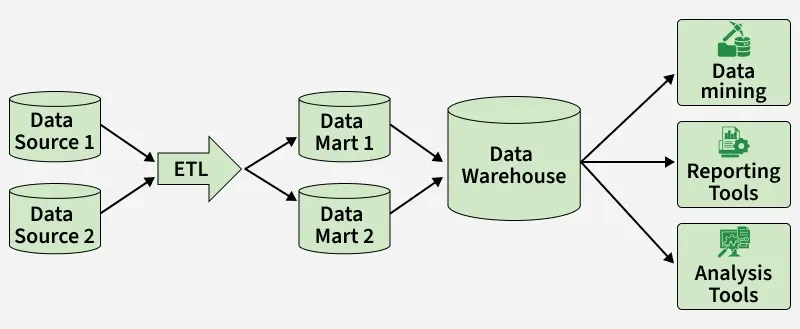
Data Modelling
This image shows how data from multiple sources is extracted, transformed, and loaded (ETL) into data marts and then a data warehouse, which supports data mining, reporting and analysis tools.
In warehouses and lakehouse platforms strong modelling enables fast querying, reliable analytics and scalable data workflows.
- Ensures organized, accurate and consistent data.
- Makes querying and analytics faster and easier.
- Supports reliable BI and data-driven decisions.
- Aligns with lakehouse layers for scalable workflows.
Data modelling Techniques
Data modelling techniques help structure, organize and standardize data to ensure efficient storage, easy access, and meaningful analysis within database and warehouse systems.
Star Schema
A star schema has a central fact table connected to multiple dimension tables. It is the simplest and most commonly used analytic model for fast querying.
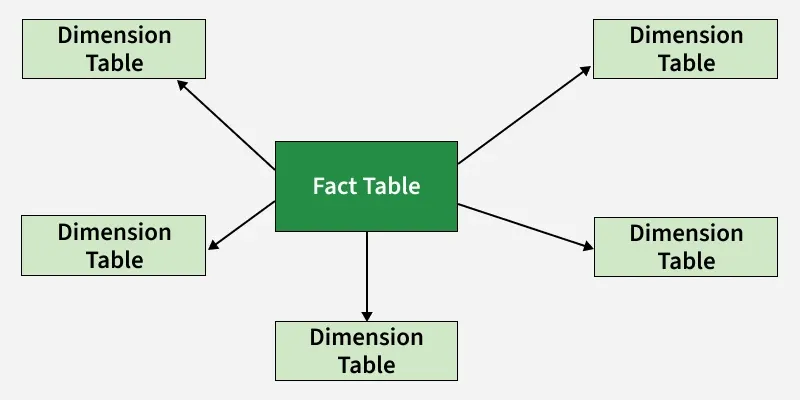
Star Schema
- Central fact table stores metrics and numeric measures.
- Surrounding dimension tables store descriptive context (customer, product, time).
- Joins occur between fact and dimensions using surrogate keys.
- Optimized for fast aggregations, reporting and dashboard queries.
Snowflake Schema
A snowflake schema is an extension of the star schema where dimension tables are normalized into multiple related tables.
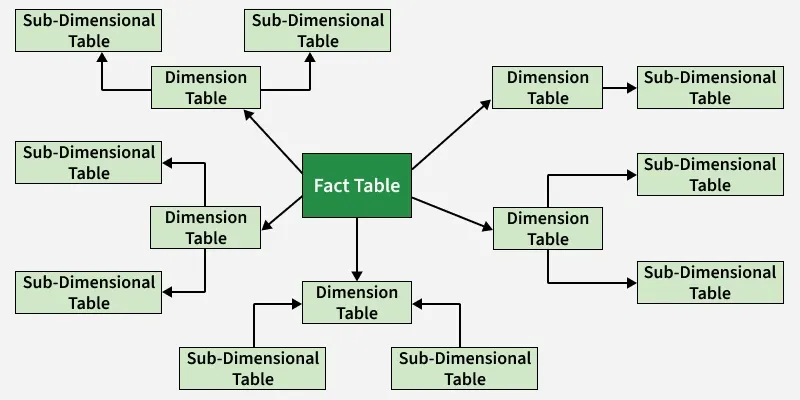
Snowfalke Schema
- Dimensions split into sub dimensions to eliminate redundancy.
- More normalized structure reduces duplicated attributes.
- Requires more joins during queries compared to star schema.
- Helps maintain cleaner, more consistent dimension data.
Galaxy Schema
A galaxy schema contains multiple fact tables that share common dimension tables, ideal for enterprise-wide analytics.
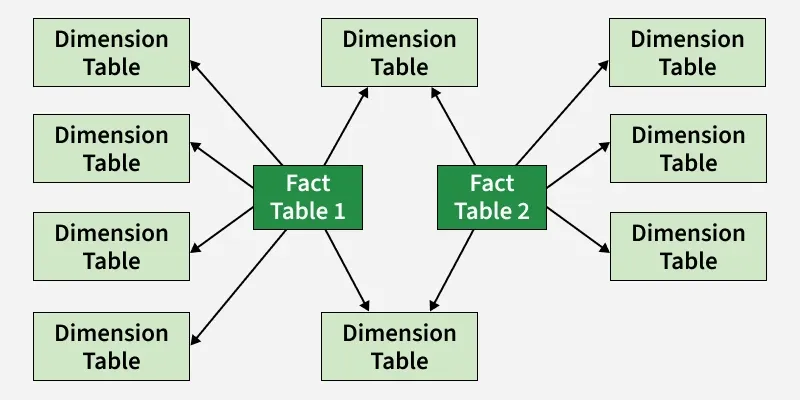
Galaxy Schema
- Multiple business processes modeled through separate fact tables.
- Shared dimensions (e.g., customer, product) unify all processes.
- Supports cross-domain reporting (sales + inventory + marketing).
- Suitable for large scale, multi departmental warehouses.
Dimensional modelling
Dimensional modelling simplifies data into facts (events) and dimensions (descriptors) to support BI and analytics.
- Focuses on business events (facts) and their context (dimensions).
- Uses star/snowflake schemas for structuring.
- Supports SCDs (Slowly Changing Dimensions) for tracking changes.
- Designed for intuitive, analyst-friendly querying.
Data Vault Model
The data vault model splits data into hubs, links, and satellites for auditability, flexibility and scalable history tracking.
- Hubs store core business keys such as customer_id and product_id, representing unique business entities.
- Links capture relationships between hubs, for example orders, transactions or payments.
- Satellites hold descriptive attributes and maintain historical changes for hubs and links.
- Uses insert-only approach for complete audit trails.
Difference Between Data Warehouse modelling Techniques
Here we compare different type of modelling technique
| Model | Purpose | Use Case |
|---|---|---|
| Star Schema | Central table with numbers, linked to descriptive tables | Quick reports and dashboardss |
| Snowflake Schema | Dimension tables split for cleaner data | Consistent analytics |
| Galaxy Schema | Multiple central tables sharing dimensions | Large organizations |
| Dimensional modelling | Organizes facts and dimensions | BI and reporting |
| Data Vault | Tracks history and relationships | Audit and compliance |