Implementation and Components in Data Warehouse (original) (raw)
Last Updated : 23 Jul, 2025
A Data Warehouse is a system that collects, processes, stores and analyzes data from different sources to help businesses make informed decisions. It involves implementation steps like gathering data, cleaning and organizing it, storing it in databases and using tools for reporting and analysis. The key components include data sources (where data comes from), ETL (Extract, Transform, Load) for processing, storage for keeping structured data, metadata for data organization and query tools for analysis.
Data Warehouse Implementation
Data warehouse implementation refers to the process of designing, building and deploying a centralized system that stores, manages and integrates data from various sources to support business analysis and decision-making. The purpose of implementing a data warehouse is to provide organizations with a unified repository of historical data, enabling efficient querying, reporting and data analysis. Proper implementation is crucial for businesses because it ensures the system meets the organization's needs for scalability, data accuracy and performance. A well-implemented data warehouse provides key benefits such as improved decision-making, streamlined data access, enhanced reporting capabilities and better data consistency, all of which contribute to data-driven business success.
Steps in Data Warehouse Implementation
- **Planning and Requirements Gathering: Understand business needs, set objectives and determine hardware/software requirements.
- **Data Modeling and Design: Choose the appropriate schema (e.g., Star, Snowflake) to optimize data organization and query performance.
- **ETL Process: Extract, Transform and Load: Extract, clean, transform and load data, ensuring consistency and accuracy, with customized ETL tools.
- **Database Design and Architecture: Design the physical architecture, including storage, indexing and optimization for efficient performance.
- **Data Warehouse Development: Create tables, views and other objects, ensuring scalability for future data growth.
- **Testing and Validation: Verify data accuracy and performance, ensuring the system meets requirements and resolving any discrepancies.
- **Deployment and Maintenance: Deploy the system, address issues, apply updates and maintain continuous data integration.
Core Components of a Data Warehouse
A data warehouse is an integrated system that consolidates data from operational systems and external sources, providing valuable insights for decision-making. It includes various components that work together to store, manage and access data efficiently. The data moves from the data source area through the staging area to the presentation server. The entire process is better known as ETL (extract, transform and load). Here are the key components of a data warehouse and their respective tasks:
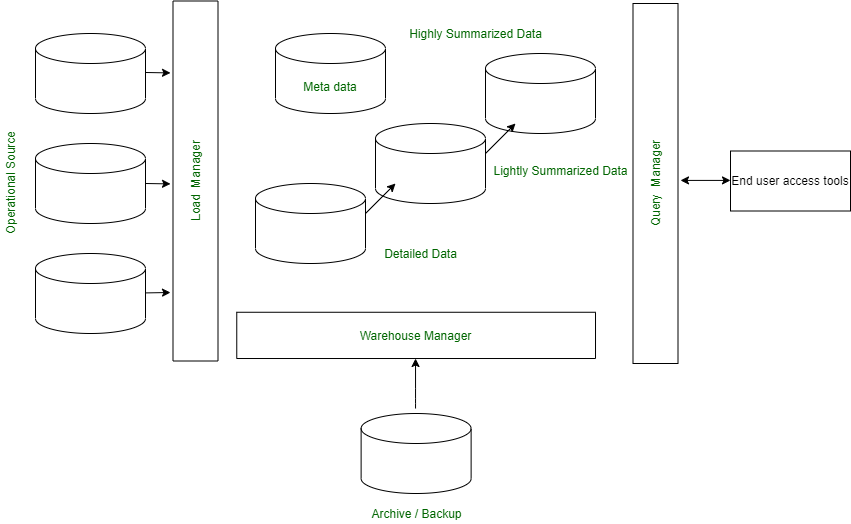
Data Warehouse Components
**1. Operational Source Systems
- Provide raw data from internal systems (e.g., relational databases like Informix oracle) and external sources.
- Serve as the primary input for the data warehouse.
**2. Load Manager
- Manages the ETL (Extract, Transform, Load) process for data extraction and transformation.
- Prepares data for entry into the warehouse, ensuring it meets the required format.
**3. Warehouse Manager
- Oversees data storage, aggregation and analysis within the data warehouse.
- Handles tasks like data de-normalization, backup, collection and optimization for better performance.
**4. Query Manager
- Handles user queries within the data warehouse.
- Supports querying, reporting and data retrieval, with functionality dependent on the available end-user tools.
**5. Detailed Data
- Stores granular, raw data for complex analysis and reporting.
- Provides comprehensive insights and supports in-depth research.
**6. Summarized Data
- Stores predefined aggregations of detailed data for faster queries and reports.
- Provides high-level insights to assist in decision-making.
**7. Archive and Backup Data
- Ensures data integrity and disaster recovery through regular backups and archival storage.
- Archives older, less frequently accessed data for future use or compliance.
**8. Metadata
- Metadata contains information about data structure, source and transformation processes.
- Supports the ETL process, warehouse management and querying by providing essential context for data.
**9. End-User Access Tools
- Serve as the interface for users to interact with the data warehouse.
- Include analysis, reporting and data mining tools, enabling users to access, query and derive insights from the data.