Introduction to Data Mining (original) (raw)
Last Updated : 24 Jun, 2025
Today, data is being generated at a rapid pace. Every time we click, make a purchase or interact online we create valuable information which businesses are using to make smarter decisions, understand customer behavior and stay competitive in the market and this process is called data mining.
What is Data Mining?
Data mining is the process of extracting useful insights and knowledge from large datasets. It involves applying techniques from statistics, machine learning and database systems to find hidden patterns, relationships and trends. These insights can be used to solve business problems, improve processes and predict future outcomes. Common applications of data mining include customer segmentation, market basket analysis, anomaly detection and predictive modeling. It is widely used across industries like finance, healthcare, retail and telecommunications to make informed decisions.

Core Components and Related Fields of Data Mining
Process of Data Mining
Data mining involves a combination of several techniques and technologies that help in discovering patterns, trends and insights from data. It includes:
- **Data Collection and Integration: The process starts with gathering large amounts of data from various sources such as transactional databases, data warehouses or even the web. This data is then integrated to create a dataset for analysis.
- **Data Preprocessing: This step includes removing noise, handling missing values and transforming data into a suitable format for analysis.
- **Pattern Recognition and Machine Learning: These techniques are used to identify patterns, correlations and trends within the data. Machine learning algorithms such as clustering, classification and regression help uncover hidden insights that drive decision-making.
- **Statistical Analysis: Statistics is used to understand how different factors are related or how strong those relationships are and whether the patterns we see are meaningful or not.
- **Evaluation and Interpretation: After patterns are identified it's important to check how relevant and significant they are. The results are presented through visualizations or reports to help businesses understand the data and make informed decisions.
- **Data Presentation and Visualization: It is very important to share the findings clearly. Visualization tools such as graphs, charts and dashboards are used to present the insights in an easily understandable format.
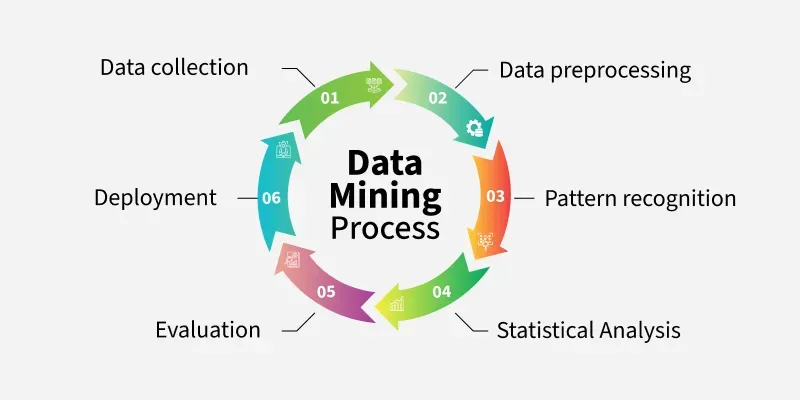
Procedure of Data Mining
**Applications of Data Mining
Here are some key areas where data mining is commonly applied:
- **Fraud Detection: Data mining plays an important role in detecting fraudulent activities in various industries. In banking it helps identify suspicious credit card transactions by recognizing abnormal spending patterns. Similarly in insurance, it helps spot fraudulent claims by analyzing historical data and identifying inconsistencies.
- **Anomaly Detection: Anomaly detection identifies unusual patterns that deviate from normal behavior. This application is particularly useful in security where it can help detect cyberattacks, system intrusions or unusual network traffic.
- **Supply Chain Optimization: It helps in improving how supply chains work by analyzing demand, production and distribution patterns. It helps manage inventory, predict shortages and make logistics more efficient, cutting costs and improving delivery times.
- **Traffic Management: Traffic systems use data mining to predict congestion make traffic flow smoother and reduce accidents. By looking at real-time traffic data, cities can make better decisions on things like infrastructure, traffic signals and routes.
- **Financial Market Analysis: In finance data mining is used to analyze market trends, predict stock movements and identify investment opportunities. It helps with portfolio management by evaluating the risk and return of different investments and spotting possible issues in the market.

Overview of Stages of Data Mining
Advantages of Data Mining
Data mining process has many benefits including,
- **Operational Efficiency and Automation: It helps to automate repetitive tasks like cleaning data, spotting unusual patterns and generating reports. This saves time and resources, allowing teams to focus on more important work, which leads to increased productivity.
- **Fraud Detection and Anomaly Identification: It detects fraudulent behavior by identifying unusual patterns in financial transactions, insurance claims and digital activity. This enhances security and reduces financial losses.
- **Risk Management and Compliance: By analyzing historical data and real-time indicators, data mining helps identify operational, financial and strategic risks. It makes it easier to assess risks, stay compliant with regulations and plan for unexpected situations.
- **Improved Resource Allocation: It helps optimize resource allocation by identifying which initiatives, products or customer segments generate the highest returns. This makes budgeting, staffing and investment decisions smarter and more efficient.
Challenges in Data Mining
- **Data Quality and Preprocessing: Raw data is often noisy, incomplete or inconsistent which makes it hard to pull out useful insights.
- **Data Privacy and Security: Handling sensitive data requires strict measures to ensure privacy and comply with regulations like GDPR. Protecting against unauthorized access and misuse of data is a major concern in data mining.
- **Overfitting and Underfitting: In machine learning, overfitting occurs when models learn noise instead of general patterns while underfitting happens when the model fails to capture important trends, leading to poor predictions.
- **Scalability of Algorithms: As datasets grow in size, many algorithms struggle to scale efficiently requiring more advanced techniques or high-performance computing resources to handle large volumes of data.
- **Bias and Ethical Issues: Data mining can unintentionally strengthen biases present in the data, leading to unfair or discriminatory outcomes. It's important to make sure data is used in a fair and ethical way, especially in areas like hiring or lending.